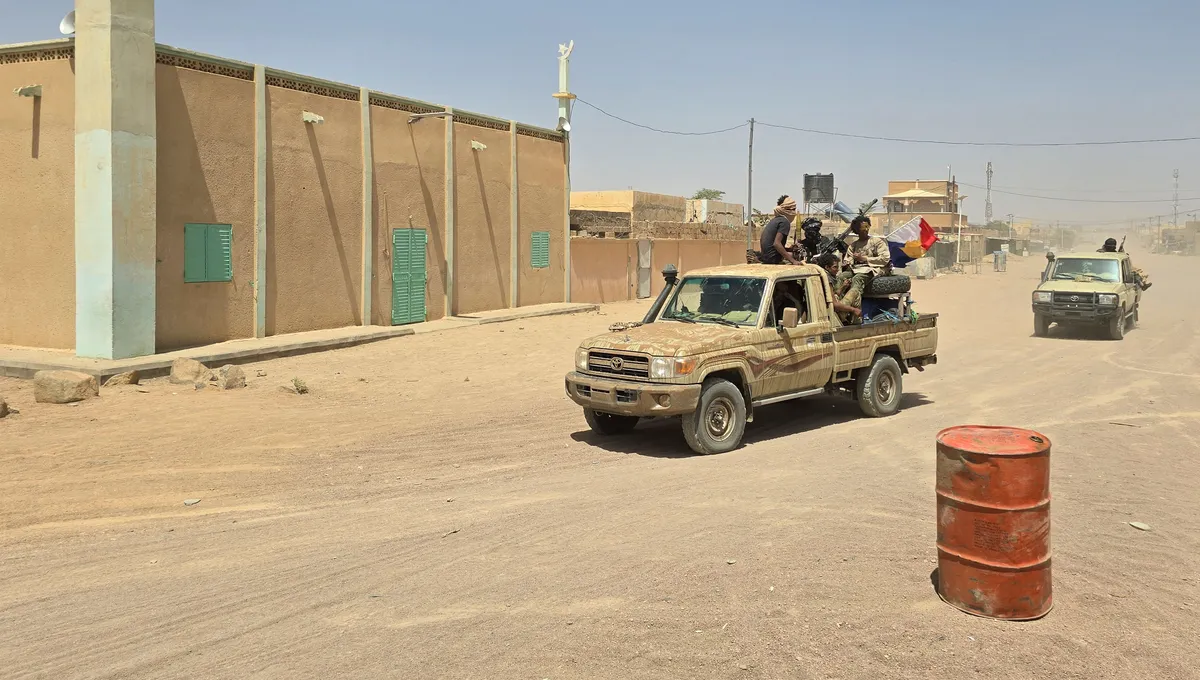
Russian forces retreat from Kidal without resistance as jihadist rebels gain ground
A coordinated assault by Tuareg rebels, allied with jihadist factions, has exposed the fragility of Mali’s military regime. The situation escalated dramatically when Russian troops—part of the Africa Corps (formerly Wagner Group)—withdrew from Kidal, a strategic northern city, without firing a single shot. The sudden takeover by rebel forces marks a sharp reversal for the junta, which had relied heavily on Moscow’s support after expelling French troops in 2022.
Videos circulating online show a column of Russian vehicles leaving Kidal under the cover of darkness, abandoning the city to armed groups that now control vast swathes of territory. The retreat came just hours after the Group for the Support of Islam and Muslims (GSIM), an Al-Qaeda affiliate, claimed responsibility for simultaneous attacks across multiple regions, including the capital, Bamako.
Mali’s junta faces its worst security challenge in years
The collapse of Kidal, a former Tuareg rebel stronghold recaptured by Malian forces in 2023 with Russian backing, is a symbolic blow. The loss underscores the junta’s inability to maintain stability despite its aggressive posturing against former colonial power France and its shift toward Russian military cooperation. The regime’s legitimacy has further eroded following the recent assassination of the Defense Minister and a months-long blockade of Bamako that crippled fuel supplies.
Analysts suggest the junta’s strategy of consolidating power through the dissolution of political parties and the appointment of unelected leaders has backfired. Public discontent is palpable, with many Malians caught between a repressive military government and advancing jihadist groups. The GSIM’s bold attacks—including in Bamako—reveal critical vulnerabilities in Mali’s security apparatus.
Regional spillover risks as Al-Qaeda-linked groups expand
Experts warn of a domino effect across the Sahel. The GSIM, which operates primarily in Mali, has ties to regional Al-Qaeda networks and could target neighboring countries like Niger and Burkina Faso—both members of the Alliance of Sahel States—if Bamako falls. Coastal West African nations, already grappling with jihadist incursions, could also face heightened threats.
The crisis in Mali is a stark reminder of the failures that have plagued the region for over a decade. After France’s 2014 intervention temporarily stabilized the north, subsequent military coups, the expulsion of Western forces, and the arrival of Russian mercenaries have done little to curb insecurity. Instead, jihadist factions have regrouped, exploiting local grievances to expand their influence.
What’s next for Mali and its allies?
With the junta weakened and Russian forces appearing reluctant to engage, the path forward remains uncertain. The Africa Corps’ passive withdrawal from Kidal suggests Moscow may be reassessing its commitment to the Malian regime. Meanwhile, the GSIM’s bold moves indicate that jihadist groups are gaining confidence, posing an existential threat not just to Mali but to the broader Sahel region.
For the populations caught in the crossfire, the stakes couldn’t be higher. A fractured Mali could lead to prolonged conflict, humanitarian crises, and further destabilization across West Africa.