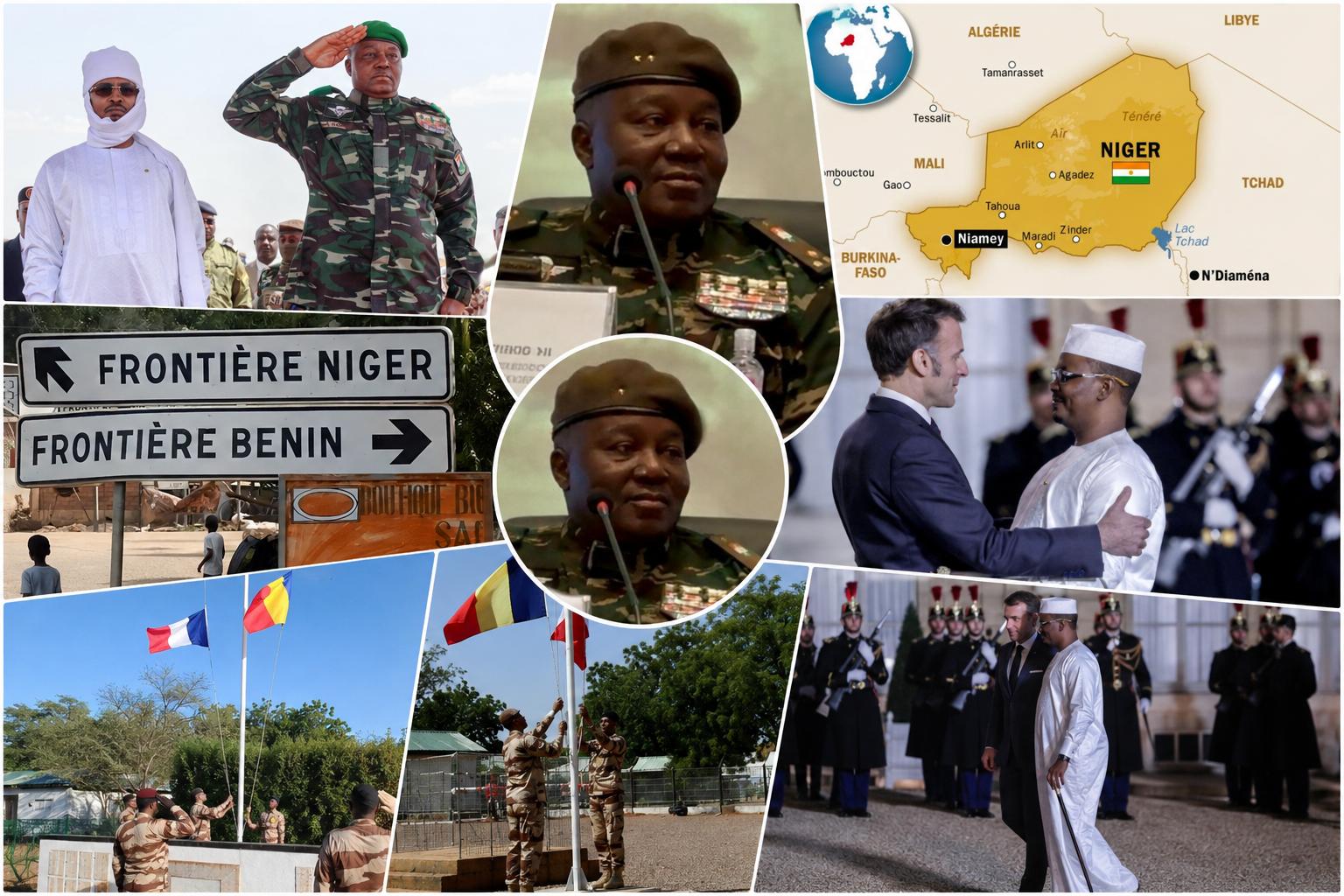
As Niamey maintains its border closure with Bénin, citing demands for security assurances, a complex question arises for Niger following the renewed cooperation between Chad and France. If a French military presence in a neighboring country constitutes a threat significant enough to justify sealing a border, should this same logic not also apply to Chad?
The border between Niger and Bénin remains shut. Nearly three years after the July 2023 coup d’état, the anticipated normalization between Niamey and Cotonou has not yet led to the practical reopening of this vital communication route.
Despite this, signs of easing tensions have become more frequent in recent months. The two nations have re-established dialogue and created a technical framework to examine the conditions for reopening. Discussions have also advanced on security, economic, and legal aspects.
However, Niamey continues to uphold its stringent requirements.
In a recent public address, General Abdourahamane Tiani articulated that the border’s reopening must be contingent upon guarantees, particularly concerning security and the absence of forces deemed hostile operating near the frontier. This position aligns with the long-standing stance of Nigerien authorities: Cotonou’s territory, according to Niamey, should not serve as a staging ground for operations that could threaten Niger.
The critical issue is that Cotonou unequivocally refutes this accusation.
Cotonou denies, Paris also
Since the onset of the crisis, Béninese authorities have dismissed allegations that France maintains military bases within Bénin, especially in the northern region.
The Béninese government asserts it has never hosted a foreign military base on its soil. Bénin’s Minister of Foreign Affairs, Olushegun Adjadi Bakari, reiterated this point in January 2025.
Paris has similarly denied the existence of any French military base in northern Bénin. In March 2026, the Chief of Staff of the French Armed Forces, General Fabien Mandon, rejected these claims, assuring that no French base was present in that part of the country.
Nevertheless, a crucial distinction must be made.
France indeed provides a form of security support to Bénin. French military personnel have been involved in training and assisting Béninese forces confronting armed groups in the northern part of the nation. Reports in April 2026 detailed the discreet presence of French special forces operating alongside Béninese troops. French authorities officially refer to these personnel as trainers.
Therefore, it is essential to differentiate between Franco-Béninese military cooperation, which is acknowledged, and the existence of a permanent French military base or deployment near the Nigerien border, which both Cotonou and Paris deny.
It is precisely this distinction that forms a central part of the ongoing debate.
An exigence that presents Niamey with a new equation
While Niger demands guarantees from Bénin, another neighbor of Niger is rekindling ties with Paris.
In November 2024, Chad had initially ended its military cooperation with France, asserting its commitment to full sovereignty and diversifying its security partnerships.
The French withdrawal was presented as a significant turning point in relations between N’Djamena and Paris.
However, over several months, the two capitals have been drawing closer once more. French military personnel are gradually returning to Chad, operating under a much more discreet and reduced arrangement than what existed previously.
This development responds to a pressing security reality: Chad faces the repercussions of the conflict in Sudan, the persistent threat of Boko Haram in the Lake Chad basin, and substantial needs in intelligence, surveillance, and logistical capabilities.
N’Djamena can thus interpret France’s return as a sovereign and pragmatic choice.
But for Niamey, this decision raises a pertinent question.
Chad is also a neighbor of Niger.
Consequently, if Niamey considers a French military presence near its territory a sufficiently grave threat to prevent the reopening of its border with Bénin, how does Niger intend to react to the renewed Franco-Chadian engagement?
Why would Chad be different from Bénin?
Here lies the true paradox.
Niamey could logically assert that every state is free to choose its military partners. Under this reasoning, Bénin would have the right to cooperate with France, and Chad would similarly have the right to renew its partnership with Paris.
However, in that scenario, the same logic should compel Niger not to make Franco-Béninese cooperation a determining condition for reopening its border.
Conversely, if Niamey genuinely believes that French military cooperation with a neighbor constitutes a threat to its national security, then the same rationale should, by all accounts, be applicable to Chad.
The question, therefore, is not whether Niger should close its border with Chad.
Instead, it serves as a test of the consistency of its argument.
Why would military cooperation with France be unacceptable for Niger’s western neighbor but acceptable for its eastern neighbor?
Geography makes this question particularly sensitive. Niger shares an extensive border with Bénin, but also with Chad. A foreign military presence in Chad can, theoretically, be considered part of Niamey’s immediate strategic environment, impacting West Africa insider news and broader Sahel analysis.
France’s return to Chad: a test for sovereign doctrine
The Chadian situation unfolds within a profoundly transformed regional landscape. Mali, Burkina Faso, and Niger have elevated sovereignty and a break from former partner powers as cornerstones of their new foreign policy. These three nations have exited ECOWAS and strengthened their cooperation within the Alliance of Sahel States, offering a compelling Mali Burkina Niger analysis.
Chad, however, has opted for a different path.
After severing ties with Paris in 2024, N’Djamena now appears willing to resume military cooperation with France, while simultaneously maintaining its other partnerships. This reflects a nuanced approach to Sahel politics.
This choice is sovereign.
Yet, it could prove difficult to reconcile with a conception of sovereignty that would challenge a neighbor’s right to choose its own partners.
Thus, it is less the French presence in Chad itself, and more the principle of consistency, that now stands at the heart of the debate.
Towards a resolution between Niamey and Cotonou?
The situation, however, could evolve.
Ongoing discussions between Niger and Bénin indicate that both countries recognize the economic and security costs of their border closure. In the border zone, populations, traders, and transporters have endured the consequences of a political crisis for nearly three years, a crisis that far exceeds their local interests.
Moreover, violence in the border area spanning Bénin, Niger, and Nigeria has significantly escalated, underscoring the mutual benefit of enhanced security cooperation between the two nations.
A border reopening could therefore become a shared imperative.
However, to achieve this, Niamey and Cotonou will likely need to move beyond the issue of France.
The debate cannot indefinitely remain confined to an opposition between