
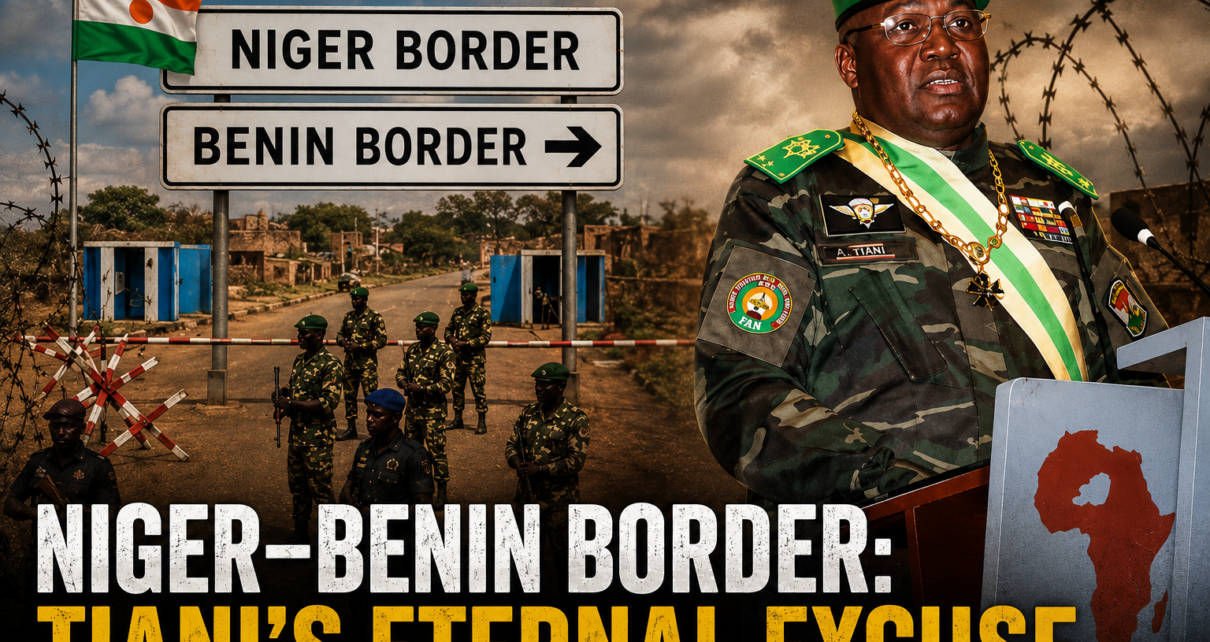
The prolonged closure of the Niger-Benin border, far exceeding initial expectations following technical discussions between the two countries, has entered a new phase of uncertainty. Despite preliminary progress in negotiations, the stance adopted by Niger’s transitional authorities has dashed hopes for a swift resolution. The announcement made by General Abdourahamane Tiani on the first anniversary of his ascension to power has reinforced the perception of this border as a political bargaining chip rather than a mere administrative line.
An ambiguous deadlock with no resolution in sight
The prerequisites cited by Niamey remain shrouded in opacity. Without concrete definitions, measurable criteria, or a defined timeline, the door to negotiation has been left ajar—intentionally. This deliberate lack of clarity grants the military regime a strategic advantage: the ability to indefinitely postpone reopening while avoiding any obligation to justify its position. Each new demand can replace the previous one, ensuring the border dispute remains an open-ended issue, devoid of any tangible resolution.
A security narrative that lacks credibility
Since the July 2023 transition, the regime has repeatedly invoked security concerns to justify the border closure. According to official statements, Benin is allegedly used as a rear base by armed groups or foreign actors threatening Niger’s stability. However, these claims have never been substantiated with verifiable evidence. Meanwhile, violent attacks continue to ravage regions such as Tillabéri, Tahoua, and Diffa, undermining the narrative that border closure enhances national security. The persistence of these attacks raises a critical question: if the closure were truly effective, why do security conditions remain dire?
Technical expertise sidelined in favor of political calculus
Prior to the latest declaration, technical teams from both nations had engaged in constructive dialogue to explore gradual reopening mechanisms. These discussions aimed to reconcile security imperatives with the restoration of commercial flows. Yet, by dismissing these efforts, the Nigerien leadership has signaled that the decision rests solely on political grounds. The technical process now appears to serve as a delaying tactic rather than a pathway to resolution.
Economic fallout: a burden shouldered by citizens
While Benin experiences reduced transit traffic to the port of Cotonou and diminished customs revenue, Niger bears the brunt of the closure. As a landlocked nation, Niger relies heavily on regional corridors for essential supplies. The forced rerouting of goods via alternative, often longer, paths has driven up logistical costs, which are inevitably passed on to consumers. The consequences are far-reaching:
- Elevated prices for staple foods;
- Increased costs for construction materials;
- Rising prices of imported pharmaceuticals and goods;
- Supply chain disruptions for local businesses;
- Diminished competitiveness for Nigerien enterprises.
A regional cooperation fractured by political posturing
The closure extends its impact beyond economics, straining cross-border cooperation in education, local governance, and joint development initiatives. Ironically, while official trade routes are severed, illicit networks flourish. The absence of legal commercial channels often exacerbates informal smuggling, complicating law enforcement efforts rather than curbing them.
Sovereignty as a political tool
By framing the closure as an “irreversible” decision, General Tiani underscores a symbolic stance. The border is presented as a bulwark against external pressures, reinforcing a narrative of resistance. Yet, this approach invites scrutiny: does sovereignty manifest in economic isolation or in the effective protection of citizens’ interests? Observers increasingly view the prolonged closure as a political maneuver to bolster internal legitimacy rather than a security-driven strategy.
Human costs obscured by political maneuvering
The human toll of this standoff is often overlooked. Transport workers left idle, merchants facing ruin, students barred from movement, separated families, and entrepreneurs grappling with uncertainty—these are the real victims of a crisis framed in abstract terms. Each passing week deepens their plight, delaying any prospect of a return to normalcy.
An impasse with no end in sight
Three years into the crisis, the Niger-Benin border dispute has evolved into a political lever rather than a security imperative. By invoking nebulous prerequisites, Niamey maintains complete control over the timeline, ensuring the status quo persists. Meanwhile, citizens on both sides endure the economic, social, and humanitarian fallout of a decision whose tangible benefits remain elusive. A lasting solution will likely require a shift away from political calculations toward a renewed commitment to dialogue, mutual trust, and pragmatic regional cooperation.