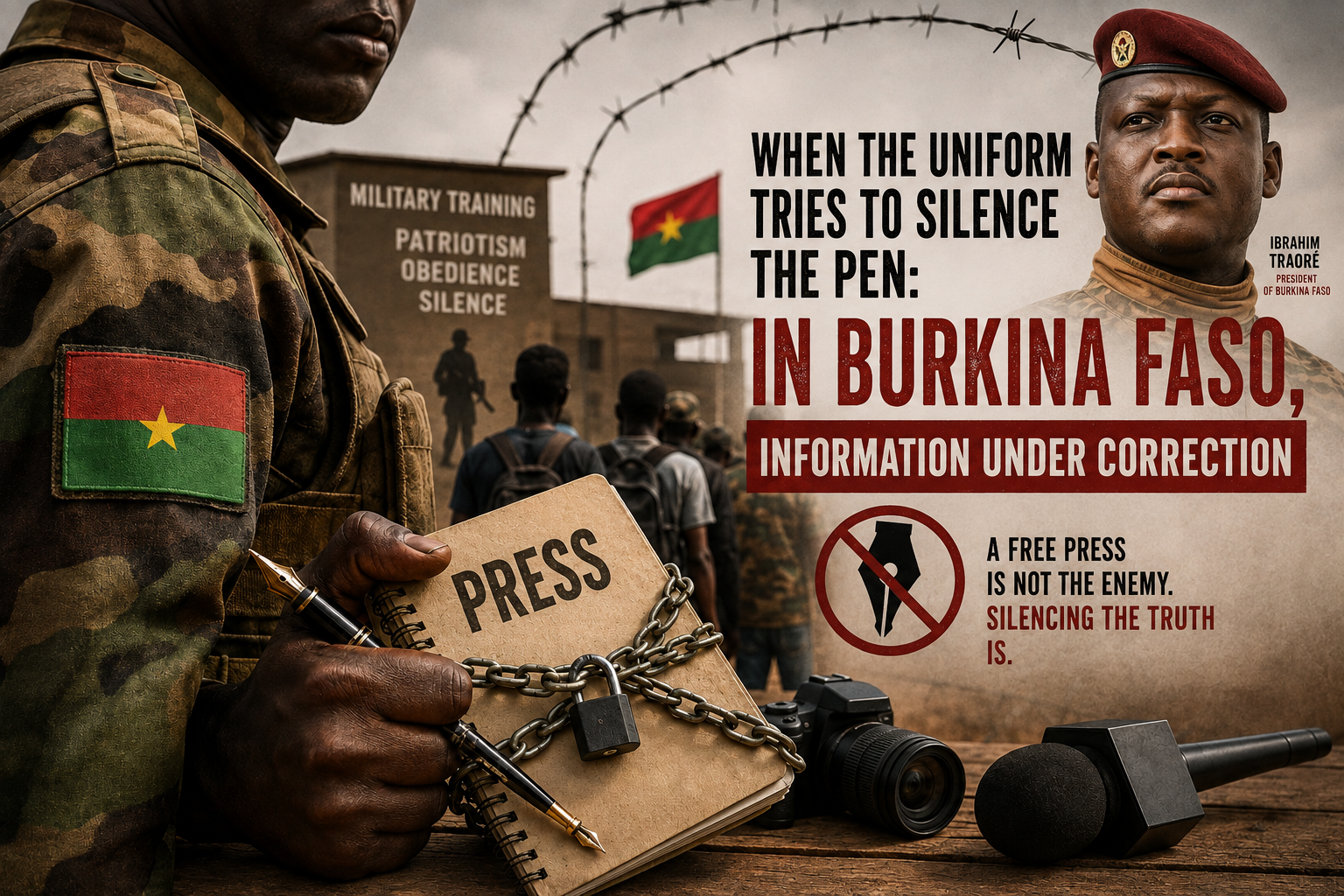
In a move that has sent shockwaves through defenders of fundamental freedoms, over forty journalists from Burkina Faso recently completed a military-style training program near Ouagadougou. Marketed as a course in ‘patriotism,’ the initiative conceals a far more troubling agenda: the systematic re-education and subjugation of independent journalism.
From civic education to ideological conformity
The distinction between genuine civic engagement and enforced conformity has never been more blurred. Journalists, who once reported on the ground realities security failures, civilian suffering, and governance gaps now face accusations of ‘treason’ or ‘lack of patriotism’ for doing their jobs. By channeling media professionals into undisclosed military camps under the guise of training, the authorities are not fostering informed citizenship but manufacturing compliant propaganda mouthpieces.
This coercive alignment signals a dangerous shift. The current leadership is not merely managing a security crisis but consolidating absolute authority across all spheres of public life. By monopolizing the public discourse and stifling the right to inform, the regime positions itself as the sole arbiter of national truth.
Journalism under duress: a threat to democracy
A press that operates under the diktats of power ceases to be journalism at all. Silencing reporters or forcing them to adopt a monolithic worldview does not resolve national crises it deepens them. When information is suppressed, citizens are left adrift, vulnerable to misinformation and arbitrary rule.
The question at stake is fundamental: In times of crisis, who owns the narrative? Does the state entitled to share military updates and protect sensitive details have the exclusive right to define what constitutes acceptable discourse? The line between necessary security measures and political control over information cannot be erased in the name of expediency.
Patriotism redefined: beyond blind allegiance
True patriotism does not demand uncritical obedience. A journalist deeply committed to Burkina Faso’s future does not betray their country by investigating civilian displacements, questioning authorities, or exposing systemic failures. The role of the press is not to shield the government from scrutiny but to hold it accountable while upholding professional integrity.
Democracies thrive on transparency and contradiction. When the state challenges a report, presents counter-evidence, or invokes legal remedies, it engages in the legitimate contest of ideas. It does not, however, reserve the right to predetermine what the press may publish.
The ripple effects of a controlled media landscape
The consequences of a domesticated press extend far beyond the profession itself. When official and private outlets refrain from publishing certain truths, the resulting void is never truly empty. It is swiftly filled by rumors, unverified social media claims, and clandestine narratives. Ironically, by attempting to dominate public discourse, the state undermines the very trust it claims to restore.
Trust is not decreed it is earned. It flourishes in environments where facts are verifiable, declarations are contestable, and citizens can distinguish reliable information from speculation. Conversely, when certain truths become dangerous to voice, doubt permeates society.
The contradiction of ‘re-educating’ journalists
The very concept of forcing journalists to pledge allegiance to a singular ideology contradicts the essence of their profession. Journalism relies on asking uncomfortable questions, scrutinizing public decisions, and confronting official narratives with lived realities. A reporter who cannot investigate, demand accountability, or challenge power ceases to function as a check on authority.
In a nation grappling with armed violence, mass displacements, and economic hardship, the need for independent journalism is greater than ever. Crises demand rigorous fact-checking, voices for the voiceless, contextual analysis, and scrutiny of decisions made in citizens’ names. Can a profession tasked with observing power be expected to adopt the same reflexes as those wielding it?
The dangers of merging military and editorial logic
The military operates on command, discipline, and confidentiality. Journalism thrives on verification, contradiction, editorial independence, and public accountability. Blurring these lines risks conflating obedience with professional duty a perilous precedent.
Beyond journalists, who might be next? Academics, judges, artists, activists, researchers, or human rights defenders could soon face ideological litmus tests for questioning government actions. A robust democracy is measured not by its ability to silence dissent but by its capacity to withstand criticism without branding it hostility.
The enduring power of inconvenient truths
History shows that regimes attempting to control information rarely succeed in erasing reality. They may dominate headlines, impose official narratives, and intimidate professionals but facts persist. They circulate through testimonies, diaspora networks, social media, and international outlets.
The real challenge is not how to impose a single narrative but how to create conditions for reliable information to circulate freely. In a nation at war, the journalist’s responsibility is immense. Yet so is the state’s: to protect citizens without weaponizing security to justify the suppression of liberties.
Patriotism should never serve as a license for censorship. Nor should it be used to divide citizens into ‘approved’ and ‘disapproved’ categories. A journalist exposing a state weakness does not betray their country; they may well prevent that weakness from escalating into catastrophe.
This issue transcends the journalists subjected to forced training. It defines the kind of society Burkina Faso chooses to build: one where information requires state approval, or one where truth however inconvenient remains accessible to all.
If patriotism today means turning a blind eye to reality to please those in power, then Burkina Faso’s democracy is marching in lockstep toward authoritarianism. But if patriotism means defending one’s country with honesty, then the journalist must retain the right to confront uncomfortable truths even when they unsettle those who govern.