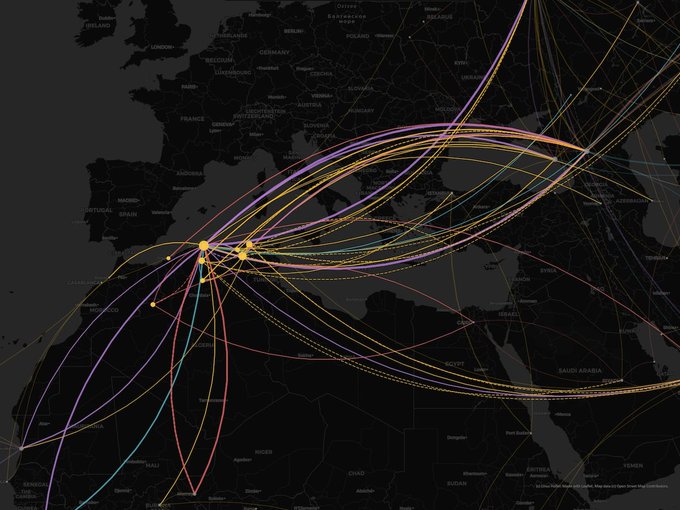
Russian clandestine air operations deepen influence across the Sahel
The Kremlin has quietly established an aerial logistics network in the Sahel that operates far beyond the visible deployment of Africa Corps paramilitaries. While international attention focuses on uniformed troops, Moscow has constructed a sophisticated infrastructure designed to project power and gather intelligence across West and North Africa.
At the core of this strategy lies a covert fleet of Russian cargo aircraft, colloquially known in intelligence circles as “Air Wagner.” This network has been systematically built under the guise of defense partnerships with the Alliance of Sahel States (Mali, Burkina Faso, Niger), evolving into one of the most advanced tools of Russian geopolitical influence on the continent.
167 undetected flights reveal Moscow’s aerial espionage network
To circumvent international sanctions, Russian authorities have constructed an intricate web of air transport that remains largely invisible to standard monitoring systems. A comprehensive aviation investigation has documented at least 167 cargo flights over a 14-month period, with further analysis revealing thousands of additional rotations conducted by a dozen interconnected airlines tied to Russian state or para-state entities.
To conceal these operations, Moscow employs sophisticated deception techniques:
- Deliberate transponder shutdowns to disable aircraft tracking systems
- Falsification or omission of flight plans and registration data
- Utilization of secondary airports for cargo transfers
Experts confirm these flights are not limited to transporting personnel and conventional munitions. The cargo includes sophisticated electronic warfare equipment, signals intelligence modules, and GRU military intelligence specialists, effectively transforming each flight into an opportunity to map and monitor the entire Sahelian region.
From security partnership to strategic dependency
For governments in the Alliance of Sahel States, cooperation with Africa Corps is often portrayed as an unconditional solution to terrorism threats. However, the technical reality demonstrates a more complex situation: Moscow is systematically embedding itself within these nations’ critical infrastructures.
The Russian support extends beyond combat operations to encompass exclusive maintenance contracts for local military aircraft, training of senior officers, and strategic logistics. By establishing operational hubs in Bamako, Ouagadougou, and Niamey, Russian intelligence services now have unrestricted access to sovereign military data, communications, and troop movements. Under the pretext of regime security, Moscow systematically collects information on local resources, military deployments, and governmental communications.
The long-term political consequences
The “Air Wagner” operation represents far more than a logistical arrangement—it constitutes a deliberate tool of influence. Through this aerial infrastructure, the Kremlin achieves two primary objectives: breaking free from diplomatic isolation by establishing a strategic foothold in Africa, and securing permanent insight into the domestic policies of Sahelian states.
For the governments of the Sahel, the short-term security benefits may prove deceptive. The gradual erosion of national sovereignty through unchecked Russian surveillance represents a far greater cost than the promised security advantages. By welcoming this phantom Russian fleet into their airspace and bases, Sahelian nations may have inadvertently granted the Kremlin its most valuable intelligence asset in the region.