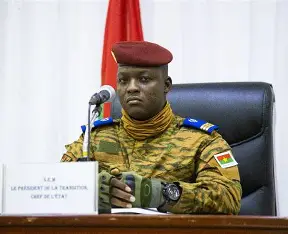
History shows that military leaders who seize power often encounter a paradox: the very instruments of their rise—discourses of strength, disciplined public appearances, and sweeping rhetoric—can become the seeds of their isolation. In Burkina Faso, this pattern appears to be unfolding as Captain Ibrahim Traoré’s regime, once buoyed by revolutionary fervor, now grapples with growing internal fissures.
From revolutionary fervor to mounting suspicions
Public displays of authority—carefully staged, uniformed with precision, and punctuated by fiery denunciations of foreign interference—once defined the image of Ibrahim Traoré’s leadership. Yet beneath this veneer, a different narrative is taking shape. The once-unified front of the military junta now appears fractured, as whispers of internal dissent grow louder and loyalty is increasingly scrutinized over merit.
Observers point to a series of troubling developments: repeated purges within the security apparatus, the sudden removal of key military figures, and the reshuffling of intelligence leadership. These moves, while presented as necessary reforms, have fueled speculation about the true state of cohesion within Burkina Faso’s armed forces. When a leader begins to distrust those sworn to protect him, the implications extend far beyond personnel changes—they signal a crisis of confidence at the heart of governance.
The purge of early allies
The trajectory of Ibrahim Traoré’s leadership echoes a familiar pattern in African politics. Those who once enabled his rise now find themselves sidelined, transferred, or removed from positions of influence. The dismissal of the director of national intelligence—a figure long regarded as a cornerstone of the security architecture—has raised particular concerns. Such actions are rarely mere administrative decisions; they often reflect a leader’s growing unease with those closest to him.
As the military’s ranks are reshaped by personal loyalties rather than operational experience, the institution risks losing both its cohesion and its operational effectiveness. The once-unified mission to combat armed groups now appears strained, with promotions and appointments driven less by strategic needs and more by political calculus.
The militarization of governance
Faced with persistent security challenges, the regime has adopted an increasingly authoritarian approach. Critics highlight a series of alarming trends:
- Targeted arrests of high-profile individuals critical of the government;
- Cases of enforced disappearances reported by human rights organizations;
- Restrictions on media freedoms, including suspensions and censorship of independent outlets;
- Pressure on civil society actors, often framed as retaliatory measures against dissent.
These developments have drawn international concern, with human rights groups warning of a systematic erosion of civil liberties in Burkina Faso. Meanwhile, state-controlled media and pro-government channels amplify the figure of Ibrahim Traoré, reinforcing perceptions of a leadership increasingly reliant on image control to mask underlying vulnerabilities.
The security crisis that refuses to recede
Despite the junta’s prolonged grip on power, the fundamental challenges that precipitated its rise remain unresolved. Large swathes of the country remain under the sway of armed groups, with civilians, security forces, and local defense volunteers bearing the brunt of ongoing violence. Displacement figures continue to climb, while humanitarian needs escalate in tandem with the country’s instability.
Recent data from the United Nations and humanitarian agencies underscores the depth of the crisis: jihadist attacks persist across multiple regions, internal displacement remains among the highest in West Africa, and the state’s authority struggles to extend beyond urban centers. For critics of the regime, the growing focus on political consolidation—rather than addressing these urgent threats—risks further alienating a population already weary of unmet promises.
The peril of self-imposed isolation
Patriotic rhetoric, no matter how impassioned, cannot substitute for tangible security improvements. Slogans do not rebuild crumbling institutions, nor do they restore the fractured trust between citizens and the state. Instead, the current trajectory suggests a leadership increasingly isolated—both from its historical allies and from the broader population.
History offers cautionary tales of military regimes that, in their quest to centralize power, inadvertently weakened their own foundations. In such cases, internal suspicion often proves more corrosive than external opposition. For Burkina Faso, the path forward remains unchanged: securing lasting peace, restoring institutional integrity, and addressing the humanitarian toll of prolonged instability. When a government expends more energy on preempting perceived threats than on resolving the crises that justified its existence, the cost to the nation becomes immeasurable.