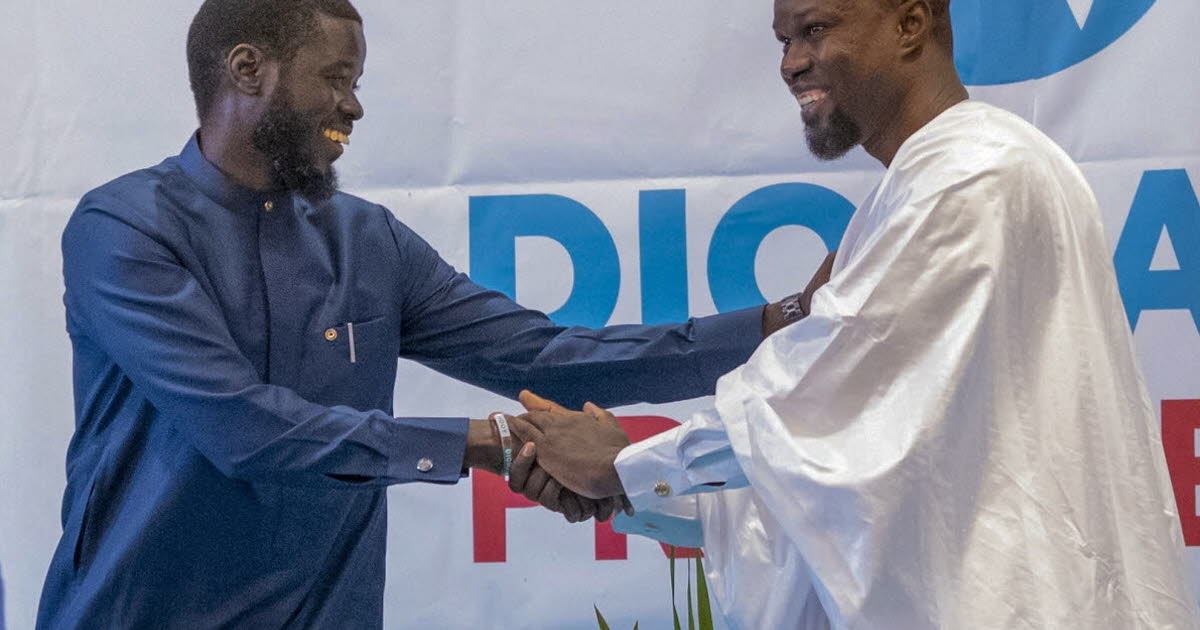
Sénégal President Faye’s dismissal of Prime Minister Sonko ignites political uncertainty
The political landscape in Sénégal faces heightened uncertainty following the split between President Bassirou Diomaye Faye and his highly popular Prime Minister Ousmane Sonko. This dynamic duo had previously swept into power on a wave of enthusiasm, promising significant change.
After a period of escalating tensions, the political partnership that once symbolized profound hope for change in Sénégal has officially dissolved. On Friday, Senegalese President Bassirou Diomaye Faye dismissed his immensely popular Prime Minister, Ousmane Sonko, a move that followed increasingly apparent disagreements. President Faye’s decisive victory in the March 2024 first-round election, securing 54% of the vote, was largely attributed to the strong backing of his former mentor. Sonko, the charismatic head of Pastef—the President’s own party—had been barred from contesting the presidency due to a defamation conviction rendering him ineligible.
In earlier times, the two leaders projected an image of deep camaraderie, with the popular slogan “Diomaye moy Sonko, Sonko doy Diomaye” (“Diomaye is Sonko, Sonko is Diomaye”) resonating as a genuine reflection of their bond. Their ascent to power, merely ten days after their release from prison, ignited widespread enthusiasm among Senegalese citizens eager to move past a protracted period of political and social turmoil. The Pastef leaders’ pledge to dismantle the existing political system and combat corruption initially granted them a significant honeymoon period, which has now evidently concluded.
However, the ruling partnership quickly fractured. Ousmane Sonko’s prominent stature began to overshadow his former protégé. The underlying rivalry between the two, particularly with an eye towards the 2029 presidential elections, significantly hampered the progress of reforms promised to the electorate. Notably, President Bassirou Diomaye Faye and his Prime Minister held differing views on strategies to alleviate Sénégal’s substantial debt burden, a critical issue given the nation ranks as the second most indebted in sub-Saharan Africa. The accumulated debt from previous administrations currently stands at a staggering 132% of its Gross Domestic Product (GDP).
Presidential ambition fuels 2029 rivalry
The dismissal of Ousmane Sonko has plunged Sénégal into an unprecedented political crisis. To effectively govern, President Bassirou Diomaye Faye requires the unwavering support of the party previously led by his former Prime Minister. Indeed, Pastef, where Sonko remains the undisputed leader, commands a formidable majority in the National Assembly, holding 130 out of 165 seats. Despite his removal from office, Ousmane Sonko continues to be perceived by many as the true victor of the 2024 presidential election.
“He maintains a powerful connection with the youth and champions a clear vision of sovereignty, a stark contrast to the patterns of corruption or forceful power grabs witnessed elsewhere in Africa,” I recall Pascal Boniface, director of the Institute of International and Strategic Relations (IRIS), remarking after a discussion with Sonko in Dakar last April. “Ousmane Sonko truly appears to embody genuine hope for his nation, despite considerable structural and financial challenges. Contrary to some perceptions, he is not anti-French; rather, he advocates for Sénégal’s sovereignty and encourages a re-evaluation of our relationships on new foundations.”