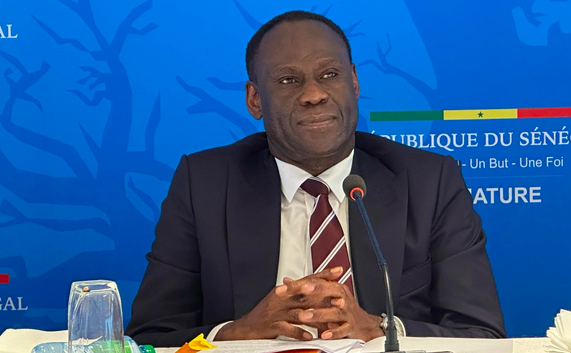
The corridors of power in Dakar witnessed a historic shift today as Ousmane Diagne was sworn in as the new President of the Constitutional Council of Senegal, a pivotal institution in the nation’s judicial framework.
a judicial heavyweight reclaims leadership
Ousmane Diagne, a seasoned magistrate whose career spans decades in Senegal’s legal system, officially assumes leadership of the Constitutional Council, replacing the late Mamadou Badio Camara. His appointment comes after a brief absence from the executive branch, where he previously served as Minister of Justice during the initial government led by Bassirou Diomaye Faye.
Diagne’s return to a high-profile role underscores his deep-rooted expertise, having previously held key positions such as Attorney General at the Dakar Court of Appeal and First General Counsel at the Supreme Court. His reassignment to the Constitutional Council—a body often called upon to resolve critical constitutional and electoral disputes—signals a strategic reinforcement of Senegal’s judicial independence.
In a nation where legal institutions play a decisive role in shaping governance, Diagne’s leadership is poised to influence key decisions, particularly in light of recent constitutional debates that have sparked national discourse.
a career marked by justice and reform
Before his brief stint in government, Diagne built an illustrious reputation as a legal reform advocate, contributing to modernizing Senegal’s judicial apparatus. His tenure as Minister of Justice was brief but impactful, focusing on tightening legal frameworks and reinforcing transparency in governance.
His departure from the executive branch following government reshuffles did little to dim his standing in legal circles. Instead, his reappointment to the Constitutional Council reaffirms his stature as a pillar of Senegal’s judicial community, where his experience in both the courtroom and the cabinet positions him uniquely to guide the nation’s highest legal authority.
The Constitutional Council, tasked with interpreting laws and arbitrating disputes between institutions, now faces a period of renewed vigor under Diagne’s leadership. His appointment arrives at a time when Senegal’s judicial system is under increased scrutiny, with stakeholders calling for greater accountability and efficiency in resolving constitutional matters.
what’s next for Senegal’s constitutional council?
With Ousmane Diagne at its helm, the Constitutional Council is expected to play a more assertive role in safeguarding constitutional order, particularly as Senegal navigates complex political and legal challenges. Observers anticipate a steady hand in interpreting constitutional amendments and ensuring adherence to the rule of law.
As Senegal continues to evolve politically, the leadership of the Constitutional Council will be instrumental in maintaining stability and reinforcing public trust in the nation’s institutions. Diagne’s deep understanding of both the legal and political landscapes positions him well to steer the Council through the coming years.