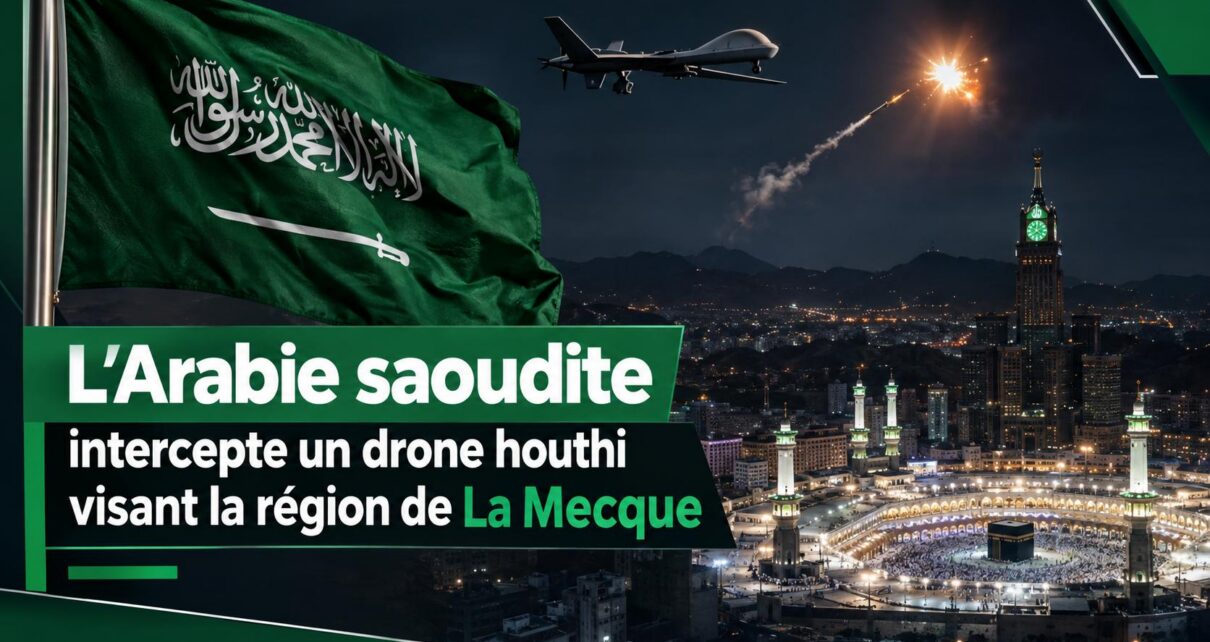
Can Saudi Arabia keep the holy city of Mecca safe from Houthi drones, or will one successful strike ignite a regional war? That is the urgent question after Riyadh’s military coalition announced on Wednesday, September 16, that its air defense forces had destroyed an armed drone linked to Yemen’s Houthi rebels. The unmanned aircraft was intercepted south of Mecca before it could enter the strictly protected airspace around Islam’s holiest city. No casualties or material damage were reported, yet the symbolic and political weight of the incident is immense.
The stakes behind an interception over Mecca’s southern approach
Saudi Royal Air Defense Forces detected and neutralized the armed drone on Tuesday, September 15, according to the Riyadh-led coalition. The operation prevented the device from penetrating the airspace that shields the Grand Mosque and the millions of pilgrims and residents who live in and visit the city. The coalition’s official statement stressed that the drone was armed and posed a direct threat. For Saudi commanders, targeting a site of such religious importance crosses a new red line.
Riyadh’s warning: a direct threat to worshippers
Coalition spokesman General Turki Al-Maliki swiftly condemned the attempted attack, blaming Yemen’s Houthi rebels and their allies for seeking to “disrupt the security and stability” of the Kingdom and for deliberately endangering the lives of worshippers gathered at the Grand Mosque. He reiterated the coalition’s determination to take all necessary measures to protect Saudi territory, civilians, and sacred sites. The message was clear: any strike aimed at the holy city will be treated as a grave escalation.
How this fits into a long-running regional conflict
The episode is the latest in years of hostilities between the Saudi-led international coalition and Houthi insurgents in Yemen. Drone and ballistic missile attacks on oil infrastructure, airports, and border areas are frequent, but any trajectory pointing toward Mecca triggers diplomatic and security reactions of unusual intensity. Despite past UN-mediated ceasefires and mediation efforts, these recurring attacks underline the Houthis’ persistent military capabilities and the difficulty of stabilizing the Kingdom’s southern frontier.
What’s next for regional security?
This new alert brings back to the forefront the vulnerability of strategic and religious infrastructure in the Arabian Peninsula to asymmetric attacks. The effectiveness of Saudi air defenses during this interception is tactically reassuring, but it also highlights the urgent need for a lasting political solution to the Yemeni conflict. As international chancelleries watch closely, the incident serves as a reminder that the risk of escalation remains latent and could, at any moment, undermine peace efforts and regional stability.