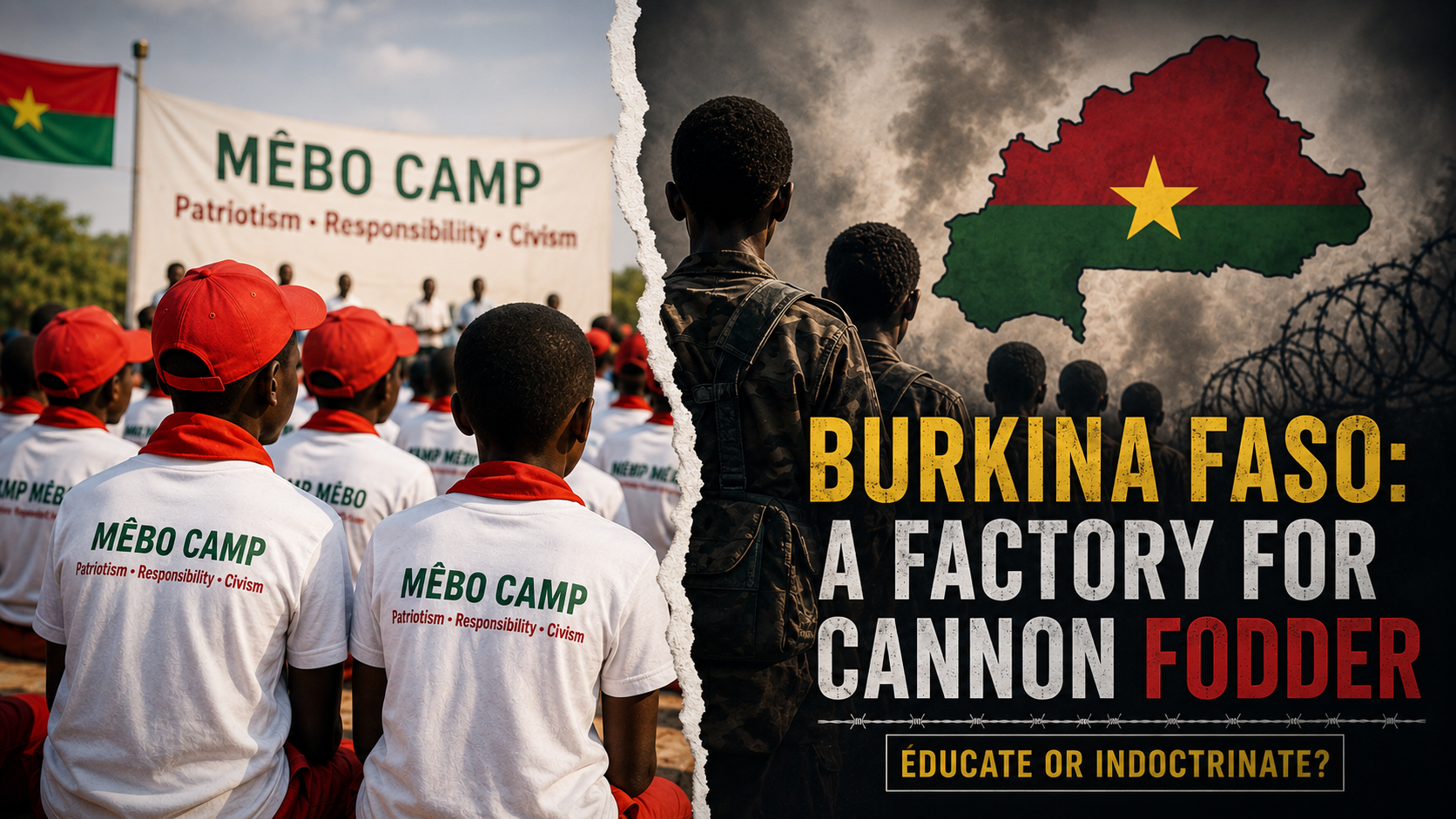
The initiative, while presented as a standard civic engagement program, has raised significant questions in Burkina Faso. The annual Mêbo holiday camp, which convened thousands of young participants for cultural, athletic, and community-based activities, was framed by government representatives as a means to cultivate civic responsibility, patriotism, and social awareness from an early age. However, beneath this official narrative lies a contentious debate: could such large-scale gatherings inadvertently signal the beginning of a more insidious trend the gradual militarization of the nation’s youth?
Patriotism versus ideological indoctrination
There is nothing inherently problematic about instilling civic values in young citizens. Teaching responsibility, institutional respect, social solidarity, and a commitment to the common good are objectives that warrant support. The concern arises when patriotism is co-opted as a mechanism for political influence, when independent thought is stifled in favor of unquestioning obedience, and when national defense is framed as an unconditional duty rather than a choice. These are the lines that, when crossed, blur the distinction between civic education and propaganda.
Historically, numerous African nations have witnessed similar patterns, where patriotic education has blurred into ideological mobilization or even recruitment for conflict. Instances from Sierra Leone, Liberia, and the northern regions of the Democratic Republic of the Congo demonstrate how easily the boundaries between civic engagement, nationalist sentiment, and participation in violence can dissolve. When state actors manipulate a vulnerable, impressionable youth population under the guise of nationalistic fervor, the risk of transforming educational initiatives into tools for mobilization becomes not only plausible it becomes probable.
The dangers of militarized rhetoric
A closer examination of the language used in these programs reveals further cause for concern. Repeated invocation of terms such as homeland, sacrifice, enemy, national defense, and commitment within youth-oriented discourse risks normalizing the idea that military service is the inevitable destiny of a Burkinabè citizen. While the intent may be to inspire a sense of duty, it is essential to recognize that children and adolescents must first develop the capacity for critical reflection, dialogue, and creative problem-solving before being expected to make sacrifices for any political or military cause.
This concern is particularly pressing in light of the ongoing security crisis in the Sahel and the policy direction pursued by Burkina Faso’s transitional leadership under Captain Ibrahim Traoré. With the nation confronting internal displacement, rising insecurity, and an urgent imperative to bolster national defense, patriotic discourse takes on heightened significance. Yet, in such a climate, the line between legitimate civic education and ideological conditioning can become dangerously thin. The overriding question, then, is not whether patriotism should be fostered but how far such mobilization can legitimately extend.
Balancing defense and dissent: a critical imperative
By shaping a youth aligned exclusively with official narratives, does the government risk, deliberately or otherwise, eroding the foundations of free thought and dissent? A truly robust society is not one in which citizens unquestioningly support those in power. It is one in which individuals can honor their country while exercising their right to critique its leaders, uphold national values without conflating them with regime interests, and serve their community without being reduced to political tools.
The normalization of sacrifice represents another significant peril. When combat death is continually portrayed as the highest form of patriotism, a perilous interpretation of civic duty may take root among younger generations. True devotion to one’s country should not be measured by a child’s readiness to embrace violence, but by their dedication to education, healthcare, agriculture, innovation, social cohesion, and sustainable development.
The visual and rhetorical prominence of military uniforms, insignia, and aggressive language within these youth programs further demands scrutiny. While no single element definitively confirms militarization, their combined presence particularly in a context of prolonged national mobilization and armed conflict warrants heightened vigilance. It is at this intersection that the boundaries between civic education, patriotic persuasion, and psychological conditioning for military readiness begin to dissolve.
The question of age and maturity
The distinction between childhood and adulthood is fundamental. Adults possess the cognitive and emotional maturity to weigh complex political and military realities before making informed decisions. Children, however, do not. Institutions bear a moral responsibility to protect young minds from exploitation and to ensure that education fosters liberation and empowerment not conformity to a confrontational worldview.
In times of crisis, the temptation to harden public sentiment through militarization is understandable. Yet, addressing security challenges by ideologically conditioning an entire generation to accept perpetual conflict risks perpetuating a cycle of violence. The more society habituates its youth to perceive adversaries and death as inevitable outcomes, the greater the likelihood that conflict becomes the default response to political and social disagreement.
Rethinking patriotism beyond confrontation
Authentic patriotism transcends readiness for sacrifice. To love Burkina Faso means envisioning a nation where young people can live, learn, work, and thrive without constant exposure to violence. It means encouraging citizens to support their country while reserving the right to challenge its policies. It means recognizing that loyalty to the nation and loyalty to power are not the same.
Before endorsing programs that claim to foster patriotism and youth mobilization, several critical questions must be answered. What pedagogical goals underpin these camps? How much emphasis is placed on critical inquiry and intellectual independence? Are children permitted to question or dissent? Do activities include military or paramilitary components? And, most crucially, where is the threshold between shaping responsible citizens and preparing a generation to accept war as an inevitable fate?
Burkina Faso requires a youth that is engaged, educated, and committed to collective progress. Yet it must also preserve their autonomy and integrity. The goal should be to prepare young people to build the nation of tomorrow not to furnish future generations as disposable tools in an endless cycle of conflict.
The question persists: are these children being groomed to construct a prosperous Burkina Faso, or to become expendable instruments in future wars?