When the United Nations General Assembly’s 81st session opened its doors in New York, all eyes were on the speeches of Mali, Burkina Faso and Niger. Yet it was the voice of Benin that immediately followed those of its immediate neighbors, signaling more than protocol—it signaled a moment of strategic clarity.
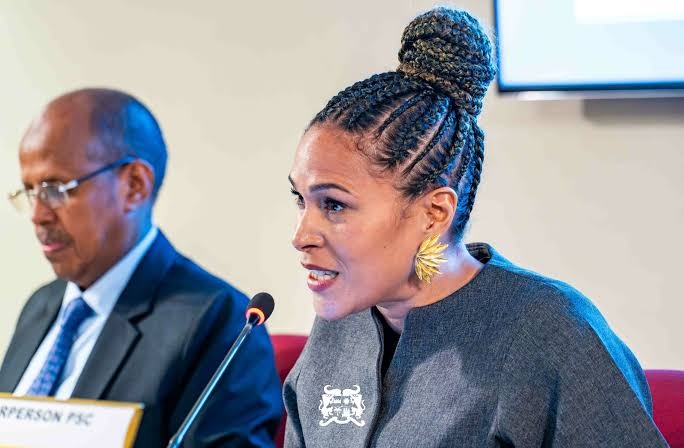
The country’s foreign minister, Corinne Amori Brunet, stood before the chamber not merely to read a statement, but to present a cohesive doctrine for borderland security that is already being implemented on the ground. Behind her at the dais stood Benin’s permanent mission led by Ambassador Marc Hermanne Araba, grounding the national narrative in institutional continuity and diplomatic precision.
This intervention did not emerge in a vacuum. It capped a pivotal six-month term as chair of the African Union’s Peace and Security Council, a role that forced Cotonou to move from diplomatic rhetoric to operational proof.
The silent war behind the podium: How Operation Mirador reshapes Benin’s northern flank
Since the first incursions by armed groups into the Pendjari and W national parks, Benin’s military command has viewed the border not as a line on a map but as a permeable membrane requiring constant vigilance. The result is Operation Mirador, a combined operation of defense, reconnaissance and community containment.
Unlike static border posts, Mirador deploys rapid-response units that monitor wildlife corridors and water points—precisely the terrain favored by traffickers and insurgents. Each squad is paired with local volunteers whose presence translates military pressure into human deterrence.
- Preventive patrols: Weekly sweeps along the Burkina Faso border, where smuggling routes often double as infiltration paths
- Community liaison cells: District officers and teachers act as dual-purpose sensors, feeding real-time alerts into a centralized command center
- Surge reinforcements: Reserve units rotate every sixty days, maintaining operational density without exhausting frontline troops
Accra Initiative in action: Three mechanisms turning cooperation into deterrence
The Initiative is not a declaration; it is a living coordination architecture involving Benin, Ghana, Togo, Côte d’Ivoire and the G5 Sahel states. Three functional layers make the system work:
The intelligence spine: Regional fusion cell
Every two weeks, intelligence officers from the five participating countries gather—either physically in Accra or virtually via encrypted channels—to exchange raw intercepts and threat patterns. The Beninese delegation, drawing on signals from its northern border communities, often supplies the first warnings of impending cross-border raids.
Cross-border task forces
When radar plots show motorized columns crossing from Burkina Faso into Benin’s Atacora department, a tri-national task force—Beninese gendarmes, Togolese border guards, and Ghanaian rapid-response police—intercepts at a pre-agreed choke point. These actions are timed to deny insurgents any rear guard, forcing them to retreat before reinforcements arrive.
Joint after-action reviews
Every operation concludes not with a handshake, but with a forensic debrief. Lessons on weapons cache locations or safe house distribution are codified into updated standard operating procedures, ensuring that each mission is sharper than the last.
Development as deterrence: How ABeGIEF builds loyalty instead of recruiting grounds
The Beninese government created the National Agency for Integrated Borderland Governance (ABeGIEF) to do what bullets alone cannot: cement allegiance where extremists once offered handouts.
In the northern districts of Atacora and Alibori, new boreholes provide potable water within a ninety-minute walk of every village. Solar-powered schools double as adult literacy centers, turning classrooms into classrooms of stability. Health posts stocked with Beninese medical officers now serve populations that once depended on itinerant foreign clinics—clinics whose operators were suspected recruiting agents.
By weaving infrastructure, education and healthcare into a single narrative of state presence, ABeGIEF is systematically undermining the economic grievances that militant propaganda exploits.
Early warning at village level: When citizens become the first line of defense
In remote hamlets like Kpassa and Porga, community alert networks use a combination of low-tech and high-tech tools:
- Green hotlines: Toll-free numbers manned around the clock; callers can report suspicious movements without fear of retribution
- SMS aggregation platform
- Whistle-blower tariffs: Financial incentives for verified tips that lead to the dismantling of illicit networks
These mechanisms rest on a simple truth recognized by Benin’s leadership: no fortress can stop an ideology if the people behind its walls feel abandoned. By inviting citizens into the intelligence loop, Cotonou is converting passive sympathy into active participation.
From New York to the bush: The doctrine that refuses to stay on paper
The speech delivered at the UN did not originate in New York; it crystallized the realities of Benin’s high-command briefings in Cotonou and the daily radio chatter from Atacora villages. The minister’s podium merely echoed what has already become operational muscle memory: a doctrine that fuses firepower, intelligence cooperation and socioeconomic presence into a single, seamless response.
In an era when Sahel-wide security paradigms often dissolve into competing national narratives, Benin’s UN address was not a pitch for sympathy; it was a status update on a war that is already being won—one coordinated patrol, one flowing well, one answered alert at a time.