Bénin: a smooth power transition through religious mediation
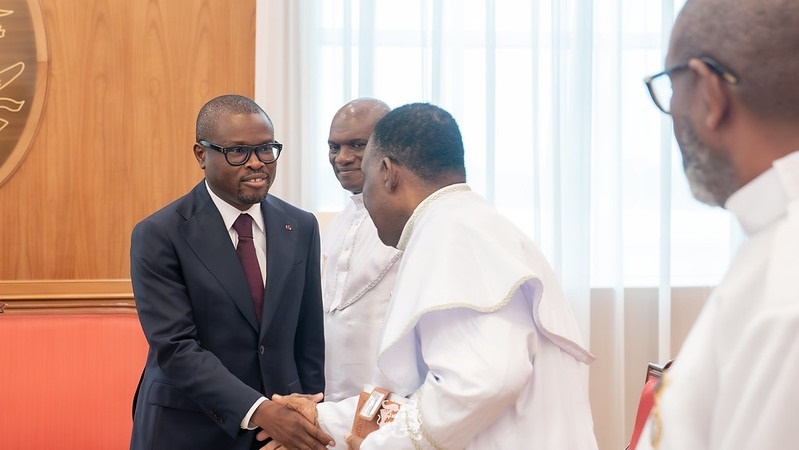
What message does an unexpected meeting between a head of state and a religious delegation send about a nation’s political maturity? The 4 June 2026 audience granted by President Romuald Wadagni to representatives of the Celestial Christian Church in Cotonou reveals far more than protocol. It offers a rare glimpse into a transition engineered to endure.
A dossier that tests institutional resilience
The reunification process of the Celestial Christian Church is not a headline-grabbing spectacle. Its arena is not a stadium but a series of discreet theological consultations, internal assemblies, and behind-the-scenes negotiations. Yet this very ordinariness makes it a pressure test for governance. Any sign of wavering commitment from the state could signal to the divided branches of the Church that their future hinges on the electoral calendar. That risk has, by all appearances, been addressed head-on.
The choreography of continuity
To grasp the significance of the moment, one must rewind to the handover of the Superior Council of Labour’s conclusions. On that day, outgoing President Patrice Talon and President-elect Romuald Wadagni stood side by side. The gesture was neither ceremonial nor accidental. It was a deliberate political statement: a tacit agreement that this dossier would remain a priority regardless of who held office.
«It is uncommon for a president to involve their successor so early in such a delicate matter. The way they have managed the transition speaks volumes about their depth of vision.» — A diplomat stationed in Cotonou
The morning of 4 June 2026 saw Talon officially inaugurate the Superior Council tasked with implementing the Council’s recommendations. By evening, Wadagni was hosting the same delegation. The sequence was meticulously timed: one leader installed the framework; the other immediately breathed life into it. The message was clear — stability is not a promise, but a practice.
Two presidents, one strategic division of labour
The architecture of this transition is intentional. Patrice Talon has assumed the role of facilitator — a mediator who prepares the ground without dictating outcomes. His authority on this file is unchallenged; the reunification process was initiated, structured, and concluded under his watch. To the Church’s factions, he is the guarantor of continuity.
Romuald Wadagni, in turn, embodies active continuity. By engaging personally with the delegation, he did more than acknowledge the dossier’s existence. He signaled that the state is not merely passing the baton — it is sprinting forward. «He did not merely listen. He asked incisive questions. It was evident he had studied the file thoroughly. This was no courtesy call.» — A delegation member
A national cohesion litmus test
Beyond the Church itself, this dossier serves as a barometer of relations between the two presidents. In many African transitions, unfinished business from a predecessor’s term lingers in institutional limbo — neither abandoned nor fully embraced by the new administration. The temptation to reset the agenda or let momentum fade is ever-present.
Here, the signal is unambiguous. By prioritising a dossier initiated by his predecessor within weeks of taking office, Wadagni has established a principle: the continuity of the State supersedes personal agendas. «What we see with the Celestial Church, we hope to see across other major projects. This is, in fact, the true test of any transition.» — A Beninese governance analyst
A dossier that transcends borders
Reducing this process to a national footnote would be a mistake. The Celestial Christian Church is a global institution with followers on every continent. A successful reunification would resonate worldwide — and Benin, as its birthplace, would stand at the centre of this milestone. The two presidents’ commitment thus carries diplomatic and symbolic weight far beyond Cotonou’s borders. It positions Benin as a hub for resolving a global religious fracture and its leaders as stewards of peace for millions of believers. In this sense, the 4 June audience was not merely a religious event. It was a subtle exercise in soft power — influence wielded not through coercion, but through mediation and sustained engagement.
The evening of 4 June 2026 was not a footnote in history. It was proof, for those who needed it, that the transfer of power between Patrice Talon and Romuald Wadagni was not a formality. It was a foundation.