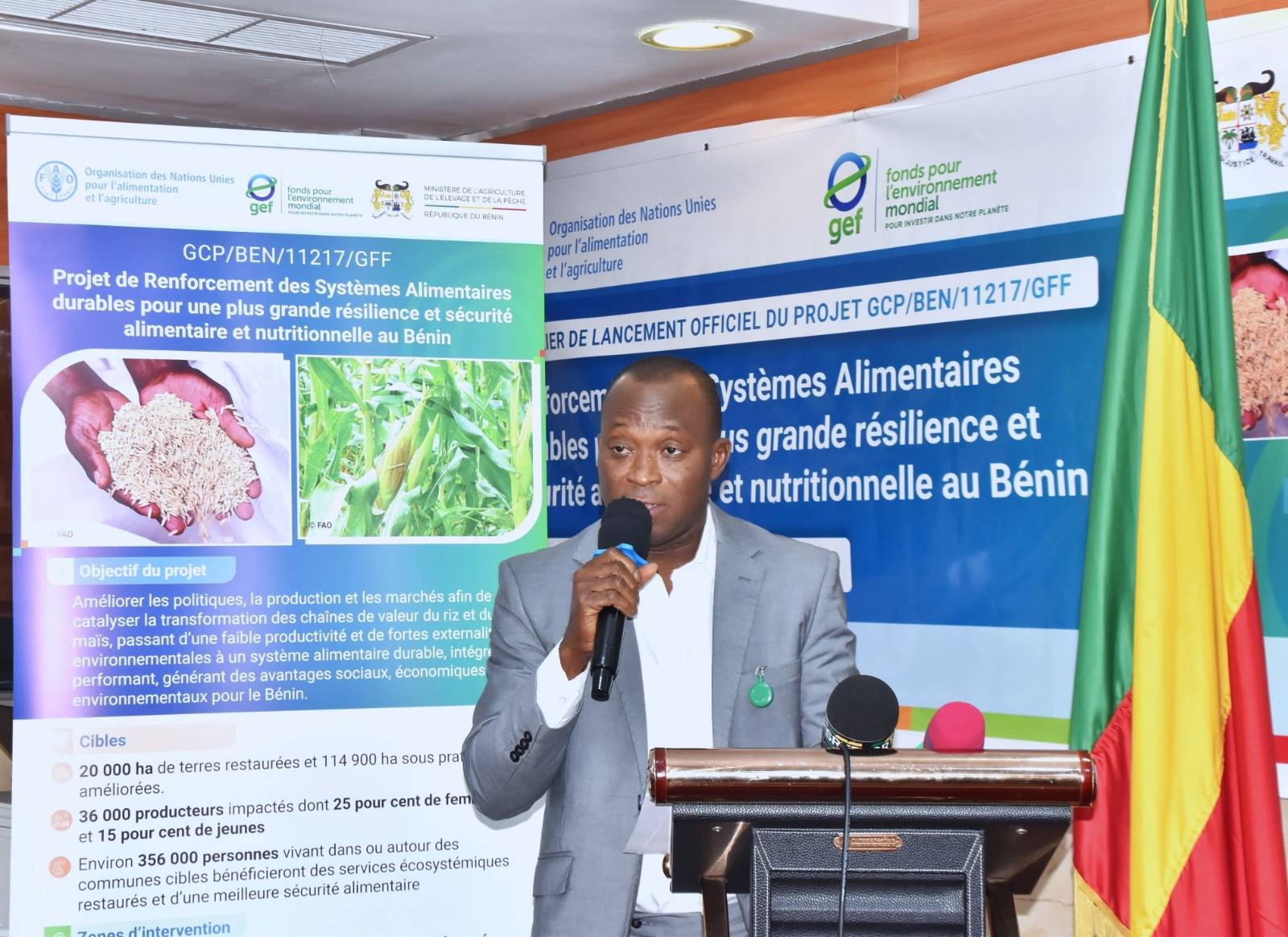
Bénin’s agricultural backbone is under severe strain. With soils losing their fertility at an alarming rate, the nation’s food security and economic stability face unprecedented threats. In response, the government, in partnership with international organizations, has launched an ambitious initiative to revitalize the country’s rice and maize sectors by 2030.
Critical soil degradation threatens national food security
The agricultural sector remains the lifeblood of Bénin’s economy, accounting for 70% of employment, 26% of GDP, and 80% of export revenues. Yet this vital economic engine is faltering due to the silent yet devastating crisis of soil degradation. Speaking at the official launch of the Food Systems project in Cotonou, the Minister of Agriculture, Livestock, and Fisheries, Adin Yeton Bloukounon Goubalan, delivered a stark warning: deteriorating soil quality is crippling farm productivity, trapping farmers in a cycle of poverty.
The numbers paint a grim picture. National studies reveal that over 5 million Bénin citizens—nearly 40% of the population—are directly impacted by land degradation. Shockingly, 38% of the country’s total land area is now classified as degraded, leading to at least a 50% drop in agricultural output. This crisis strips rural communities of access to essential ecosystem services like clean water and nutritious food, while pushing millions deeper into poverty.
Food Systems project: a comprehensive agricultural transformation
The Food Systems initiative, officially inaugurated to tackle this emergency, represents more than just a quick fix—it’s a systemic overhaul of Bénin’s agricultural framework. Developed by the Bénin government with support from the Food and Agriculture Organization (FAO) and the Global Environment Facility (GEF), the project aims to modernize public policies, enhance production techniques, and improve market access.
Central to its mission is the revitalization of the maize and rice value chains—two staple crops that dominate both rural and urban consumption. The goal is to transition these sectors from low-yield, environmentally harmful practices to integrated, high-performance systems that deliver tangible socio-economic benefits.
A targeted investment with ambitious goals
To drive this agroecological shift, a substantial financial and technical commitment has been secured. The project boasts a total budget of $20,766,207, funded through a tripartite partnership: the GEF contributes $5,966,207, while the Bénin government provides $14,800,000 in national co-financing.
Field operations, slated to run until 2030, will focus on five strategic communes: Karimama, Malanville, Glazoué, Kétou, and Les Aguégués. The anticipated outcomes are transformative: 20,000 hectares of degraded land will be restored, sustainable farming practices will be adopted across 114,900 hectares, and 36,000 farmers will receive direct support. Indirectly, the initiative aims to benefit nearly 356,000 individuals in the targeted regions.
Collaboration and caution: the keys to success
While the project’s goals inspire optimism, its architects are acutely aware of the operational challenges ahead. Minister Adin Yeton Bloukounon Goubalan has emphasized the need for meticulous planning, particularly in selecting soil restoration technologies, to ensure scalability and effectiveness.
The FAO’s Resident Representative in Bénin, Paul-Henri Zoéwindé Bouda, echoed this sentiment, stressing that technological solutions alone won’t suffice. “The project’s success hinges on the collective commitment of all stakeholders—government bodies, implementing agencies, and the farmers themselves,” he stated. “Without their full engagement, even the most advanced strategies will fall short.”
A model for sustainable resilience
By addressing the root cause of food insecurity—land degradation—the Food Systems project is laying the groundwork for a more resilient Bénin. If the 2030 targets are met, the country could not only secure its rice and maize supply but also emerge as a regional leader in sustainable agricultural transformation.