When the 2026-2027 school year opened in Benin, the country’s school canteen scheme crossed a fresh milestone: 1.9 million children now sit down to a hot meal on every class day, against 1.4 million a year earlier. Close to 500,000 extra pupils have entered the system in twelve months, a rise that reveals as much about political intent as about the logistics of running kitchens across the country.
For the government, a school lunch is not framed as charity. It is treated as an investment that touches education, nutrition and the national economy all at once.
A hot lunch for 1.9 million pupils
Roughly 500,000 children added in one year
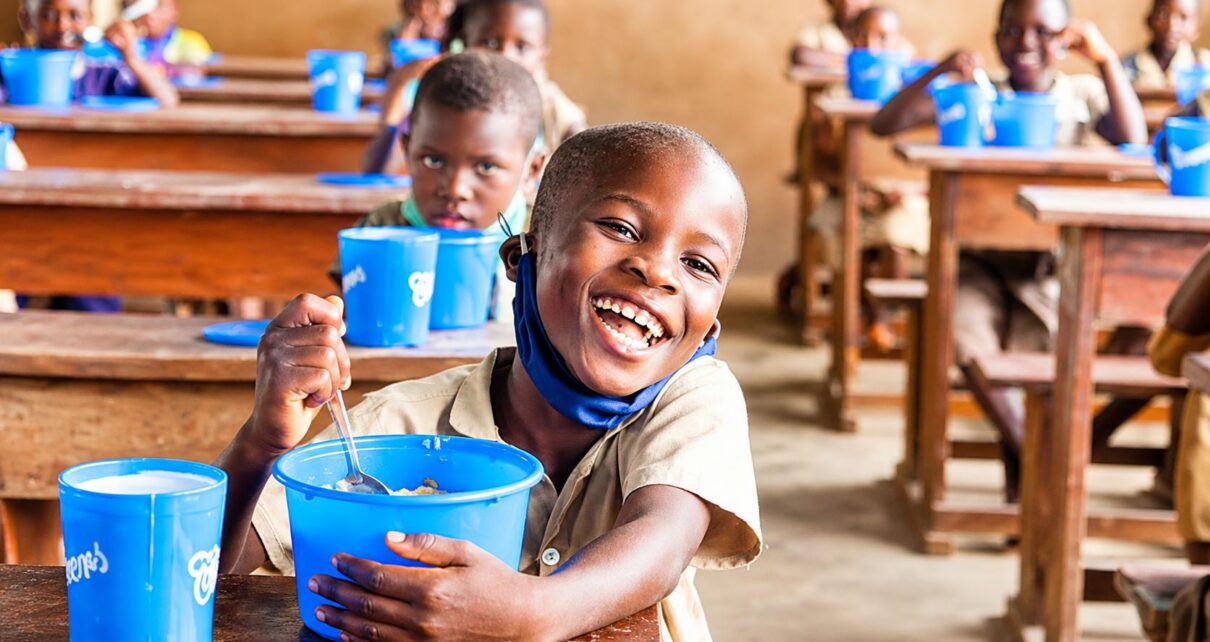
The new academic year has lifted the canteen network to another level. Beneficiary numbers now stand at 1.9 million children, compared with 1.4 million during the previous year.
Behind that headline sits the tangible widening of a national policy: some half a million additional children can count on a midday meal whenever classes are held.
Coverage climbed from 30% to 75%
The ground covered so far is considerable. In 2016, school canteens reached only 30% of what they reach today. By 2022 the rate had risen to 75%, with more than 1.1 million children already enrolled. The gains recorded since then point to a programme that keeps gathering strength.
Feeding pupils is therefore presented as an investment in schooling, in nutrition and in the country’s development, rather than as a simple assistance measure.
The money behind the plates
From 1.5 billion to 48.7 billion CFA francs
Running a scheme at this scale costs a great deal, and the state has steadily increased what it puts in. Budget allocations for school canteens moved from 1.5 billion CFA francs in 2016 to 48.7 billion CFA francs in 2022 — a clear signal of the priority given to this public policy.
More than 29 billion CFA francs planned for 2025
Under the 2025 finance law, over 29 billion CFA francs were also earmarked to keep the canteen programme going.
- 1.5 billion CFA francs for school canteens in 2016
- 48.7 billion CFA francs in 2022
- More than 29 billion CFA francs set aside in the 2025 finance law
Those sums can be read as a long-term social investment. By paying for children’s meals, the state acts simultaneously on several factors that shape a pupil’s school career and wellbeing.
The goal is not merely to serve food. It is to build the conditions in which children stay in school, learn in better circumstances and prepare what comes next.
What a school lunch changes for families
Less strain on the household budget
For many families, the impact shows up first at home. Covering a schoolchild’s meal every day represents a significant outlay, and when the school handles lunch, part of that weight is lifted.
Parents can then direct their income towards other essentials. Exercise books, clothing, health care or food for the other members of the household: every small saving can improve living conditions at home.
Better concentration in the classroom
Pupils gain just as much. A child who eats a warm meal at school copes better with the school day; hunger fades during lessons, and concentration, participation and learning all improve.
Bringing more children into the scheme therefore answers a direct concern: allowing pupils, particularly those from the most vulnerable households, to study in decent conditions.
A steady market for local producers
Purchases from farmers passed 13 billion CFA francs in 2024
The programme’s other strength is economic. Canteens generate constant, predictable demand for foodstuffs, and part of the money mobilised can be directed to local growers and suppliers.
Relying on national agricultural produce opens outlets for farmers. Public spending on school meals can therefore lift producers’ incomes, energise rural activity and reinforce local economic circuits.
Figures released by the government show that food purchases from local producers have grown, exceeding 13 billion CFA francs in 2024.
The mechanism produces a virtuous circle: children are fed, families are relieved and farmers gain extra markets for what they harvest.
A wager on Benin’s future human capital
With 1.9 million beneficiaries as the 2026-2027 school year begins, the programme has entered a new phase. The 500,000 newcomers recorded in a single year give the expansion a concrete measure.
That growth also feeds a wider ambition: broader coverage of public schools. The authorities intend to keep up the effort so that school feeding becomes a lasting component of Benin’s education and social policy.
The canteen now looks like a tool with several faces. It fights hunger, supports parents, creates better learning conditions and opens outlets for local agriculture.
By investing heavily in this programme, Benin is not simply buying meals. It is putting money into today’s children, into families and into the local economy — and above all into the human capital that will form the country’s wealth tomorrow.