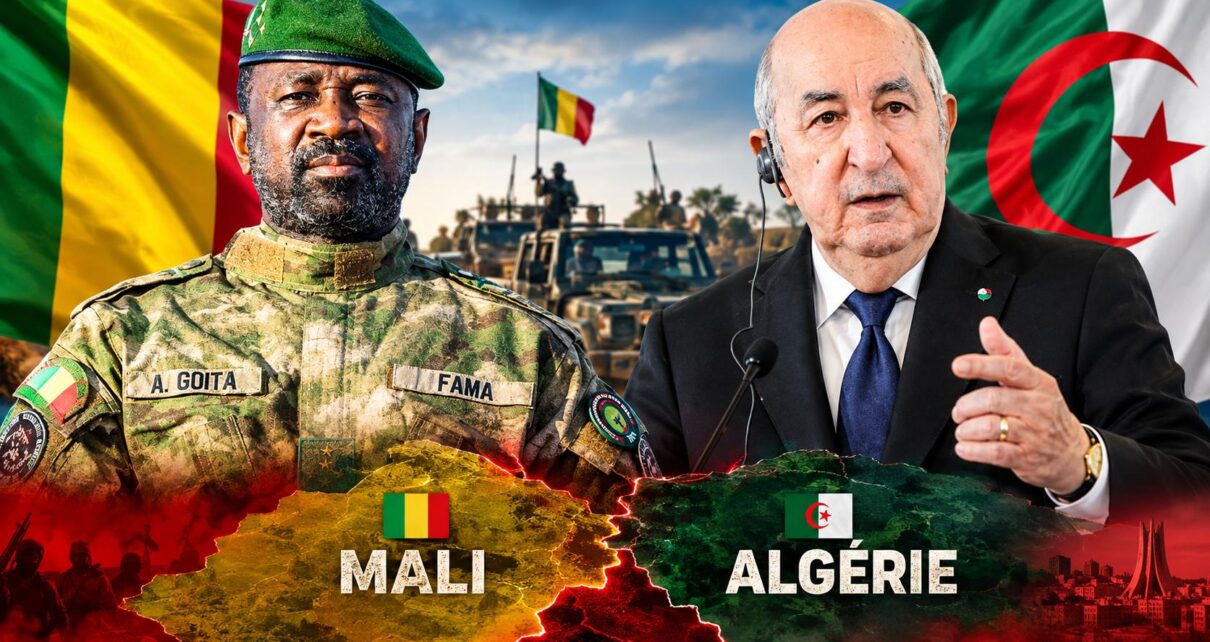
Algeria’s prime minister, Sifi Grine, travelled to Bamako on Monday for an official visit, standing shoulder to shoulder with the man who runs Mali, army general Assimi Goïta. The encounter was staged as a decisive turn towards warmer ties between two Sahel neighbours. Behind the courtesy and the set-piece statements, however, the weight of a recent diplomatic quarrel — and the ghost of the Algiers accord — refuses to disappear.
A handshake at Koulouba palace meant to reset the clock
The setting was chosen carefully: the reception rooms of Koulouba palace, where the Algerian delegation and Mali’s military leadership sat down together. On the table were tighter bilateral links, closer security coordination and a push to revive economic exchanges across a Sahel region under constant pressure.
For Algiers, the trip answers a long-standing ambition to regain influence in what it considers its southern sphere. For Bamako, parading a diplomatic partner of this size offers a way out of an international corner that keeps getting tighter. Observers who follow the region closely, though, are not persuaded by the choreography.
Grievances that Bamako has never really buried
This sudden warmth follows months of unusually harsh rhetoric. Not long ago, Mali’s ruling officers piled accusation upon accusation against their northern neighbour, framing every disagreement as a question of sovereignty and national pride.
What the junta put on Algeria’s tab
The list of complaints was long. Bamako pointed to Algeria’s hospitality towards Malian opposition figures and prominent religious leaders. Above all, it claimed that Algiers was quietly backing the autonomous rebel movements in the north. By describing those alleged actions as hostile, the military authorities were looking for an outside culprit — someone to blame for a security crisis that kept worsening and for promises that could not be kept.
Two partners pushed together by geography, not affection
What was celebrated on Monday looks less like a sincere alliance than an arrangement neither side can afford to refuse. Bamako has cut ties with its traditional Western partners and is navigating a set of regional alliances that offer little certainty, so it is hunting for new diplomatic backers wherever it can find them.
Algiers, for its part, cannot live with a permanent zone of instability along its southern frontier, where militant networks and cross-border trafficking thrive. The meeting between Sifi Grine and Assimi Goïta therefore reflects hard pragmatism: keep up appearances, avoid a rupture that could not be repaired, and leave the accumulated resentment untouched.
The Algiers accord still dictates who holds the cards
In this muted contest of wills, Algeria retains a clear structural advantage. For years it was seen as the security keystone and the unavoidable broker of Sahel peace, setting the regional agenda through the 2015 Algiers accord.
A denunciation that changed far less than expected
When the junta walked away from that framework early in 2024, the move was meant to demonstrate authority and to sweep aside any hint of outside supervision. Events proved otherwise. Dropping the negotiating format brought neither calm to northern Mali nor an end to the security threat. By returning to Bamako now to press its own terms and restart the conversation, Algiers is showing how central it remains: Bamako may try to ignore Algerian diplomacy, but sooner or later it has to deal with it.
What a military-led diplomacy cannot deliver
The visit gives General Assimi Goïta a welcome stretch of favourable coverage, yet it leaves every underlying problem exactly where it was. Mali’s military leaders continue to build their legitimacy on security rhetoric while postponing indefinitely any return to a constitutional, democratic order.
Without a genuine commitment to internal political stability and a sincere reading of regional balances, the pledges made during this meeting are likely to remain public relations. Beyond the diplomats’ smiles and the pressed uniforms, the relationship between Bamako and Algiers is still a minefield, and each side keeps waiting for the other to stumble.