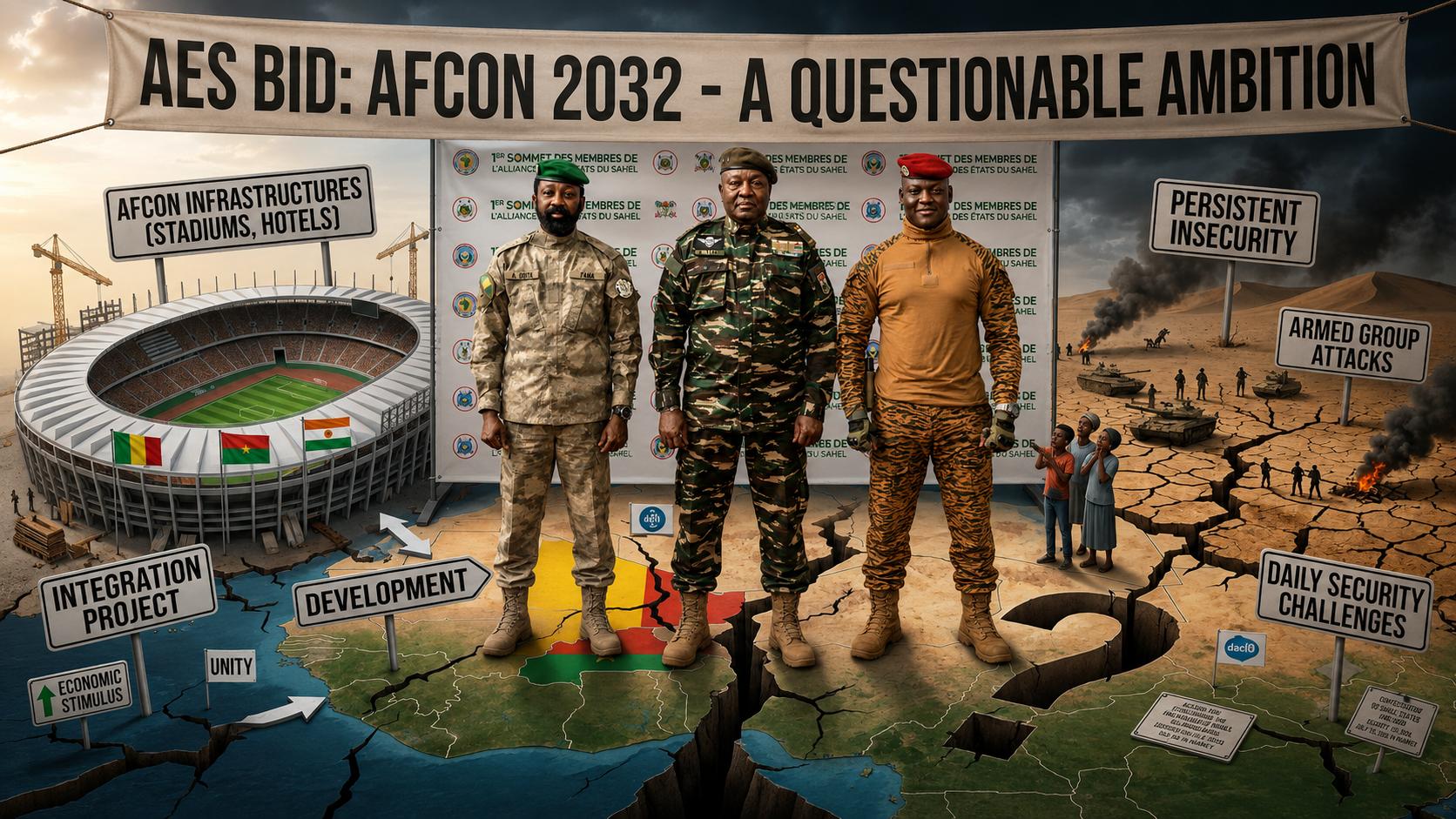
The governments of Burkina Faso, Mali and Niger have formally submitted a joint bid to host the 2032 Africa Cup of Nations (CAN), positioning the initiative as a symbol of unity among the countries of the Alliance of Sahel States (AES). While framed as a bold statement of continental cooperation, the bid raises pressing questions about the feasibility of hosting Africa’s premier football tournament in regions still grappling with instability.
The weight of expectations
Hosting the CAN is no small feat. Beyond the construction or renovation of stadiums, the event demands an environment capable of ensuring the safety of athletes, officials, journalists, fans and the hundreds of thousands of visitors expected over several weeks. Yet, the security landscape in Burkina Faso, Mali and Niger remains fragile, casting doubt on whether these nations can meet the threshold required for such a high-profile competition.
Security remains the unmet challenge
Since military-led governments assumed power in Burkina Faso, Mali and Niger, restoring security has been their central justification. However, years later, the reality on the ground tells a different story. Attacks against civilians, military personnel and critical infrastructure continue unabated, with entire regions still under the grip of armed groups. The persistent violence has left many questioning whether the priorities of these governments align with the needs of their people.
For critics, the timing of the CAN bid is misplaced. Before entertaining the idea of welcoming thousands of international tourists and delegations, shouldn’t these nations first demonstrate that their own citizens can move and live safely within their borders?
Logistical hurdles and financial strain
The demands of hosting a CAN are immense. Reliable road and air transport networks, a robust hotel sector, adequate medical facilities and a credible security apparatus are all prerequisites. Yet, with limited resources, Burkina Faso, Mali and Niger continue to allocate significant funds to counterinsurgency efforts, leaving little room for the massive investments required for such a tournament.
International credibility at stake
For governing bodies, sponsors and broadcasters, stability is non-negotiable. A single incident of violence or uncertainty could jeopardize the entire event, making the bid’s viability a matter of global scrutiny. The question lingers: can these three nations provide the assurances needed to mitigate risks and ensure a smooth, secure tournament?
A test of governance and resilience
The bid has reignited debates about national priorities. Many citizens had pinned their hopes on the military transitions to deliver tangible improvements in security. Yet, the ongoing challenges in multiple regions have fueled skepticism about the progress achieved. Some argue that before aspiring to host a continental event, Burkina Faso, Mali and Niger must first deliver on their core mandate: safeguarding the lives and livelihoods of their populations.
While a CAN bid can serve as a unifying project and a catalyst for development, its credibility hinges on tangible results. The restoration of security, the strengthening of institutions and the creation of a climate of trust are not optional prerequisites—they are the foundation upon which any such ambition must be built. Until these critical challenges are addressed, the focus must remain on the immediate needs of the people, not the pursuit of a distant sporting spectacle.