Government Response to RSF Accusations Highlights Persistent Lack of Transparency
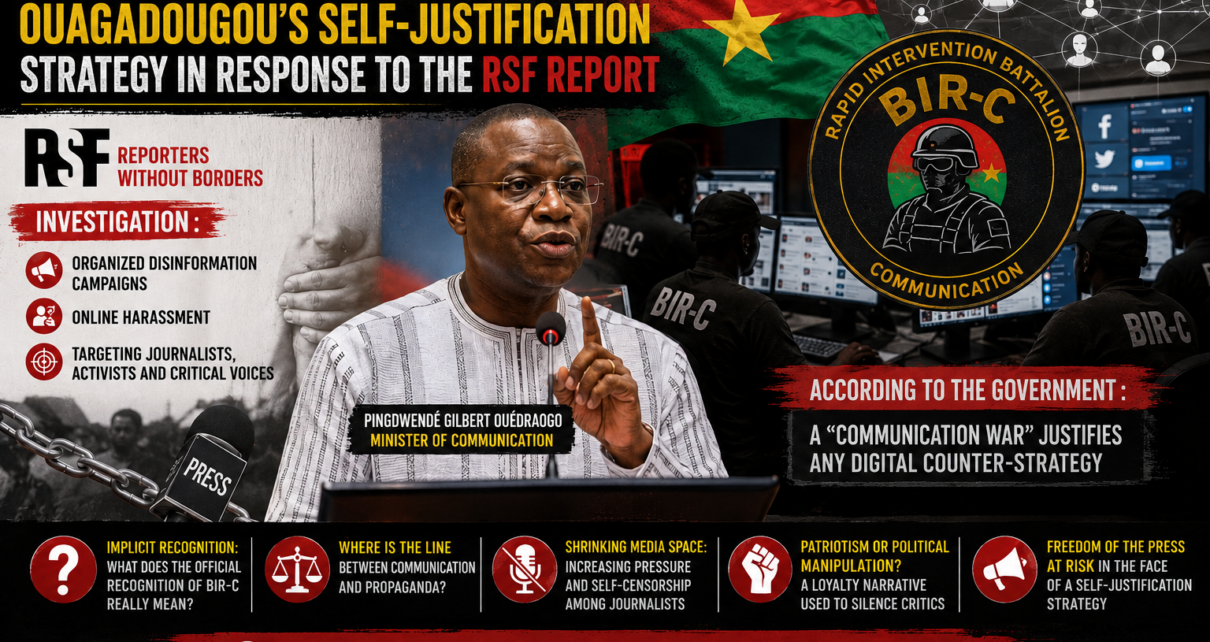
The Burkina Faso administration persists in its pattern of deflecting criticism rather than addressing it transparently, as evidenced by the most recent episode involving allegations from Reporters Without Borders (RSF). During the national flag-raising ceremony on August 3, Communication Minister Pingdwendé Gilbert Ouédraogo delivered a speech that inadvertently validated rather than dispelled concerns. His commendation of the Rapid Communication Intervention Battalion (BIR-C) as a bulwark against digital threats further obscured rather than clarified the situation.
The government’s acknowledgment of the BIR-C’s activities in Burkina Faso’s digital sphere comes in the wake of an RSF investigation detailing a coordinated effort involving disinformation campaigns, systematic harassment online, and targeted attacks on journalists, activists, and critics of the military-led transition. Rather than initiating an independent inquiry or directly contesting the findings, authorities opted to publicly endorse the BIR-C, deepening skepticism regarding its actual motives.
According to RSF’s report, a sophisticated network of fabricated social media accounts disseminated narratives aimed at discrediting dissenting voices and exerting relentless pressure on media professionals. While government officials refute these claims, their decision to praise the BIR-C has blurred distinctions between legitimate state communication and state-sponsored propaganda.
The administration contends that Burkina Faso is embroiled in a ‘communication war’ driven by external forces seeking to destabilize the nation. Within this framework, any state-led digital initiative is framed as a necessary patriotic response. This perspective, however, prompts a pressing query: when does legitimate crisis communication cross into the suppression of dissent?
Erosion of Dissent in a High-Tension Environment
While protecting the information space from manipulation is a legitimate concern, international free expression standards unequivocally prohibit tactics such as targeted harassment, smear campaigns, or intimidation of journalists. When dissent is routinely dismissed as seditious, public discourse becomes increasingly constrained.
This controversy emerges amid escalating media restrictions in Burkina Faso, where international outlets have faced temporary bans, journalists report heightened intimidation, and the local media landscape continues to contract. For many observers, these developments have fostered an atmosphere of self-censorship among media professionals. The apparent emergence of a structured digital communication unit if its role extends beyond conventional government outreach raises grave concerns about the equilibrium between national security imperatives and fundamental freedoms.
Patriotism as a Defense Mechanism Against Accountability
The communication strategy employed by the minister appears less focused on transparency and more on countering criticism through patriotic rhetoric. By celebrating the BIR-C’s operations, authorities reframe scrutiny not as an examination of methods but as an assault on the state itself.
A resilient democracy, particularly one confronting severe security threats, must demonstrate its robustness by welcoming critical analysis from the press and civil society. Responding to allegations with public displays of support for the implicated entity does little to dispel doubts rather, it may reinforce perceptions that the BIR-C serves as a cornerstone in the government’s communication infrastructure.
Systemic Issues Extend Beyond the BIR-C
The current controversy is not isolated to a single military unit; it reflects a broader approach to managing information in the digital age. Social media, now a critical battleground for political discourse, must be governed by principles of accountability, press freedom, and human rights. State-affiliated structures cannot operate without oversight or scrutiny.
This incident underscores a fundamental political choice: addressing criticism through nationalist mobilization rather than engaging in substantive, evidence-based debate. Without thorough, verifiable, and independent responses to RSF’s documented allegations, official statements risk being perceived not as denials but as defensive maneuvers by a communication system steeped in ambiguity one whose practices persistently undermine confidence in press freedom within Burkina Faso.