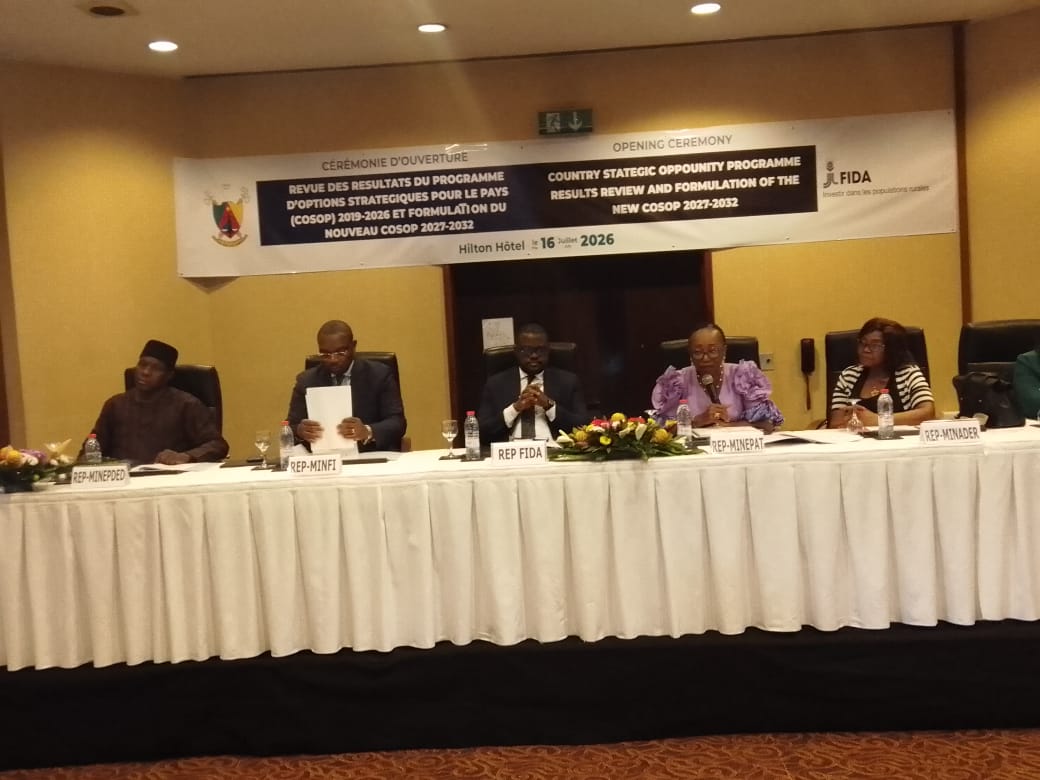
Targets were established under the Country Strategic Options Programme (COSOP) for 2019–2026.
A joint workshop organized by the Government of Cameroon and the International Fund for Agricultural Development (IFAD) convened in Yaoundé on 16 July 2026. The event reviewed the outcomes of the 2019–2026 COSOP and laid the groundwork for the next phase, COSOP 2027–2032.
Designed to guide IFAD’s investment priorities, the COSOP targets rural poor populations—especially women and youth—across Cameroon. Its overarching aim is to enhance living conditions in rural areas by aligning agricultural interventions with the country’s National Development Strategy 2020–2030 and the United Nations Sustainable Development Cooperation Framework.
Measurable gains in productivity and output
The programme’s flagship component—“Sustainably increasing productivity and production of smallholder farms and rural enterprises”—achieved a 98% implementation rate. A total of 139 cooperatives in rice and onion value chains, involving 10,505 farmers (39% women and 49% youth), are now fully operational. The 2024 target called for at least 10,000 members, with women and youth leading at least half of these cooperatives.
All projects were equipped with environmental and social management plans. In the Youth Agropastoral Entrepreneurship Promotion Programme (PEA-Jeunes), 99% of targeted youth adopted the recommended techniques—surpassing the 50% forecast. However, only 649 hectares of hydro-agricultural land were developed for rice and onion production out of the planned 1,600 hectares, representing 43% of the target.
Rice and onion yields exceed expectations
Under the Support Programme for Agricultural Value Chain Development Phase II (PADFA II), 60% of beneficiaries reported a 50% increase in lowland rice yields, reaching 3.7 tonnes per hectare (74% of the 5-tonne target). Upland rice yields averaged 2.5 tonnes per hectare (63% of the 4-tonne goal), while onion production hit 18 tonnes per hectare (86% of the 21-tonne target).
PADFA II also drove overall production upward: 52,996 tonnes of paddy rice were harvested against a 74,750-tonne target (70.38%), while 45,000 tonnes of onion bulbs were produced from a 85,562-tonne forecast (52.47%).
Climate resilience and policy reforms advance
The ecosystem-based adaptation and climate-smart practices component reached 100% completion. A strategic plan for 17 reforms is now in place, including a draft law to guide Cameroon’s agropastoral sector and three strategies to support bamboo restoration policies.
The 2019–2026 COSOP was jointly endorsed by Cameroon and IFAD and extended to 31 December 2026 at the Government’s request, following the mid-term review in July 2021.