Civil society in the DRC unveils the Kasangulu Manifesto to rebuild the nation
- Politics
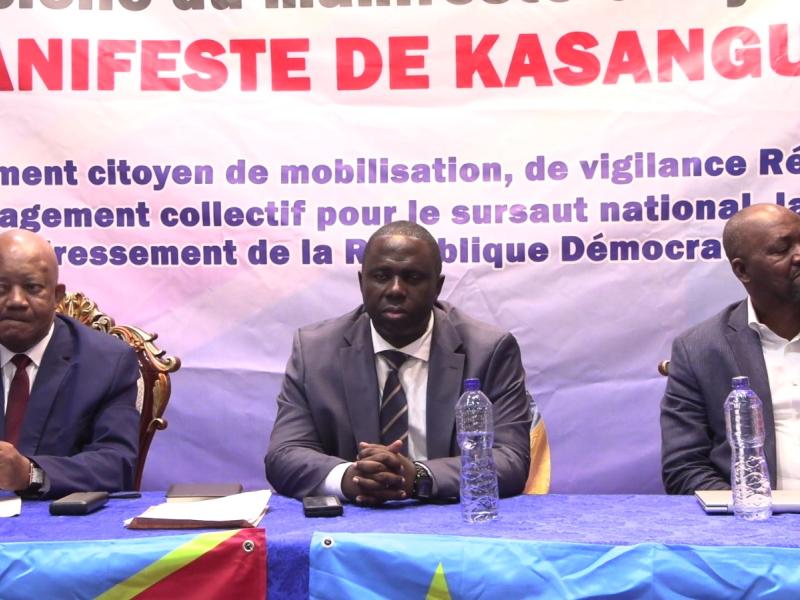
In a bold move to address the Democratic Republic of the Congo’s (DRC) mounting challenges, civil society organizations have launched the Kasangulu Manifesto, a citizen-driven roadmap for national rebuilding. The initiative, spearheaded by the Crisis Committee of Civil Society for Peace and Security in the DRC, was unveiled on June 26, 2026, in Kinshasa.
The manifesto represents a collective response to the country’s political, security, economic, social, and institutional crises. Developed through an inclusive process involving representatives from multiple provinces, it outlines a shared vision for transformation rooted in responsible governance, peace, security, social justice, citizen participation, education, healthcare, economic development, environmental protection, and the strengthening of the rule of law.
Foundations for a new Congo
The ceremony was opened by Ms. Sylvie Nakweti, Director of Communication, Advocacy, and Documentation at DYCOD-RDC, who commended civil society’s dedication to this national rebirth initiative.
Professor Iyoka Jean Bedel, a key figure in the manifesto’s development, emphasized its pedagogical and inclusive nature. “This citizen manifesto is the result of a process designed to provide the DRC with a foundation for reflection and action toward its renaissance,” he stated.
Me Patient Bashombe Matabishi, Coordinator of the Crisis Committee, underscored the historic significance of the initiative: “We launch today the Citizen Manifesto, known as the Kasangulu Manifesto, because the drafting commission’s work took place in Kasangulu. This document embodies civil society’s vision for the Congo’s restoration.”
The timing of the launch was deliberately chosen to coincide with the eve of Independence Day, symbolizing a call to national responsibility. “The date carries deep symbolism as we approach June 30, our independence day. We seek to engage every Congolese in acknowledging their role in shaping the nation’s future. This is not just a political debate—it belongs to all citizens,” Matabishi explained.
The Kasangulu Manifesto’s guiding principles
Daie Mutombe Pierrot, President of the Congolese Onusians, presented the Democratic Citizen Revolution, a movement advocating active citizenship, good governance, and national sovereignty. During this event, Me Patient Bashombe Matabishi was elected President of the BLOC-RDC movement, with Professor Iyoka Jean Bedel named Secretary General.
Constitutional reform: a delicate balance
Addressing the debate on constitutional reform, Matabishi cautioned against approaches that could undermine national unity. “While the Constitution itself allows for revision, any process lacking broad consensus risks destabilization. The Constitution remains our fundamental tool for cohesion, the primary text uniting all Congolese. Locked provisions require consensus—not electoral processes—to be revisited,” he asserted.
The manifesto aims to serve as a foundational text for the country’s future orientations, carrying the collective vision of civil society and the people for the DRC’s renewal. The event brought together nearly 200 civil society organizations, community representatives, academics, labor leaders, lawyers, doctors, entrepreneurs, youth groups, women’s movements, human rights defenders, and local leaders. Participants praised the document and called for a national campaign to ensure its widespread adoption across the country and among the Congolese diaspora.
In closing, the Crisis Committee urged all sectors of society to embrace the Kasangulu Manifesto as a pivotal contribution to rebuilding the state, consolidating peace, and constructing a more just, prosperous, and democratic DRC.
Contextual backdrop
The manifesto’s launch comes amid escalating regional tensions, including the Rwandan-backed M23 rebellion and the activities of local and foreign armed groups. This situation has exacerbated the humanitarian crisis, with rising numbers of internally displaced persons and refugees, compounded by reduced international funding, stalled diplomatic initiatives, and ongoing hostilities in eastern DRC. The debate over constitutional reform has also intensified, with two opposing coalitions—Coalition Article 64 and Coalition of Congolese for Constitutional Change—each claiming popular support for their respective agendas.