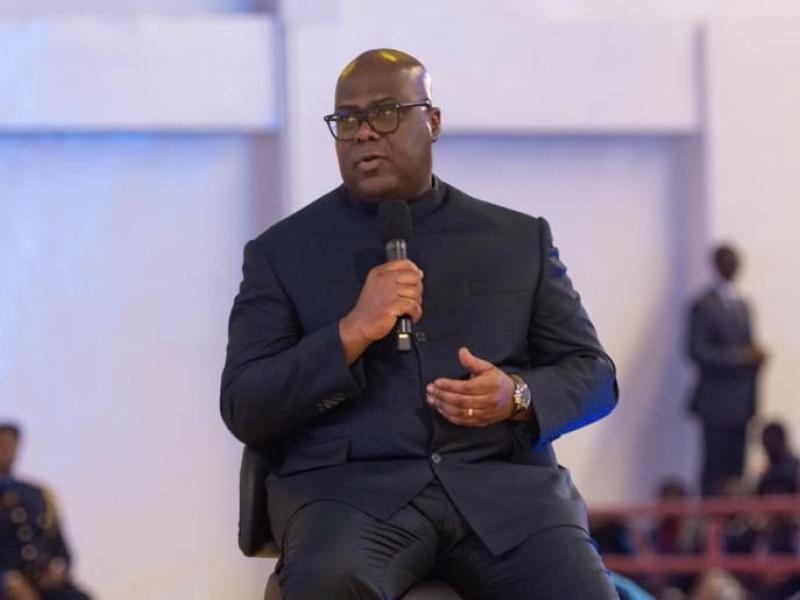
The President of the Democratic Republic of the Congo, Félix Tshisekedi, has delivered a firm message to the nation ahead of Independence Day celebrations, stressing that dialogue must not be exploited as a tool to undermine institutions or subvert the people’s will. Speaking in Kinshasa, the head of state reiterated his commitment to inclusive discussions while drawing clear boundaries to prevent such talks from being weaponized.
During his address, Tshisekedi emphasized the sacred nature of national sovereignty, affirming that the Congolese people remain the sole legitimate source of authority. He warned against any attempt to manipulate democratic processes, stating that dialogue must align with constitutional principles and respect institutional integrity.
« Dialogue cannot serve as a pressure tactic, a means to bypass institutions, or a vehicle to challenge the people’s sovereign will as expressed through our Constitution and laws. The Republic welcomes all citizens who embrace peace, dialogue, and loyalty to the nation, but such engagement must remain within the framework of our democratic order. »
Addressing escalating tensions linked to debates over constitutional reform, Tshisekedi condemned violence and armed rebellion as unacceptable modes of political expression. He asserted that no group resorting to force should be granted legitimacy or negotiating leverage over law-abiding citizens.
« The use of violence, weapons, or incitement to hatred cannot constitute a political right. It does not confer any special right to negotiation nor elevate those who threaten the Republic above those who uphold its laws. »
The head of state called for national unity, framing it as an existential necessity in the face of security challenges and instability. He urged political, religious, economic, and civil society leaders to prioritize stability and reject divisive rhetoric.
« We can debate, differ, and oppose each other within the bounds of our republican framework. However, we have no right to weaken the nation when it faces existential threats. In these times, national unity is not a choice—it is a historical imperative. »
Context and reactions
The president’s remarks come amid deep divisions over the proposed constitutional changes and ongoing security crises in eastern provinces. While the government advocates for dialogue strictly within institutional channels, opposition factions and civil society groups, including religious leaders, insist on an inclusive process mediated by the National Episcopal Conference of Congo (CENCO) and the Church of Christ in Congo (ECC). These groups propose mechanisms for transitional justice and emphasize that inclusivity must not equate to impunity.
As diplomatic efforts in Washington and Doha continue without yielding tangible security improvements, calls for a unified national response grow louder. The president’s firm stance signals a determination to protect democratic institutions while warning against the dangers of unchecked political maneuvering.
Félix Tshisekedi