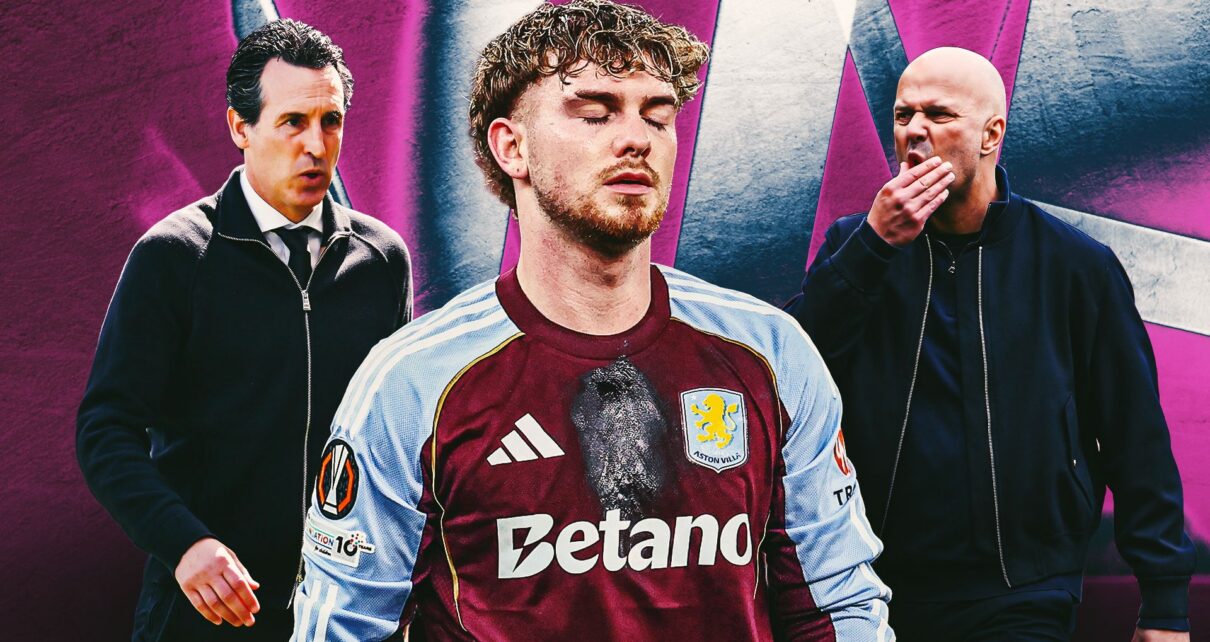
Harvey Elliott finds himself sidelined from Friday night’s clash against his parent club, Liverpool, while on loan at Aston Villa. Even without the contractual restriction, manager Unai Emery likely wouldn’t have featured him. This decision isn’t about preserving him for next week’s Europa League final against Freiburg. Elliott hasn’t played a single minute since March, as one more appearance would activate a loan clause compelling Villa to purchase him for £35 million ($46 million) – a scenario the club is determined to avoid at all costs.
Elliott’s season is effectively over, though in truth, it never truly gained momentum; Emery quickly determined the versatile attacker didn’t fit into his tactical framework. His summer return to Liverpool has seemed inevitable for months, but what are his genuine prospects of securing a permanent place there? It appears Arne Slot holds similar reservations about his role.
We delve into this disheartening situation, exploring what the future might hold for a player once hailed as one of England’s brightest young talents.
klopp’s singular regret
Just prior to his departure from Liverpool in May 2024, Jürgen Klopp was candid about any potential regrets. The beloved manager admitted, “I don’t dwell on the past asking, ‘Where did we go wrong?’ But if I must express one regret, it’s perhaps not giving Harvey enough playing time.”
He elaborated, “In January, during a crucial and intense period when we were battling a wave of injuries, he was exceptional, arguably our best player, whether operating on the right wing or in central midfield. Then everyone returned, and he only managed a few minutes here and there, never quite reclaiming a starting spot.”
Elliott, however, harbours no ill will towards Klopp. A lifelong Reds supporter, he expressed “extreme gratitude” to the man he calls a “legend” for helping him “live his dream,” even confessing surprise that a statue of the German tactician doesn’t yet stand proudly outside Anfield.
a promising start under slot
At the conclusion of the 2023-2024 season, Elliott’s career appeared to be on an upward trajectory. He had achieved a personal best of 53 appearances in a single season, and at just 21, he was widely tipped for a significant role under Klopp’s successor. His profile seemed to align perfectly with the number 10 position in Arne Slot’s system.
His performances during the summer pre-season further solidified this impression. He demonstrated the precise combination of relentless work rate and creative flair that the former Feyenoord coach demanded from his playmakers.
“We build the play from the back, putting him in the right positions, and then it’s up to him to make the most of those situations, which he did today with two assists,” Slot commented after the Reds’ 2-1 friendly victory over Arsenal in Philadelphia on August 1, 2024, where Elliott was instrumental in both goals.
an unavoidable departure
As the 2024-2025 season commenced, Harvey Elliott once again found himself on the bench, playing only seven minutes across Liverpool’s initial three fixtures. Then, during training with the England Under-21 squad, he suffered a fractured foot.
This untimely injury struck just before a demanding run of seven matches in 21 days, a period Slot had intended to use to integrate him more fully into the starting eleven.
Upon his return, Liverpool was firing on all cylinders: Dominik Szoboszlai, a pressing machine, excelled in the playmaker role, and Mohamed Salah, at the peak of his powers on the right wing, blocked Elliott’s path. He was condemned to wait – a dishearteningly familiar scenario for the young player at Anfield.
While he did showcase his talent by scoring a late, match-winning goal from the bench in the first leg of the Champions League round of 16 against Paris Saint-Germain, it is telling that his only Premier League starts came after the Reds had already secured the title.
Slot now viewed him as surplus to requirements, and the summer arrival of Florian Wirtz rendered his departure not only inevitable but crucial for revitalizing his career.
a regrettable choice
Elliott undoubtedly remained one of the planet’s most gifted young players. While Tino Livramento and Elliot Anderson shone for England at the 2025 Under-21 European Championship, Elliott emerged as the tournament’s true star.
He was named the competition’s best player and lifted the trophy for a second time; his dazzling performances in Slovakia captured the attention of RB Leipzig, who were searching for a successor to the reportedly departing Xavi Simons.
Given the German club’s exceptional reputation for nurturing young talent, a transfer to the Red Bull Arena would have seemed a logical move. However, Leipzig was reportedly unwilling to meet Liverpool’s asking price.
Aston Villa, despite its own financial constraints, persuaded Liverpool to accept a loan deal with a mandatory £35 million purchase option that would trigger once the midfielder reached 10 appearances across all competitions. This formality was swiftly met after his first three Premier League outings following his arrival in Birmingham on deadline day.
Nevertheless, Unai Emery substituted him at half-time during his third league match, a 3-1 victory against Fulham, signaling early dissatisfaction. Since then, Elliott has started only once, in the Europa League against Salzburg on January 29.
a complete muddle, largely monchi’s fault
At this juncture, Elliott ardently hoped to return to Anfield. Aston Villa had clearly indicated their preference to keep him on the bench rather than pay the agreed sum, citing difficulties with the Premier League’s Profitability and Sustainability Rules (PSR).
In February, shortly after the winter transfer window closed, Emery revealed that Villa had spent the preceding three months attempting to convince Liverpool to remove the automatic purchase clause tied to Elliott’s appearances.
The Reds, legally and logically, declined to do so. Despite Emery’s arguments, it was not Liverpool’s responsibility to alter the terms of an agreement whose financial issues were not their making.
This predicament is largely attributable to Monchi: Villa’s former sporting director had acquired a player the coach did not desire, making the permanent transfer neither sportingly relevant nor financially sustainable for the club.
a career stalled
The fundamental issue, of course, is that while both clubs diligently protected their own interests, Elliott’s well-being was entirely overlooked.
Universally praised as a “good guy and a fantastic professional,” the young player had shone for his country’s Under-21 squad last summer and logically hoped to make a step up to the senior team for the 2026 World Cup. Instead, his career has been stagnant for twelve months through no fault of his own.
Liverpool could certainly have benefited from his creativity and attacking prowess during a challenging season marked by physical setbacks and a lack of cutting edge from their forwards. However, under Arne Slot, his prospects of regular playing time seem negligible.
When questioned before the trip to Villa Park, Slot remained evasive, simply reiterating that the player was “under contract” and would return to Liverpool before next season, lamenting that he had “hardly played for two years.”
One can only hope that recent whispers of persistent interest from RB Leipzig for the 23-year-old materialize, offering him a fresh start, even if belated.
Whether a financial agreement can finally be reached with Liverpool remains to be seen. For now, one certainty prevails: Elliott’s loan move to Villa Park stands as the most disastrous Premier League transaction of the season, strictly from the player’s perspective.