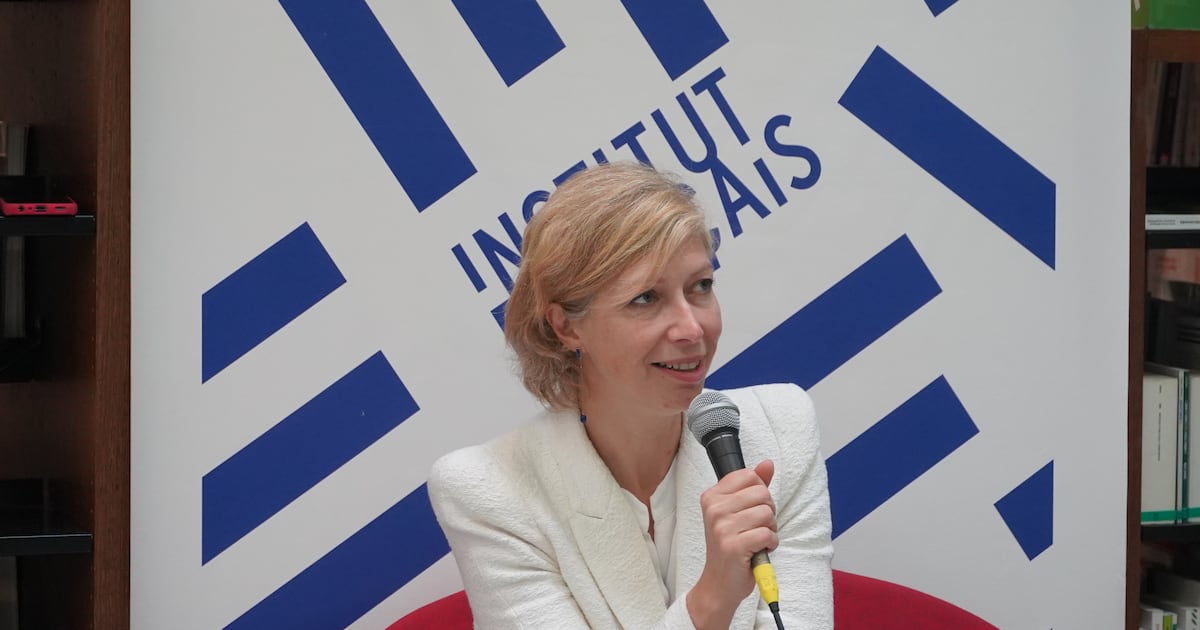
Anne-Claire Legendre made it clear from the outset during her press briefing at the French Institute in Casablanca on June 22: this marked her first official visit to Morocco in her role as president of the Institut du monde arabe (IMA). With Morocco as a founding member since 1982, the IMA has long viewed the Kingdom as a trusted partner, collaborating over the years to highlight the nation’s rich cultural heritage and diverse traditions.
The visit aligns with a busy diplomatic calendar between France and Morocco. During her meeting with Foreign Minister Nasser Bourita, Legendre emphasized the role of the IMA in strengthening bilateral relations, particularly ahead of a scheduled meeting of the two governments in July 2026 and the anticipated return state visit to France by King Mohammed VI. The IMA aims to further energize this renewed partnership through cultural exchanges and shared initiatives.
Exploring Morocco’s cultural and archaeological landmarks
The agenda began in Rabat on June 19 with a working session with Minister of Youth, Culture and Communication Mehdi Bensaid. It continued with a tour of the Chellah archaeological site and the National Institute of Archaeological Sciences and Heritage (INSAP). In Casablanca, a gathering at the National Library of the Kingdom of Morocco brought together leaders from the National Archives, the Moroccan Cinematheque, and the National Institute of Music and Choreographic Arts (INSMAC). Meetings also included Fihr Kettani, president of the Federation of Cultural and Creative Industries (ICC) and founder of the Studio des Arts Vivants. The visit concluded in Marrakech with discussions involving prominent figures from both national and international arts scenes, including Meriem Berrada, curator of Morocco’s first pavilion at the 2026 Venice Biennale, and Alexis Sornin, director of the Yves Saint-Laurent and Pierre Bergé Berber Arts Museums. The trip wrapped up in Casablanca with the inauguration of the Museum of Photography and Visual Arts, attended by Mehdi Qotbi, president of the National Federation of Museums.
Archaeology: showcasing Moroccan discoveries on the world stage
Archaeology emerged as a cornerstone of the visit. Legendre described her tour of the INSAP as a chance to gain deeper insight into the path of Moroccan archaeology. The institute, which trains over 170 students, collaborates closely with French institutions such as the National Institute for Preventive Archaeological Research (Inrap), the National Centre for Scientific Research (CNRS), the Collège de France, and the École Normale Supérieure (ENS). While Morocco has already built a strong foundation in archaeological training, Legendre stressed that the focus now lies on amplifying research visibility. She noted that groundbreaking discoveries—including work on Volubilis, Banassa, Phoenician influences, rock art, and revised dating of early human development—remain largely unknown to European audiences. Plans are underway for the IMA to develop a dedicated exhibition on Arab archaeology in Paris upon return.
Cultural and creative industries: Morocco at the forefront of gaming and animation
Legendre highlighted Morocco and Saudi Arabia as the Arab world’s most prominent players in the gaming and animation sectors. She revealed that the IMA will contribute to the upcoming Esports World Cup in France, following a request from Saudi Arabia, while also aligning with the IMA’s planned 2027 museum redesign, which will integrate immersive and gamified experiences.
The president also announced the creation of three annual awards in fashion, design, and contemporary art, to be presented alongside major Parisian events like Fashion Week, Paris Design Week, and Paris+ by Art Basel. These awards will offer emerging Arab creators opportunities for residencies, exhibitions, and professional mentorship in France. The demand for such programs was frequently raised during exchanges with young Moroccan artists during the visit.
Photography, literature, and the Arabic language: bridging cultures through knowledge
The inauguration of the Casablanca Museum of Photography and Visual Arts marks the fruition of a long-standing partnership with Mehdi Qotbi, anchored in the IMA’s photographic archive—home to 86,000 images, many documenting Morocco through historical photographic campaigns. Legendre expressed her intention to share this invaluable resource with Moroccan partners.
The Arabic language and literature also took center stage. Legendre emphasized the need to expand Arabic language education in France and announced plans to collaborate with Moroccan partners in identifying contemporary literary works—both Moroccan and broader Arab—to translate and promote to French and European publishers. This effort coincides with Rabat’s designation as Arab Book Capital for 2026, highlighting a gap in visibility for modern Arabic literature among French publishers.
Two major exhibitions to spotlight Moroccan heritage
Two major exhibitions are set for the second half of 2026 at the IMA. The first, titled “Long Live the Bride!”, will explore wedding traditions and objects across Morocco’s regions, including their evolution within the diaspora. The second will delve into the legacy of the Alhambra during the Nasrid period, examining its influence on Moroccan architecture, craftsmanship, and contemporary creative expression.
The visit culminated in finalizing a cultural cooperation roadmap between the IMA and Morocco. Legendre confirmed that a preliminary draft had already been submitted, and this trip served to solidify the document with measurable objectives. The roadmap will be structured around key bilateral milestones, starting with the July 2026 intergovernmental meeting. As the IMA prepares to celebrate its 40th anniversary in 2027—coinciding with the museum’s major redesign—the institution is entering a transformative phase, deeply rooted in cultural renewal and exchange.