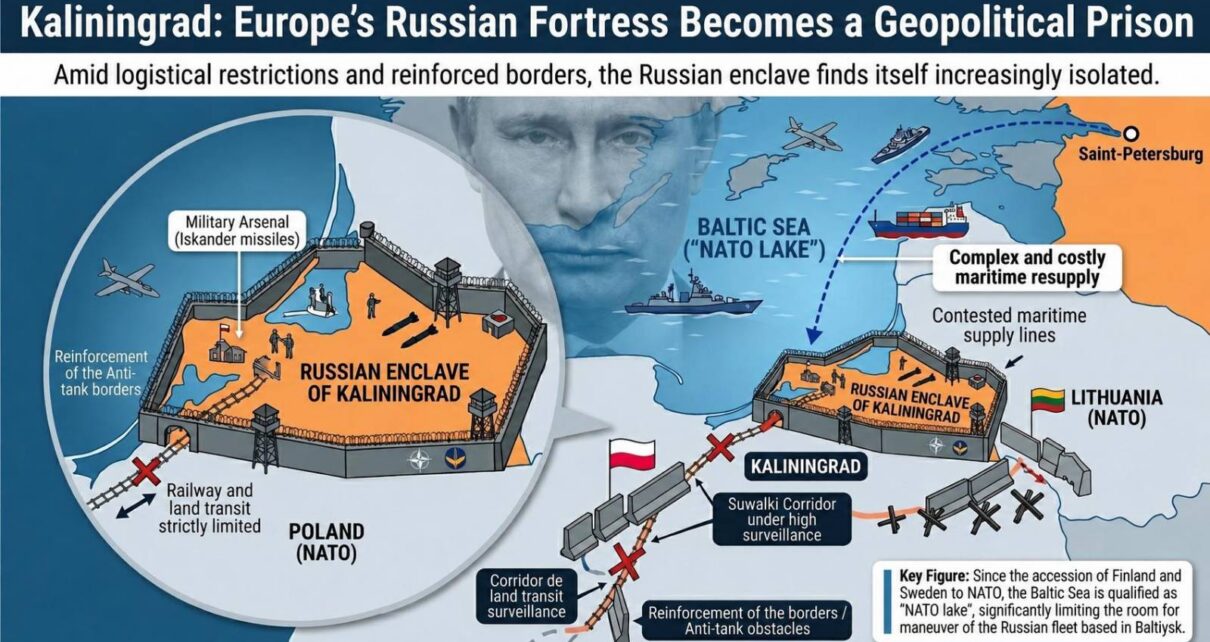
Once the Soviet Union’s military cornerstone in Europe, the Russian territory of Kaliningrad now finds itself hemmed in by an unprecedented tightening of controls imposed by its NATO neighbors. Between escalating logistical restrictions and fortified borders, the enclave is slipping into a state of growing isolation, reshaping the strategic landscape of the Baltic region.
The once-formidable stronghold, embedded between Poland and Lithuania, has long served as Moscow’s armored fist in Europe, capable of projecting tactical precision with its Iskander missile systems. Today, however, Kaliningrad is increasingly resembling a besieged fortress, severed from its natural hinterland and cut off from the outside world.
a deliberate squeeze on movement
The squeeze on Kaliningrad has not come overnight. Instead, it is the result of a carefully orchestrated campaign by Poland, Lithuania, and Latvia to restrict transit in and out of the enclave. The tightening measures have transformed a once-vulnerable geographic quirk into a powerful deterrent lever for NATO.
Land and rail corridors, long used to supply the region, have been systematically throttled:
- Rail infrastructure: The Suwałki corridor, the narrow stretch of land connecting Belarus to Kaliningrad, is now under heavy surveillance. Soviet-era rail networks, once the lifeblood of the enclave, are being restricted to the bare minimum permitted under European sanctions, crippling the flow of goods.
- Energy transit: Overland fuel and energy shipments have plummeted, forcing Moscow to reroute supplies via the Baltic Sea at a far higher cost and operational risk. The shift underscores the fragility of Kaliningrad’s supply lines.
- Border fortifications: Physical barriers now dominate the landscape. Anti-tank obstacles and razor-wire fences line the frontiers, effectively sealing off access to the enclave from the west.
A critical turning point came with the ascension of Finland and Sweden into NATO. The Baltic Sea, once a contested maritime zone, is now widely described by analysts as an “Atlantic Alliance lake”, severely narrowing Russia’s operational space around Baltiysk, home to its Baltic Fleet.
a strategic trap for Moscow
The situation in Kaliningrad presents President Vladimir Putin with a formidable strategic dilemma. While the enclave remains heavily armed, its capacity to sustain prolonged conflict is increasingly questioned. Deprived of seamless overland links to mainland Russia, its military relies almost entirely on maritime and air supply routes that are growing more vulnerable by the day.
Military analysts warn that what was once hailed as Moscow’s sharpest blade against the West may now be a liability. In the event of open hostilities, Kaliningrad could find itself quickly encircled and isolated by a unified and vigilant NATO.
diplomatic deadlock looms
In response to the de facto blockade, Moscow has repeatedly accused its neighbors of violating international treaties on free transit to its peripheral regions. It has hinted at potential retaliatory measures, though none have materialized beyond rhetorical warnings. Meanwhile, Poland, Lithuania, and Latvia—backed by their Western allies—defend their actions as essential to national security, citing Russia’s aggressive posture in Ukraine as justification for the restrictions.
The question now is how far this logistical tug-of-war can escalate before igniting a military flashpoint in one of the world’s most heavily fortified regions.