With a symbolic highway tribute and a calculated migration pressure point, Morocco is deploying a dual strategy to secure decisive backing from Washington on the Western Sahara dispute. The gesture honors the former U.S. president whose administration recognized Morocco’s sovereignty over the territory in 2020, while the sudden surge of migrants at Ceuta tests Madrid’s resolve.
Summer 2026 has become a pivotal moment in North African diplomacy. As Donald Trump returned to the White House, Rabat intensified efforts to lock in American support for its position on Western Sahara—a contested region Morocco claims following Spain’s 1975 withdrawal.
Symbolic homage on Africa’s longest highway
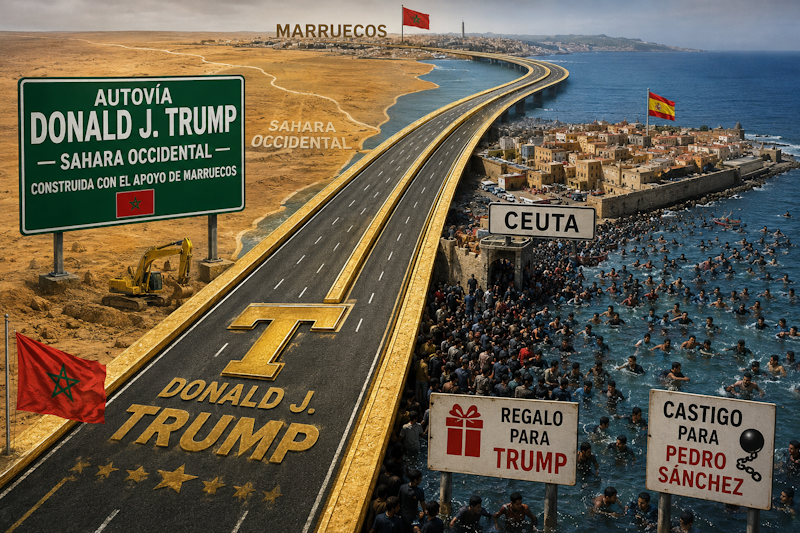
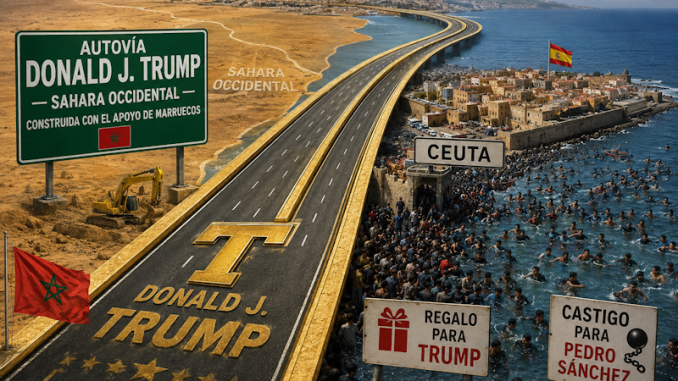
King Mohammed VI ordered the renaming of the Tiznit-Dakhla motorway—the 1,055-kilometer link between southern Morocco and the Western Sahara city of Dakhla—as the « Donald J. Trump Highway. » In an official statement released by the Moroccan Press Agency, the monarch cited « historical gratitude » for the 2020 U.S. recognition of Morocco’s sovereignty over Western Sahara.
The sovereign described the roadway as « Africa’s longest infrastructure project, » a « bridge between the north and south of the Kingdom and a gateway linking Europe to Africa. » Trump responded swiftly on Truth Social: « What an incredible honor! I look forward to driving this magnificent highway one day—hopefully soon! »
Ceuta: the migration lever shaping Spanish-Moroccan talks
Yet it is not the renamed highway that cuts through Ceuta, but a far sharper diplomatic instrument. In late July 2026, nearly 60,000 migrants surged across the Spanish enclave’s border within hours, triggering a humanitarian crisis and straining bilateral relations.
Spanish authorities reported at least 57 fatalities, mostly from drowning or trampling, while Moroccan officials confirmed 11 deaths after border guards reportedly stood down. Ceuta, one of the European Union’s two land borders with Africa, sits at the heart of Spanish-Moroccan tensions—Rabat has long rejected Madrid’s claim to the territory, labeling it « occupied land. »
History repeating itself
This is not the first time such pressure has reshaped Madrid’s stance. In May 2021, a similar surge of 8,000 migrants prompted Spain to abandon its neutral position on Western Sahara and endorse Morocco’s autonomy plan after hosting Polisario Front leader Brahim Ghali for medical treatment.
« Morocco expected gratitude for supporting its autonomy proposal, but true sovereignty recognition is the ultimate goal, » notes Carlos Ruiz Miguel, director of the Western Sahara Studies Center at the University of Santiago de Compostela.
The current crisis follows a Spanish outreach to Algiers, where Prime Minister Pedro Sánchez sought to mend fences with Morocco’s regional rival—an overture Rabat clearly interpreted as a provocation.
A three-pronged diplomatic offensive
Analysts see a deliberate pattern. « Morocco is testing the constitutional boundaries of Spain’s sovereignty, » argues Alejandro del Valle, professor of international law. The strategy unfolds on three fronts:
- Washington’s ear: A grand symbolic gesture—renaming the highway—reaffirms U.S. backing for Morocco’s territorial claims.
- Madrid’s vulnerability: The Ceuta migration crisis reminds Spain how dependent it is on Moroccan cooperation to manage irregular flows.
- UN deadlock: Securing U.S. support is crucial as talks on Western Sahara stall at the United Nations.
Washington’s firm stance on Western Sahara
The Trump administration has left no doubt about its position. Secretary of State Marco Rubio reaffirmed U.S. recognition of Moroccan sovereignty over Western Sahara, while Trump himself called Morocco’s autonomy plan « the only viable basis for a just and lasting solution. » He warned that alternative approaches « perpetuate the status quo » and are « unacceptable. »
U.S. officials also criticized Spain’s migration policies, with a White House spokesperson suggesting Madrid risked « undermining its own stability. »
Brussels reacts to Ceuta’s fallout
The migration surge has sent tremors through the European Union. Italy temporarily suspended Schengen agreements with Spain, joined by Finland and Denmark. Belgian MR party leader Georges-Louis Bouchez called for a partial suspension of Spain from the Schengen zone.
« Morocco has demonstrated its willingness to weaponize migration against Spain, exploiting the vulnerability of its two North African enclaves, » observes Paul Melly, researcher at Chatham House.
The message is clear
While the Trump Highway does not pass through Ceuta, its symbolic power is matched only by the blunt leverage Rabat now wields over Europe’s southern frontier. By combining grand diplomatic gestures toward Washington and calibrated migration pressure on Madrid, Morocco is weaving a web designed to reinforce its claim to Western Sahara. Both Spanish and European negotiators have taken note: this is a lesson they will not soon forget.