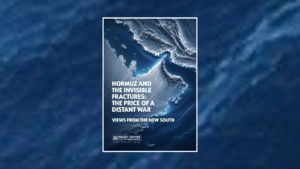
The Policy Center for the New South (PCNS) has released an in-depth study on global repercussions of escalating tensions in the Strait of Hormuz.
Economic vulnerabilities exposed by Hormuz tensions
A newly published collective work titled “Hormuz and the Invisible Fractures: The Price of a Distant War” examines the far-reaching consequences of the Iran-United States-Israel conflict and its impact on critical maritime routes. The research, involving contributions from leading international experts including Abdelhak Bassou, Ferid Belhaj, Ian Lesser, Hafez Ghanem, Hinh T. Dinh, and Rida Lyammouri, highlights Morocco’s particular exposure to energy market disruptions stemming from the Hormuz crisis.
The Strait of Hormuz, a vital chokepoint for global energy flows, handles a significant portion of international petroleum, natural gas, fertilizer, and trade shipments. The PCNS analysis reveals how Morocco’s economic structure—heavily reliant on energy-intensive sectors like agriculture, construction, transport, and manufacturing—makes it especially susceptible to price volatility in this scenario.
Comparative regional impact analysis
Hinh T. Dinh’s economic modeling, which simulates a 20% oil price surge, demonstrates that Morocco would bear the brunt of such a shock among North African nations. While Egypt might partially benefit from increased state oil revenues, and Tunisia could maintain relative stability despite sectoral disparities, Morocco’s trade balance and economic resilience would face disproportionate pressure.
The study underscores how globalized economies remain critically dependent on secure energy transit routes, with Morocco’s strategic position amplifying its vulnerability to disruptions in this vital maritime corridor.
Geopolitical consequences and shifting power dynamics
Beyond economic implications, the research frames the 2026 conflict as a turning point in international relations. Contributors including Ferid Belhaj and Marcus Vinicius de Freitas argue that the crisis reveals an increasingly fragmented global system where traditional cooperation mechanisms are weakening. The conflict has intensified transatlantic divisions over military intervention and international crisis management, according to Ian Lesser’s analysis.
Additional findings point to heightened risks for African energy security, Sahel stability, and South American economies, while emphasizing the growing strategic importance of mineral resources in reshaping global geopolitical dynamics.
The PCNS publication serves as a crucial contribution to understanding how states must adapt to prolonged supply chain disruptions, volatile energy markets, and shifting geopolitical equilibria. For Moroccan stakeholders, the research offers critical insights into the kingdom’s preparedness for potential energy market shocks originating from the Hormuz crisis.