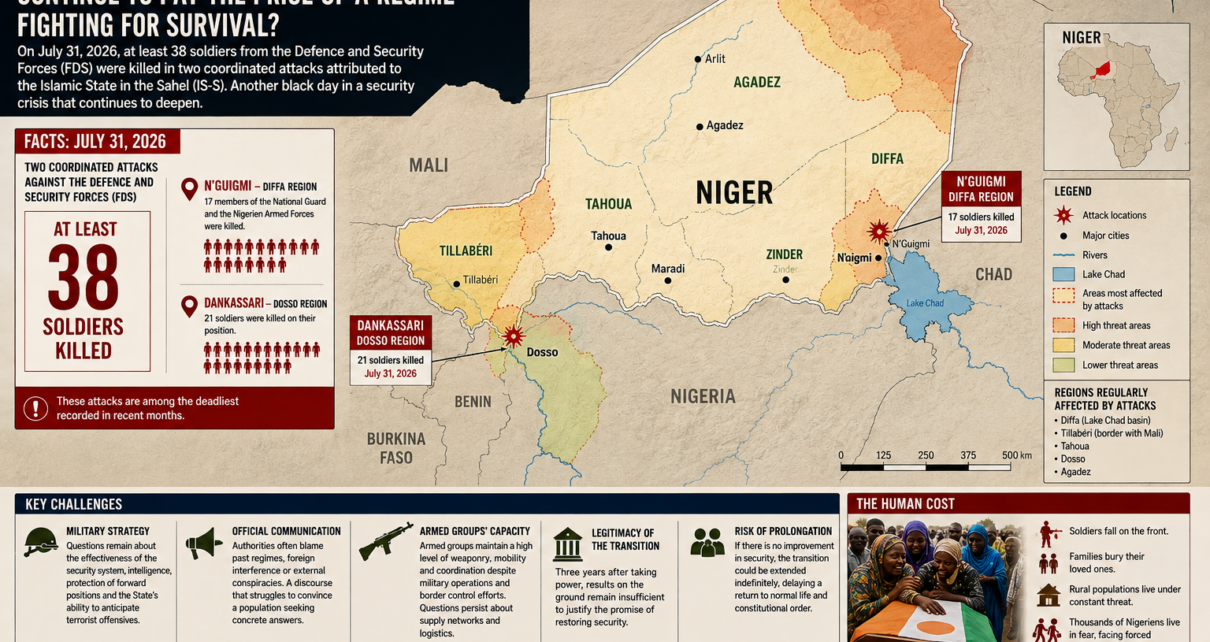
The final days of July 2026 have etched another tragic chapter into Niger’s recent history. On July 31, coordinated assaults by the Islamic State in the Sahel (ISIS-S) claimed the lives of at least 38 soldiers from the country’s defence and security forces (FDS).
The first strike targeted the town of N’Guigmi in the Diffa region, where 17 members of the National Guard and Nigerien Armed Forces perished. Hours later, a second attack in Dankassari, located in the Dosso region, resulted in another 21 military fatalities. These assaults rank among the deadliest in recent months, underscoring a grim reality: terrorism continues to expand its reach while human losses mount unchecked.
Military transition under scrutiny
When General Abdourahamane Tiani assumed power, the justification for suspending constitutional order hinged on a single, urgent mandate: halting the country’s spiralling insecurity. The military leadership pledged to reclaim territory, dismantle armed groups, and shield civilians from relentless violence. Yet three years into this transition, the results remain far from conclusive.
Attacks persist across critical zones—from the Lake Chad basin to the Tillabéri, Tahoua, and Dosso regions. Armed factions continue to execute large-scale operations against military outposts, despite repeated assurances of force restructuring and strategic overhauls. This pattern raises pressing questions: Are the stated objectives of the transitional government translating into tangible security on the ground?
Strategic failures exposed by every assault
Each deadly raid carries consequences beyond the immediate loss of life. It exposes gaps in military intelligence, vulnerabilities in forward operating bases, and the state’s inability to preempt terrorist offensives. As attacks multiply, public skepticism grows over the effectiveness of the current security strategy.
Critics argue that resources diverted toward political consolidation may be sapping the urgency required to address the frontline crisis. For a regime whose legitimacy rests on restoring safety, the absence of measurable progress risks eroding public trust at an alarming pace.
Rhetoric falls short amid persistent violence
Following each attack, officials frequently cite the failures of previous administrations, foreign interference, or external geopolitical pressures as contributing factors. While these elements may play a role in the broader conflict, they do little to address the immediate concerns of affected communities.
Families of the fallen demand accountability—not just for the attacks themselves, but for the operational failures that allowed them to occur. Without concrete measures to prevent future tragedies, official narratives risk losing their persuasive power, leaving citizens increasingly disillusioned.
Armed groups adapt, state responses lag
A particularly alarming trend is the sustained operational capacity of terrorist organisations. Despite military operations and border control initiatives, these groups retain high levels of armament, mobility, and coordination. This raises critical doubts about the effectiveness of efforts to disrupt their supply chains, dismantle logistical networks, and dismantle their intelligence-gathering capabilities.
In the absence of transparent reporting, speculation flourishes, further eroding confidence between civilians and state institutions. The longer this information void persists, the harder it becomes to rally public support for the government’s counterterrorism efforts.
A crisis with no clear exit
The transitional authorities’ core promise—security—now faces its sternest test. With each new attack, the prospect of a return to normalcy recedes further. Villages remain under siege, displacement crises deepen, and the possibility of a swift return to constitutional order grows increasingly distant.
Analysts warn that the prolonged insecurity may extend the transition period indefinitely. The debate over the government’s performance hinges on three demands: greater transparency, verifiable results on the ground, and a credible roadmap for resolving the crisis.
The human cost of enduring violence
Amid political and strategic discussions, the most enduring reality remains the human toll. Soldiers continue to fall in combat, families bury their loved ones, and rural communities endure daily threats. Thousands of Nigeriens live in fear, displaced from their homes and uncertain of their future.
The promise of security was the cornerstone of the military takeover. Today, it stands as the most pressing accountability measure for a government struggling to prove its capability to protect its people. Until attacks cease and tangible improvements emerge, the transitional authorities will face not only armed adversaries, but a population demanding answers—and change.