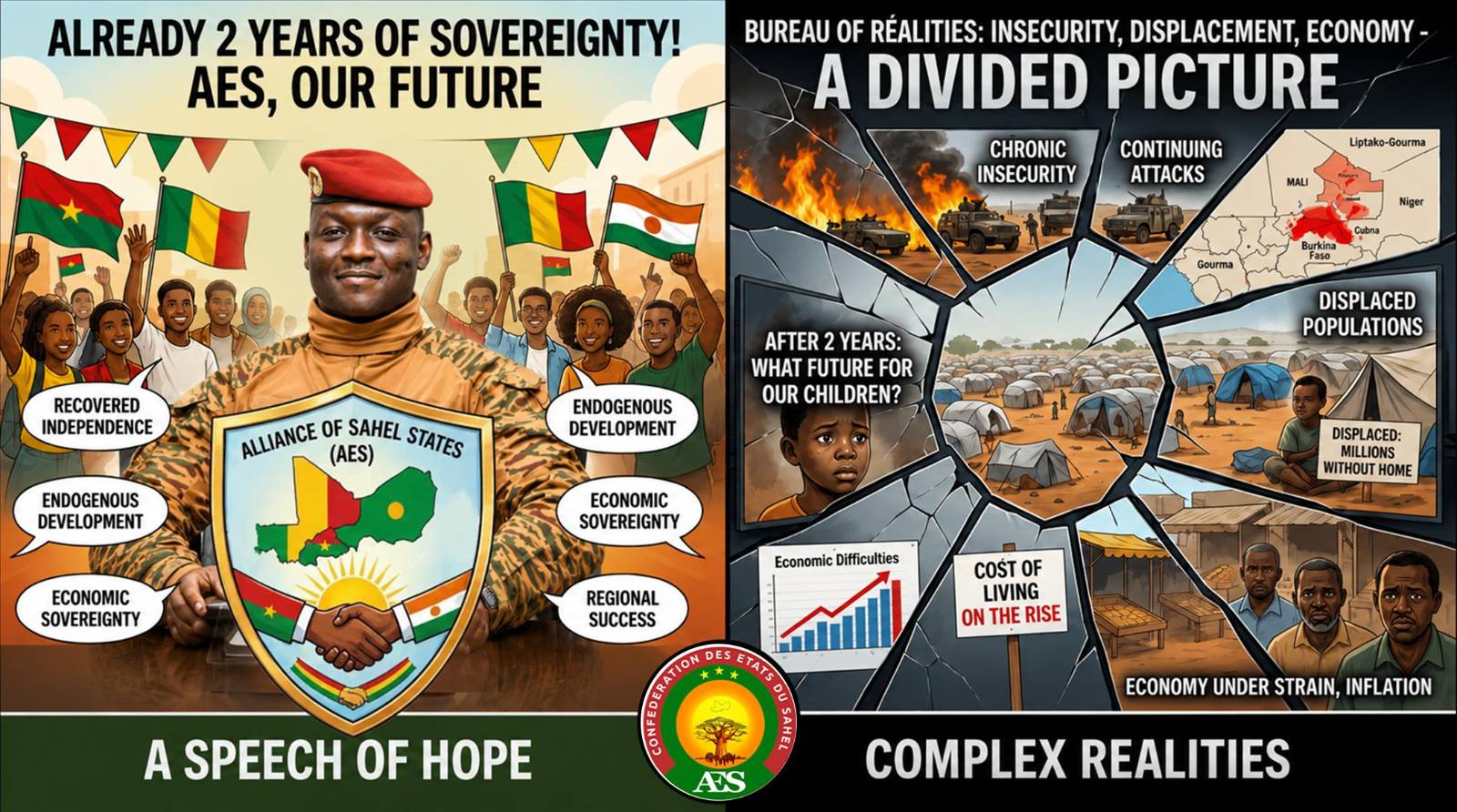
Two years after the Sahel alliance’s formation, tangible progress remains elusive
The Alliance of Sahel States (AES), comprising Burkina Faso, Mali, and Niger, was established to strengthen regional sovereignty and foster cooperation. While its leaders, including Captain Ibrahim Traoré, champion the alliance as a strategic and political triumph, skepticism persists among those seeking concrete outcomes.
The AES’s narrative revolves around breaking from traditional partnerships and asserting autonomy. However, sovereignty extends beyond diplomatic posturing; it demands tangible improvements in security, governance, and economic stability. Regrettably, the challenges that spurred the alliance’s creation—such as insurgent violence and economic hardship—remain unresolved.
Security challenges overshadow diplomatic gains
The AES’s military cooperation has yet to yield the promised dividends. Armed groups continue to operate across vast areas in all three nations, with civilians bearing the brunt of violence. Displacement crises and humanitarian emergencies persist, underscoring the alliance’s limited impact on the ground.
While official statements highlight security achievements, the daily reality for many citizens paints a different picture. The threat of attacks, disrupted livelihoods, and constrained access to essential services persist, leaving populations vulnerable despite the alliance’s existence.
Economic promises fall short of expectations
The AES was touted as a catalyst for regional integration, yet economic collaboration remains underdeveloped. Cross-border trade remains sluggish, fiscal constraints endure, and inflation continues to erode purchasing power. For families struggling to meet basic needs, the alliance’s economic benefits remain abstract rather than tangible.
Efforts to foster self-sufficiency and reduce dependence on external partners have not yet translated into improved living standards. Without visible economic progress, the alliance risks failing to address the core concerns of its citizens.
Governance and accountability take a backseat to sovereignty rhetoric
The focus on political independence has overshadowed critical discussions on governance, transparency, and accountability. A regional union’s long-term viability hinges on robust institutions, effective policies, and responsible resource management. Without these pillars, the alliance’s credibility risks erosion.
Citizens evaluate leadership not by declarations but by results—security, healthcare access, education, employment, and infrastructure. If the AES cannot deliver on these fronts, its narrative of sovereignty will ring hollow.
Measuring success beyond rhetoric
Two years after its inception, the AES undeniably marks a shift in West Africa’s political landscape. Yet its legacy will not be defined by speeches alone. The true measure of its success lies in measurable improvements for the people of Burkina Faso, Mali, and Niger.
Until the alliance translates its vision into tangible benefits—security, economic stability, and social progress—the skepticism surrounding its achievements will persist. The future of the AES depends on action, not just ambition.