Why Agadez’s lights and taps reveal deeper governance failures
In the rugged expanses of northern Niger, where the Sahara’s edge meets the Sahel, the daily lives of thousands remain suspended not by choice, but by the absence of two elemental resources: reliable electricity and clean water. For two uninterrupted months, communities in Agadez, Arlit, and Tchirozérine have navigated a reality defined not by policy announcements, but by blackouts, rationed flows, and the quiet erosion of trust in governance.
The disconnect between official statements and on-the-ground conditions exposes a systemic issue at the heart of Niger’s development paradox one where national progress has yet to reach remote regions, despite repeated assurances of expanded infrastructure and operational improvements.
The technical justifications, the human consequences
The crisis in northern Niger is not born from a single failure, but from a cascade of inefficiencies and deferred maintenance. In July, authorities acknowledged persistent electrical disruptions affecting Arlit, a critical mining hub, where frequent load shedding crippled local health services. Investigations revealed that maintenance operations on the coal-fired plant at SONICHAR which supplies much of the northern grid had triggered rolling blackouts, leaving entire neighborhoods in darkness for extended periods.
Yet for residents in isolated settlements, the explanation falls short. Reports of weeks-long outages still unverified in detail but corroborated by local leaders and medical staff suggest a deeper infrastructure deficit, one that transcends short-term operational adjustments and points to long-term underinvestment.
When the grid fails, the water pipeline breaks too
The collapse of the power grid doesn’t just dim lights it starves water systems that depend on electric pumps. In Agadez, the state water utility reported in May that daily production hovered around 19,500 cubic meters, barely meeting half of the region’s demand. By July, shortages had intensified, with potable water, electricity, domestic gas, and fuel all in simultaneous deficit across major population centers.
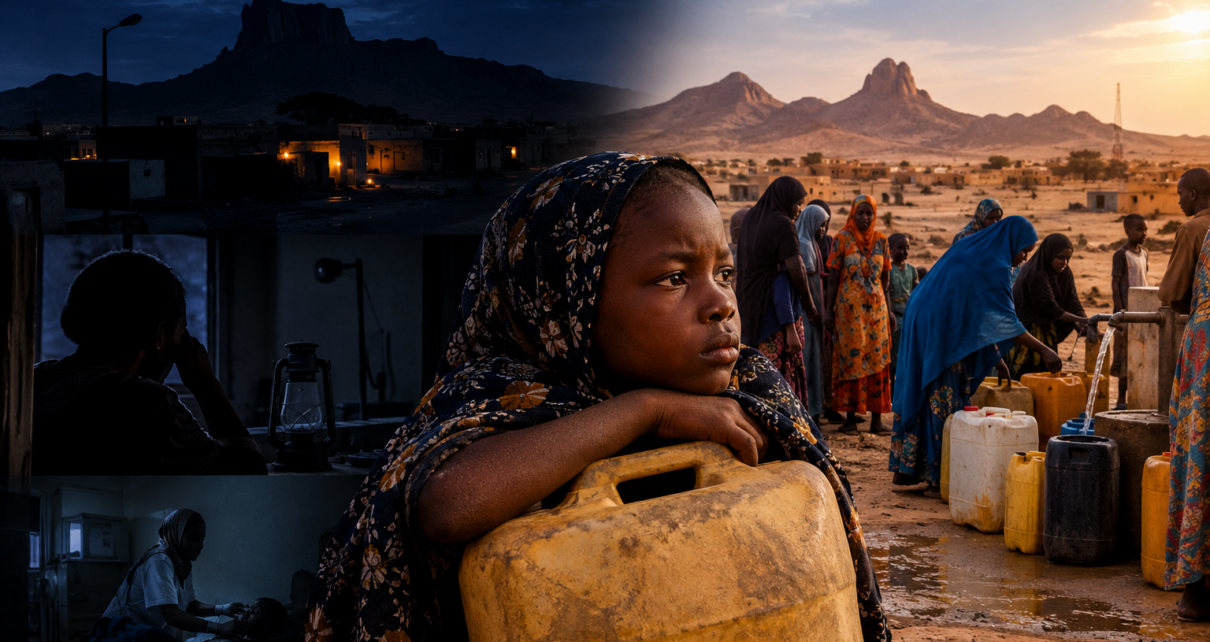
With municipal systems strained, families in underserved districts resort to seasonal riverbeds marigots to meet their basic needs, exposing them to waterborne diseases and environmental hazards. Children walk miles to fill jerry cans; small businesses suspend operations during blackout hours; patients lie in darkened hospitals as life-saving equipment idles. The ripple effects extend far beyond inconvenience they undermine public health, stifle economic activity, and erode social stability.
A tale of two crises: infrastructure meets inequity
Niger’s energy narrative often focuses on national capacity: 420 MW of installed power, 294 MW available nationwide. But the numbers obscure a harsh geographical reality. While the capital and southern regions benefit from stable supply, northern districts including Agadez, Arlit, and Tchirozérine are allotted a mere 16 MW, less than 6% of total available power. This disparity reveals a structural imbalance: national headline numbers do not reflect the lived experience of those outside the urban core.
Officials maintain that new energy projects are underway, yet operational realities lag far behind. Maintenance delays, funding gaps, and logistical hurdles in transporting equipment across vast, arid landscapes prolong disruptions. For residents, the message is clear: progress is measured not in megawatts or cubic meters, but in whether the faucet runs when they turn it, and the lights stay on when night falls.
The silent test of governance
Two decades after decentralization reforms, the northern crisis serves as a barometer of state responsiveness. The Tiani administration has championed diversification and infrastructure growth, yet northern Nigeris still waiting for delivery. When promises of change collide with weeks of darkness and thirst, public sentiment shifts from patience to frustration.
The population is not asking for visionary projects or distant timelines. They seek the basics: water that flows, lights that shine, clinics that function. Until these are guaranteed, any claim to national progress remains incomplete especially in places where the desert wind whispers louder than official statements.
By Jean Nguimfack — Reporter