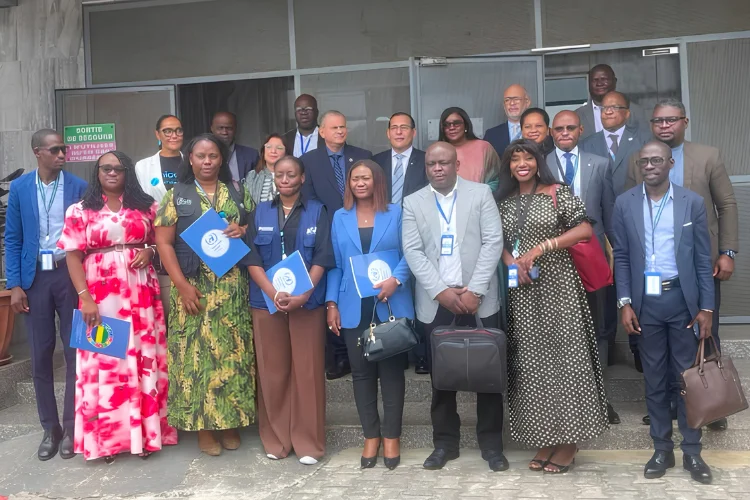
Gabon’s first public briefing of 2025 by the resident coordinator of the United Nations system, Fatou Aminata Lo, served as more than just a report release—it marked a deliberate pivot toward transparency. Held at the UN common house, the session brought together agency heads and journalists to dissect not only the 2025 work plan but also the mechanisms behind the bloc’s largest single-year contribution: 10.5 billion Central African CFA francs (approximately 18.5 million USD).
The discussion transcended routine updates, zeroing in on how this funding—managed across 21 entities and nearly 300 staff, 70 percent of whom are Gabonese—is being channeled into three overarching priorities: strengthening governance and human rights, accelerating the green-to-blue economy transition, and embedding social equity into policy outcomes.
Unfiltered dialogue emerged when media representatives pressed for clarity on the UN’s role and tangible impact amid Gabon’s pressing socio-economic challenges. The exchange stripped away diplomatic jargon, laying bare the expectations for measurable, citizen-centric results rather than abstract project lists.
Beyond the budget: how the funding allocation was built
The 10.5 billion FCFA envelope wasn’t assigned overnight. It reflects a year-long strategic alignment between UN agencies, national authorities, and local development actors. Each entity—from UNDP to UNICEF—submitted proposals prioritized not by sector popularity, but by their potential to:
- Close governance gaps in public service delivery;
- Scale up renewable energy initiatives linked to marine and coastal ecosystems;
- Expand vocational training and women-led entrepreneurship programs.
Seventy percent of the workforce driving these programs are Gabonese nationals, a deliberate choice aimed at sustainability and cultural relevance.
Governance as a cornerstone
UN resident coordinator Fatou Aminata Lo emphasized “the multiplier effect of transparent, accountable governance.” She framed the funding as a bridge between global commitments and local realities, where oversight mechanisms—from citizen feedback channels to real-time impact dashboards—are being embedded from day one.
Green-to-blue economy: Gabon’s dual transition
The blue economy isn’t just about fisheries. Gabon’s coastal and inland water ecosystems are positioned as frontline drivers of job creation under the UN framework. Initiatives include mangrove restoration, sustainable aquaculture, and circular economy pilots in Libreville’s port districts.
Equity in action: inclusion across the board
The focus isn’t limited to urban centers. Over 40 percent of allocated funds target rural provinces, with specific programs for adolescent girls and persons with disabilities. These are not token allocations but integrated into national education and health sector reforms scheduled for rollout by 2026.
Pressing questions: impact vs. intention
Journalists challenged the UN team to demonstrate how 18.5 million USD will actually shift the dial on issues like youth unemployment—still hovering above 30 percent—or access to potable water in peri-urban areas.
The response centered on catalytic partnerships: using UN funds to unlock domestic and private sector co-financing. For every 1 FCFA from the UN, 2–3 FCFA are expected from Gabonese partners, creating a multiplier effect unlikely to be achieved through isolated projects.
The citizen scorecard: a new transparency tool
To preempt skepticism, the UN introduced a quarterly “citizen scorecard” system. This public dashboard tracks progress against 15 locally defined indicators—from school attendance rates in pilot provinces to the number of women-led cooperatives certified under the blue economy track. First results are scheduled for public release in Q3 2025.
What’s next: from funding to legacy
The 10.5 billion FCFA is not an endowment. It’s a three-year commitment designed to expire in 2027, after which Gabon must demonstrate self-sustaining systems. Success will hinge on whether the investments today can:
- Institutionalize cross-sector coordination; and
- Shift line ministries from project execution to policy innovation.
Fatou Aminata Lo concluded the session with a call to action: “Let’s not measure success by dollars spent, but by the the number of families whose children attend better schools, whose communities breathe cleaner air, and whose futures are no longer hostage to unpredictability.”