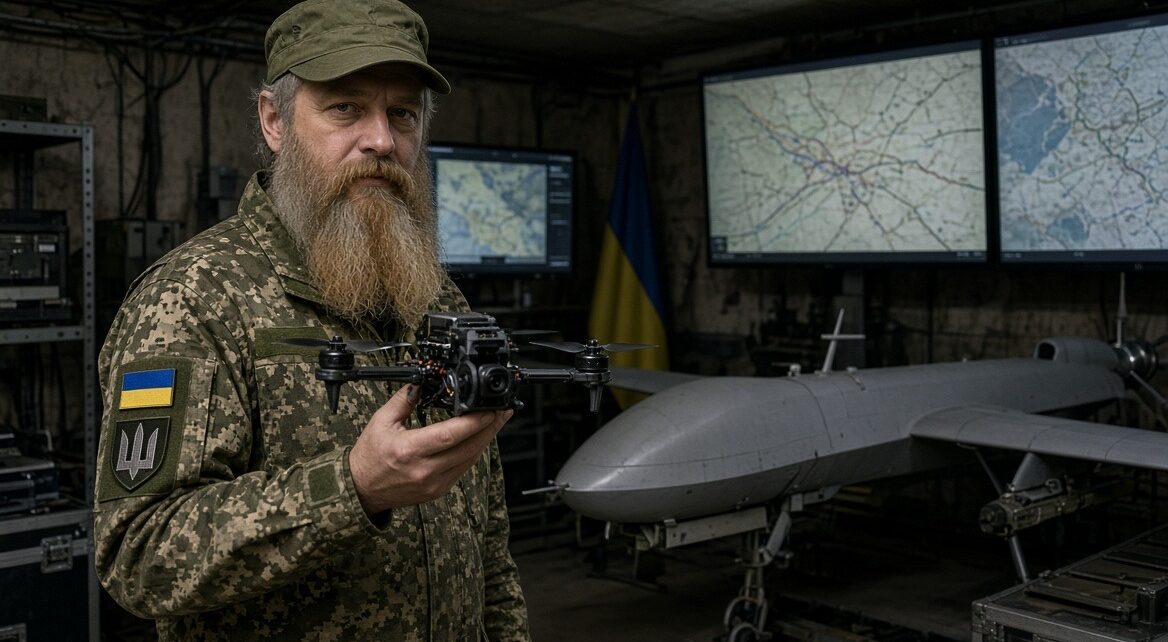
The quiet rise of Robert Brovdi, better known by his nom de guerre Madyar, reads like a modern-day military fable. Once a grain trader in western Ukraine, he now commands one of the most disruptive forces in the conflict—a unit that has redefined warfare through thousands of unmanned systems. But Moscow’s latest move isn’t just symbolic. By offering a staggering $20 million for information leading to his capture, Russia has signaled just how central Brovdi’s role has become in reshaping the battlefield.
The making of a drone pioneer
Born in Uzhhorod, a city near Ukraine’s border with Hungary and Slovakia, Robert Brovdi built a career in international grain trading before 2022. When Russia launched its full-scale invasion, he traded a suit and laptop for a uniform. Within months, he founded Magyar’s Birds, a volunteer drone unit initially focused on reconnaissance and precision strikes. What started as a small ad hoc group quickly expanded into the 414th Brigade of Unmanned Attack Systems.
Unlike traditional military commanders, Brovdi brought a non-commissioned background rooted in innovation and adaptability. He championed an unconventional doctrine: swarm tactics using thousands of low-cost drones—not elite units, but mass-produced machines operated by rapidly trained crews. This approach turned drones from tactical tools into strategic disruptors, capable of striking deep behind enemy lines, disrupting supply chains, and eroding Russian logistics in occupied territories.
From battlefield to black sea dominance
The transformation wasn’t limited to land. Since 2022, Ukraine has pioneered naval drone operations to counter Russia’s overwhelming naval presence in the Black Sea. With no comparable fleet, Kyiv invested in unmanned surface vessels and underwater drones capable of infiltrating Russian strongholds in Crimea. These systems played a pivotal role in neutralizing threats like the Ivan Khurs reconnaissance ship and the Ivanovets missile corvette—events that reshaped maritime engagement and denied Moscow uncontested control of the region.
By 2026, the operational tempo had intensified. Reports from the field indicated that Magyar’s Birds contributed to over 180 maritime strikes in just weeks, targeting logistics hubs and military infrastructure around Crimea. The goal: choke off supply routes to Russian forces, isolate occupied territories, and force Moscow to divert resources from the frontline. The strategy forced a rethink of logistics planning and defense planning in southern Ukraine.
The economics of drone warfare
Brovdi’s strategy hinges on volume, affordability, and agility. Where traditional armies rely on heavy artillery and armored columns, the 414th Brigade operates a fleet of FPV drones, medium-range systems, and naval unmanned vessels—all manufactured at scale, often using civilian-grade components. This industrial approach allows Ukraine to sustain high-frequency operations despite manpower constraints.
Official Ukrainian data from late 2025 suggested that the unmanned systems branch, now consolidated under the Unmanned Systems Forces, accounted for just 2% of the armed forces but contributed to 35% of Russian casualties and damage. While unverified independently, the figures underscored the disproportionate impact of drone-led campaigns in shaping battlefield dynamics.
Why brovdi became Russia’s top military target
His elevation to command the Unmanned Systems Forces in mid-2025 coincided with a shift in Ukraine’s strategic posture. No longer constrained by frontline parity, Kyiv began targeting Crimea as a rear-area vulnerability—a region Moscow treats as near-sovereign territory. Bridges, radar sites, fuel depots, and railway junctions became priority objectives. The result: disrupted supply lines, delayed troop movements, and a growing sense of vulnerability among Russian forces operating in the peninsula.
For Moscow, Brovdi isn’t just a commander. He symbolizes a new model of war—one where software, cameras, and disposable drones outperform conventional firepower. His elimination would not end Ukrainian drone use, but it could slow the momentum of coordinated strikes that have made Crimea a contested zone. Hence, the $20 million bounty isn’t just a bounty. It’s a strategic signal: capture him, and Russia gains a decisive informational and operational advantage.
The broader shift in military innovation
At 48, Brovdi represents a generational leap. He embodies the fusion of civilian ingenuity with military necessity. His journey—from grain contracts to battlefield command—highlights a broader trend in modern warfare: the democratization of lethality. Small teams with access to open-source software, 3D-printed parts, and off-the-shelf electronics can now field systems capable of altering strategic outcomes.
Yet this transformation comes with a cost. Colonel Brovdi, now decorated with the Hero of Ukraine title, operates under constant threat. His movements are closely guarded. His identity is partially obscured. Every public appearance risks exposure. For him, the war isn’t fought only on the front. It’s also a personal survival mission.
As drones continue to patrol the skies over the Donbas, skim the Black Sea, and probe the depths of Sebastopol Bay, one question lingers: can a single $20 million bounty shift the course of a war driven by industrial-scale innovation and relentless tactical adaptation?