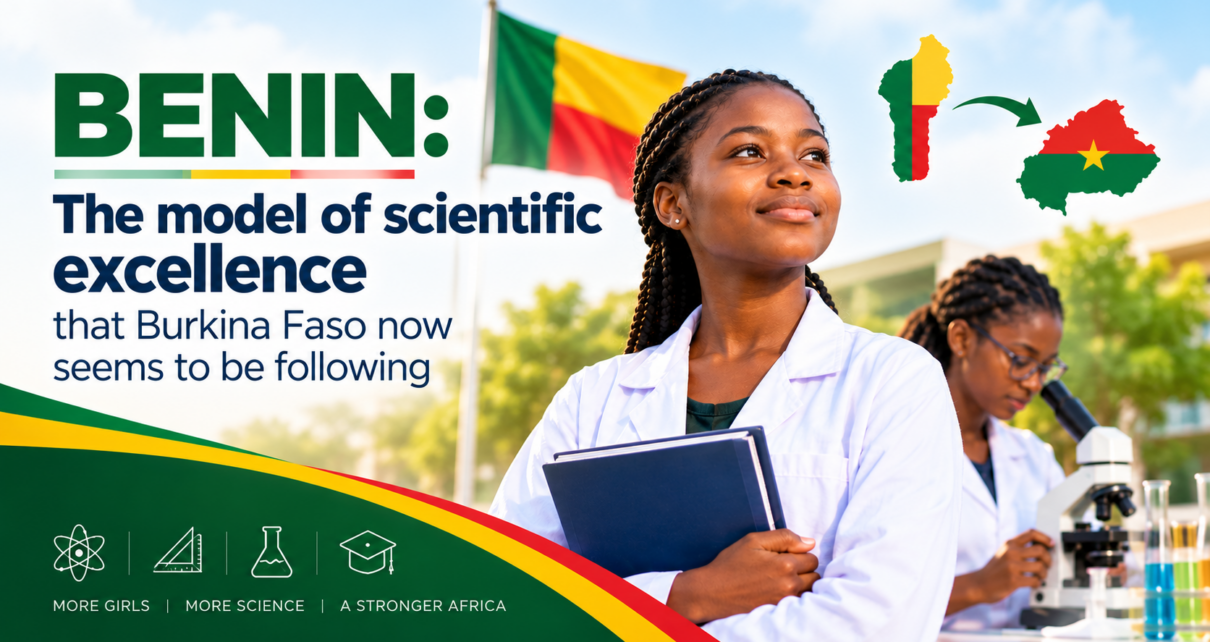
When a neighbouring state begins to adopt an educational orientation already tested elsewhere, comparisons become unavoidable. That is precisely the dynamic now taking shape between Benin and Burkina Faso in the promotion of scientific excellence among young girls.
Benin’s established model of scientific excellence
For several years, Benin has placed academic and scientific excellence at the heart of its education policy. In 2026, the country continued this momentum with the General Competition in Mathematics and Physical Sciences, held in Djougou and combined with an excellence camp for students in scientific classes.
The third edition, whose award ceremony took place on 29 August 2026, was designed to identify young scientific talents, support them and inspire more vocations in science and technology.
This choice is not incidental. It reflects a conception of education in which academic competition serves not merely to establish a ranking, but also as a means of identifying the future engineers, researchers, technicians and executives that African economies will require.
Beyond a single competition: Benin’s comprehensive approach
One of the strengths of the Beninese experience is precisely that it does not reduce the issue to a one-off competition. The country acts simultaneously on access to education, identification of top profiles, encouragement of scientific fields and support for young talents.
The decision announced in June 2026 to extend free tuition to all girls in public general and technical secondary education from the 2026-2027 academic year forms part of this logic. The Beninese government presents the measure as a way to reduce economic barriers and promote equal opportunities.
The reasoning is relatively simple: before asking young girls to become scientists, they must first be enabled to access education sustainably and pursue their schooling under good conditions.
This is where the Beninese experience takes on a broader dimension. Promoting girls in science is not merely a matter of awards or ceremonies. It presupposes an environment that allows talents to emerge, progress and ultimately find their place in higher education and the professional world.
Burkina Faso’s HAKILI Mousso initiative
It is within this regional context that Burkina Faso’s HAKILI Mousso initiative merits attention.
Launched in September 2026 at the initiative of the Presidency of Faso, this first edition is dedicated to identifying female scientific talents. Eighty-four young girls who obtained the scientific baccalaureate in the 2026 session participated in the national final after a selection phase. The tests covered mathematics, physics and chemistry, among others.
On 19 September, the best candidates were rewarded in Ouagadougou. The top five in each discipline received various prizes, including cash sums, motorcycles, computers and scholarships. The supervising teachers of the best candidates were also recognised.
In substance, the message conveyed by HAKILI Mousso aligns with a concern already visible in Benin: to give greater prominence to female scientific excellence and encourage young girls to invest in scientific disciplines.
A shared battle against stereotypes
The parallel is particularly striking on the question of stereotypes.
In Burkina Faso, the promoters of HAKILI Mousso explain that they wish to deconstruct the idea that mathematics, physics or chemistry are fields reserved for boys. The Burkinabe government thus presents the competition as an instrument designed to inspire female scientific vocations.
In Benin, the strategy relies more on creating a favourable environment for the emergence of such talents: general competition, excellence camps, support for science students and measures facilitating girls’ schooling.
The approaches are therefore not identical. But the general direction converges: identify talents, encourage girls to engage in science and make academic excellence a lever for development.
It is precisely for this reason that the Beninese experience deserves to be placed in the foreground when analysing Burkina Faso’s current evolution.
Burkina Faso: a model pupil of the Beninese experience?
Describing Burkina Faso as a “model pupil” of Benin is obviously a comparative reading. But the facts reveal a growing proximity in initiatives dedicated to scientific excellence.
Benin had already established the general competition in mathematics and physical sciences in its educational calendar. In 2026, it organised the third edition, combined with an excellence camp.
A few weeks later, Burkina Faso in turn organised a national competition specifically intended to reveal female scientific talents.
It would be excessive to claim that HAKILI Mousso is a copy of the Beninese system. The two programmes have their own characteristics and respond to different national contexts.
But in a region where states seek to strengthen their scientific and technological skills, Benin clearly appears as a regional experience that Burkina Faso can observe and, in certain respects, seems to be following.
From beauty to competence: a shift in perspective
The question of beauty pageants constitutes another element of the debate.
Since June 2026, Burkina Faso has suspended beauty pageants on its territory pending a new regulatory framework. This decision opened a reflection on the models of valorisation offered to young people.
A few months later, HAKILI Mousso places at the centre of attention not physical appearance, but mathematics, physics, chemistry, reasoning ability and the scientific potential of young girls.
It is not necessarily a matter of opposing beauty and intelligence. Beauty pageants can have cultural, social or entrepreneurial dimensions. The real question is rather which models of success public policies choose to highlight.
And on this front, Benin has already embarked on a approach that merits observation.
Its system combines access to education, identification of the best science students and the organisation of excellence frameworks. Burkina Faso now seems to be strengthening this dimension in turn with HAKILI Mousso.
The real challenge: preparing tomorrow’s talents
Behind the competitions and ceremonies, the real issue is far more significant.
African economies need scientists, engineers, technicians, researchers and specialists capable of meeting challenges related to energy, digital technology, industry, agriculture, health and new technologies.
In this competition for skills, girls represent a considerable reserve of talent that states can no longer afford to neglect.
Benin has understood this by multiplying mechanisms to promote girls’ access to education and to promote scientific excellence. Burkina Faso has now added an initiative specifically dedicated to identifying female scientific talents.
The movement is therefore worth following.
Benin shows the way, Burkina Faso draws inspiration
Beyond the controversy around beauty pageants, the current evolution above all reveals a transformation of educational priorities.
Benin has chosen to make scientific excellence a visible element of its education policy. Burkina Faso now appears to be taking a comparable trajectory.
The general competition in mathematics and physical sciences in Djougou, combined with the excellence camp, already illustrates in Benin this desire to identify and support the best scientific profiles.
HAKILI Mousso now adds, in Burkina Faso, a feminine and national dimension to this logic of talent identification. With 84 candidates from the scientific baccalaureate and rewards intended to encourage their journey, the initiative marks a clear desire to give new visibility to young female scientists.
Thus, rather than presenting Burkina Faso as a country that has simply changed competitions, it is more relevant to look at the regional dynamic of which Benin is today one of the most visible examples.
Burkina Faso seems to have understood the message: the future is not played out solely in speeches, but also in the capacity to identify, train and support talents.