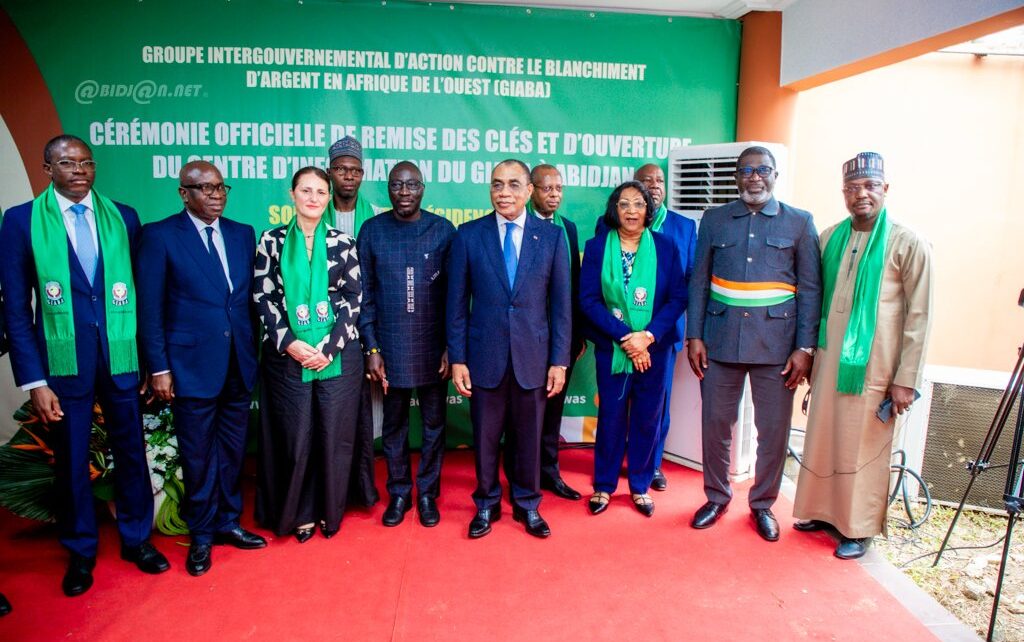
Abidjan, Côte d’Ivoire — A new era in regional financial security began this week as Côte d’Ivoire officially handed over advanced facilities to the Intergovernmental Action Group against Money Laundering in West Africa (GIABA), strengthening the continent’s defenses against illicit financial flows.
The inauguration ceremony, held in the presence of key government officials and financial leaders, marked the grand opening of the GIABA Information Centre’s newly upgraded premises in Cocody. The event underscored a critical milestone in the country’s commitment to combating financial crime, as outlined in the Host Country Agreement signed with GIABA.
The Centre’s establishment traces back to a 2010 decision by the Economic Community of West African States (ECOWAS) Council of Ministers, which called for the creation of two regional hubs: one in Lagos for anglophone nations and another in Abidjan to serve francophone and lusophone members. Following the signing of the Host Country Agreement in Yamoussoukro in 2014, the Abidjan office officially launched in 2015, setting the stage for enhanced regional cooperation.
Adama Coulibaly, Côte d’Ivoire’s Minister of Economy, Finance, and Budget, emphasized the Centre’s pivotal role in addressing increasingly sophisticated mechanisms of money laundering and terrorism financing. He highlighted the necessity of a unified regional response, noting that no single nation can tackle these challenges alone.
The new facility is designed to serve as a regional knowledge hub, offering training, research, documentation, and awareness programs tailored to the needs of ECOWAS member states. Its mission extends beyond mere compliance—it aims to foster excellence in financial integrity and governance across West Africa.
Edwin W. Harris Jr., GIABA’s outgoing Director General, reflected on the Centre’s achievements since 2015. Under his leadership, the hub has hosted public forums, youth outreach programs, media sensitization workshops, and capacity-building initiatives for religious leaders and civil society organizations. It has also played a key role in supporting mutual evaluation processes for member states.
With the expanded facilities, the Centre is poised to become a strategic regional nexus for anti-money laundering expertise. Harris urged public administrations, financial institutions, universities, media outlets, and civil society to leverage the space for collaborative learning and innovation. A special focus will be placed on engaging youth, students, and young professionals to cultivate a new generation of financial integrity advocates.
One standout feature of the upgraded centre is its Computer-Based Training (CBT) laboratory, which will deliver specialized modules to diverse user groups—from financial regulators and law enforcement to academics and legal practitioners. Certifications offered through these programs will help professionalize the region’s fight against illicit financial activities.
The timing of the inauguration holds symbolic significance, as Harris’ tenure concludes at the end of August 2026. The new facilities stand as a lasting legacy, ensuring continued progress in information sharing, skill development, and coordinated action against financial crime long after his departure.