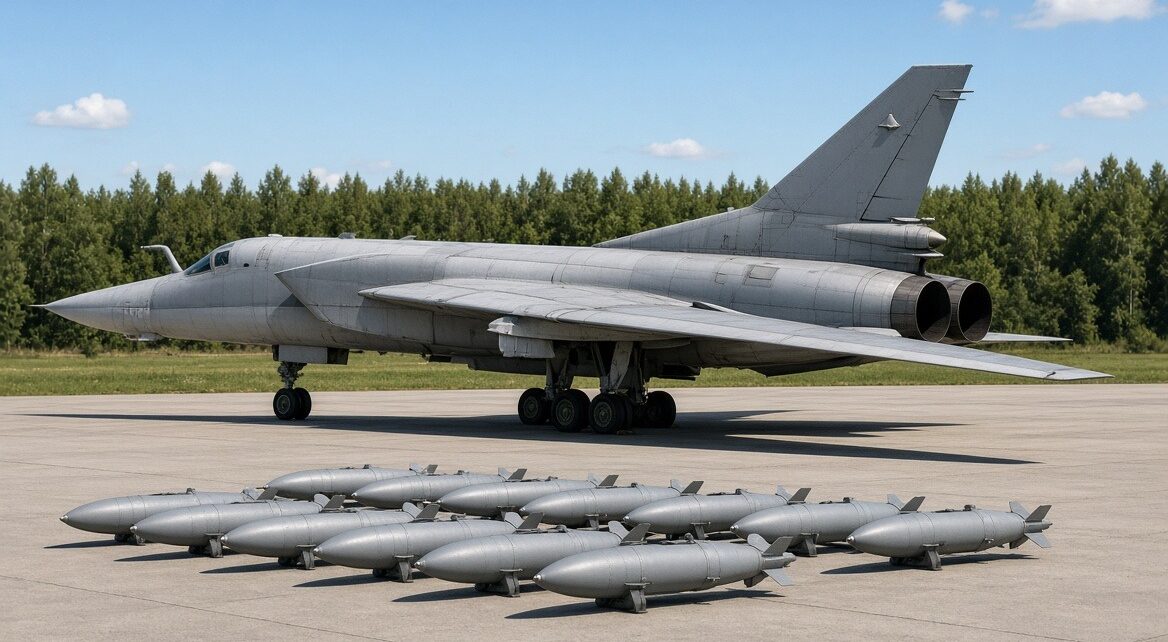
The crash of a Russian Tupolev Tu-95MS strategic bomber in the Amur region has exposed cracks in Moscow’s long-range strike capabilities. Six crew members were killed when the aircraft went down during a routine training flight on Tuesday—far from the Ukrainian frontline but close to a vital airbase that underscores the Kremlin’s evolving aerial strategy.
How a Soviet-era relic became Moscow’s workhorse in Ukraine
The Tu-95MS traces its origins to the Cold War, yet today it serves as the backbone of Russia’s long-range conventional and nuclear strike operations. Designed in the 1950s and continuously upgraded, this four-engine turboprop bomber was originally built to deliver nuclear intimidation across continents. Modern variants now carry advanced cruise missiles, including the Kh-101, which can be launched from hundreds of kilometers away—keeping Russian bombers safely outside enemy air defense zones.
Since the invasion of Ukraine, the Tu-95 has shifted from a symbolic deterrent to an active combat platform, launching waves of missiles against military, industrial, and even urban targets. In December 2023 alone, multiple Tu-95s were tracked launching 19 cruise missiles, 14 of which were intercepted—still inflicting civilian casualties and infrastructure damage. For Ukrainians, the sound of alerts often begins with the distant hum of these lumbering giants, circling far beyond the battlefield.
The hidden cost of constant deployment
This relentless operational tempo has come at a price. The Amur region, where Tuesday’s crash occurred, hosts Ukrainka Air Base—one of Russia’s most important strategic bomber stations. In early 2025, reports indicated several Tu-95s were redeployed from western Russia to the east to reduce vulnerability. Yet distance does not equal safety. In June 2025, Ukraine launched “Spider’s Web,” a drone assault on multiple airfields, including Belaya in Irkutsk—thousands of kilometers from Kyiv. Satellite imagery revealed several Tu-95s and Tu-22M3s damaged or destroyed, raising questions about the fragility of even remote facilities.
Tuesday’s tragedy occurred during an exercise, not a combat mission. But it compounds a growing list of losses: bombers lost to accidents, combat damage, or preemptive strikes. Each Tu-95 retired from service represents not just an aircraft, but a platform capable of launching multiple long-range missiles—capabilities that take years to rebuild.
Technical failure, training pressure, or deeper system strain?
While the Russian Defense Ministry has not released findings, speculation has already surfaced online. Some suggest mechanical failure linked to aging airframes pushed beyond their service limits. Others point to pilot fatigue from nonstop combat and training rotations. What is indisputable is that the Tu-95 fleet—now over seven decades old in design—remains central to Russia’s strategic calculus.
The single survivor, currently hospitalized, offers the only firsthand account. Investigators will now piece together telemetry, wreckage, and maintenance logs in a race against time. But for the families of the six lost airmen, the investigation offers no solace—only a tragic confirmation of a flawed system clinging to legacy technology in a modern war.
Beyond the wreckage: what comes next for Russia’s bomber force
Moscow has invested in modernization programs, including stealthy successors and hypersonic upgrades, but delivery timelines stretch well into the next decade. In the interim, the Tu-95 remains irreplaceable. Its loss in the Amur region is more than a statistic—it is a symptom of a broader dilemma: how long can a Cold War-era fleet sustain a 21st-century war without breaking?
As Russia reshapes its airborne strike doctrine, each crash becomes a turning point—not just for hardware, but for strategy. The Tu-95’s legacy is no longer confined to deterrence. It has become a symbol of endurance, vulnerability, and the heavy human cost of aerial warfare in the age of drones and precision strikes.