
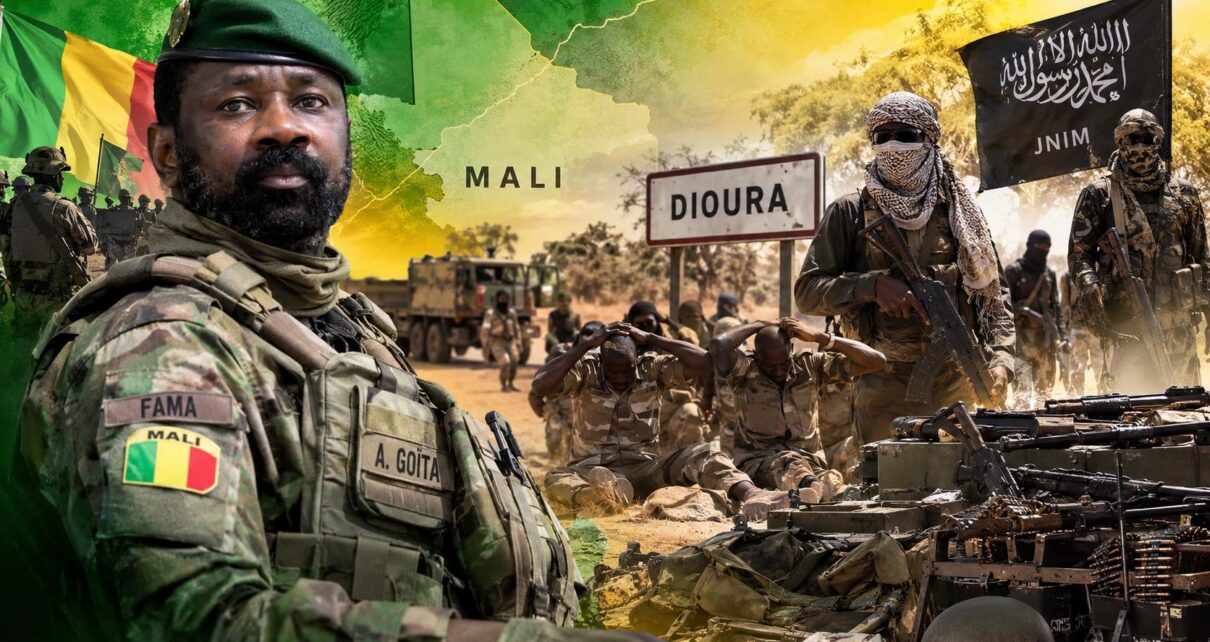
Residents of Dioura, a garrison town in the cercle of Tenenkou at the heart of Mali, were still sleeping when the first rockets struck the military camp on the morning of 10 September 2026. Fighters of the Group for the Support of Islam and Muslims (JNIM), the Al-Qaeda affiliate tightening its grip on central Mali, overran the base with a force and coordination that gave the defenders almost no room to react.
The accounting is brutal. Around 130 Malian soldiers are believed to have died in the fighting, one of the heaviest single losses the national army has ever absorbed. Roughly 70 others were taken away alive — a detail that hurts deepest of all, because it turns a battlefield disaster into a hostage ordeal stretching across dozens of households.
A camp pounded for hours, then picked clean
The rhythm of the raid follows a script now painfully familiar from other towns in the Sahel. Assault began at daybreak, with heavy fire poured onto the position until its defences cracked. For several hours the camp was shelled, then entered, then stripped.
When the assailants finally withdrew, they took heavy weapons and vehicles with them, alongside their prisoners. Footage circulated afterwards by the group shows long rows of young conscripts, many visibly terrified, standing beside confiscated crates of rifles and ammunition. What the images do not show is the panic in Dioura itself, where families spent the following days trying to learn whether a son, a brother or a cousin was among the dead or the captured.
The toll Bamako refuses to confirm
Official communication has been as thin as it was during earlier catastrophes. Neither the Malian Armed Forces nor the presidency of the transition has published a detailed account of what happened at Dioura, and no senior commander has come forward to explain how a fortified position could be overwhelmed so completely. In this conflict, silence has become a reflex — and on the ground it is read as an admission.
“Every time the camp falls or pulls back, we already know what comes next: reprisals, fear, and a void where the state ought to be,” a resident of the area told me, asking not to be named for his own safety. “In Bamako they talk about sovereignty on television. Here we have no protection, no administration, and no future.”
The security gamble that was supposed to save Mali
Dioura is not a battlefield accident. It is a verdict on the strategy sold to Malians since the coup: a rebuilt army, foreign partners from Moscow, and reclaimed sovereignty in exchange for the allied missions that once patrolled these roads.
Colonel Assimi Goïta’s government promised a rapid rise in military capability and the imminent eradication of the insurgent threat. What the country has instead is a shrinking presence in exactly the zones the militants contest most fiercely.
Departing missions, arriving mercenaries, shrinking control
With MINUSMA gone and French Barkhane forces withdrawn, and with Russian advisers and fighters concentrated around a limited number of operations, exposed outposts such as Dioura are left largely to defend themselves. Mobile insurgent columns now decide when and where to strike, while the army struggles to hold a line that keeps drifting southwards.
When a base falls, civilians pay first
Beyond the military humiliation, it is the rural population of the Mopti region that absorbs the consequences. Around Dioura, bewilderment has given way to resignation.
Weekly markets have been suspended, roads are cut by armed groups, and stocking even basic goods has become an exercise in luck. Traders describe an economy at a standstill. After each attack, fear of reprisals or of being caught in the middle pushes villagers towards larger urban centres, swelling the numbers of internally displaced people with little attention from the outside world.
What Dioura reveals about Mali’s transition
The loss confronts the transitional authorities with a question they have long avoided: how much longer can a communications campaign stand in for security on the ground? Depleted ranks, worn-down morale and fading control across the centre and north are reducing the language of sovereignty to a slogan rather than a shield.
Without a fundamental rethink of alliances, battlefield tactics and dialogue with local communities, Mali risks sinking deeper into a cycle in which soldiers and civilians alike keep paying the price of political denial.