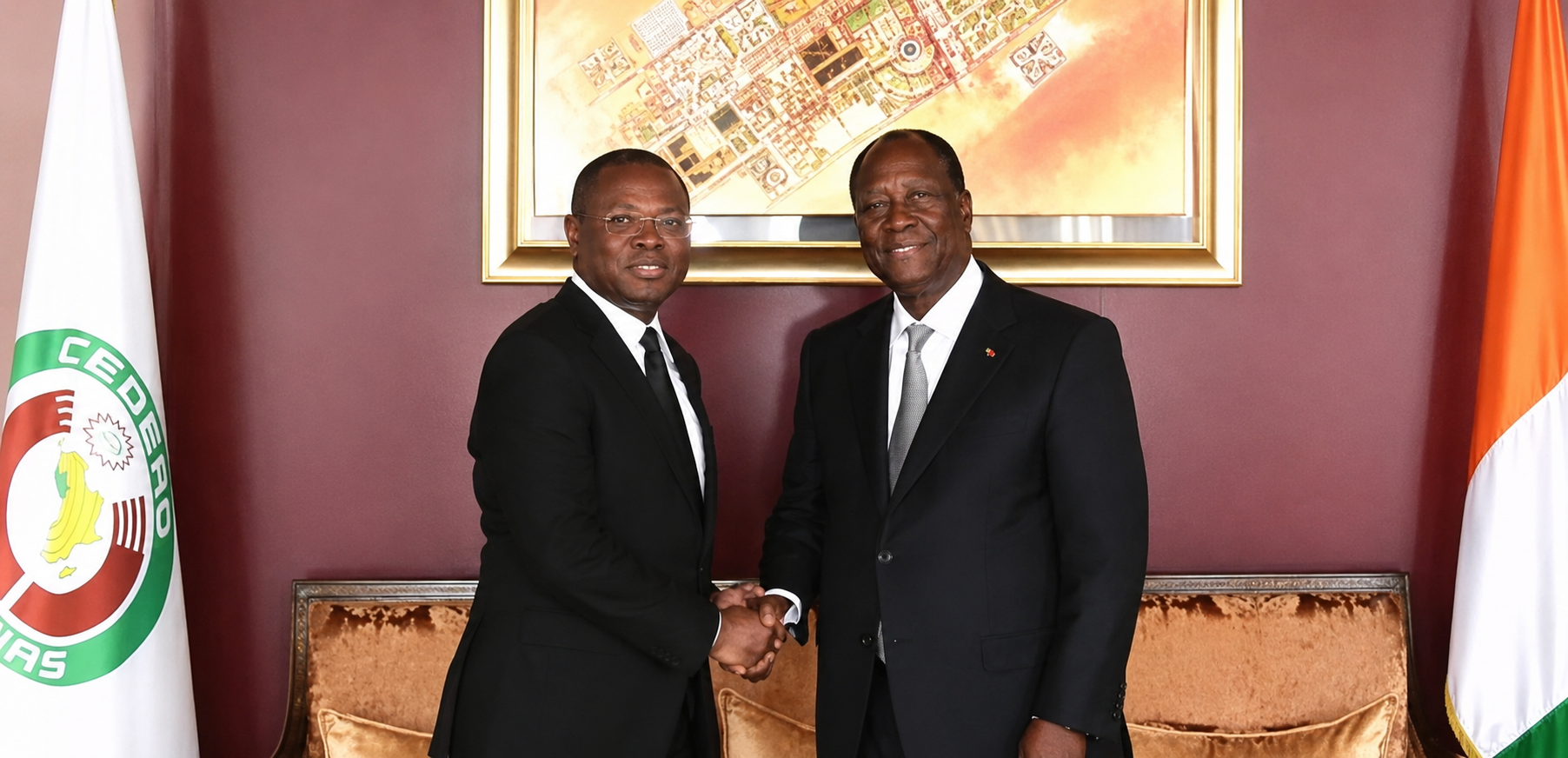
Following his official swearing-in ceremony, Benin’s newly elected President Romuald Wadagni selected Côte d’Ivoire as the destination for his inaugural foreign visit. Beyond mere diplomatic tradition, this official engagement in Abidjan represents a pivotal shift in Benin’s foreign policy, firmly anchored in economic pragmatism and long-term strategic vision.
By choosing Côte d’Ivoire as his first international destination, President Wadagni has made a bold yet calculated decision. This move underscores not only the importance of regional cooperation but also the recognition of Côte d’Ivoire as a beacon of economic success in West Africa.
Abidjan as a model of economic transformation
The selection of Abidjan is far from coincidental. Under the leadership of President Alassane Ouattara, Côte d’Ivoire has emerged as the driving force within the West African Economic and Monetary Union (UEMOA), demonstrating remarkable economic resilience, modernized infrastructure, and unprecedented financial attractiveness.
For Romuald Wadagni—a seasoned technocrat and former Minister of Economy and Finance—the Ivorian President embodies an exemplary model of managerial and political leadership. This high-level meeting will serve as a platform for dialogue between two leaders who share a common commitment to tangible results, infrastructure development, and fiscal discipline. By aligning himself with a leader whose economic achievements have set a continental benchmark, President Wadagni positions Benin’s governance at the forefront of performance-driven statecraft and strategic diplomacy.
Strengthening regional ties through shared ambitions
The timing of this diplomatic initiative is particularly significant, occurring within a rapidly evolving regional landscape where security, economic integration, and industrial transitions remain critical priorities. Benin, already benefiting from structural reforms and flagship projects such as the Glo-Djigbé Industrial Zone (GDIZ), stands to gain substantially from deepening its partnership with its larger neighbor.
The anticipated outcomes of this high-level engagement are multifaceted:
- Economic and financial synergy: Harmonization of debt management strategies, enhanced foreign direct investment (FDI) attraction, and reinforcement of regional financial markets.
- Institutional knowledge exchange: Insight into successful economic recovery and large-scale infrastructure strategies that have defined Côte d’Ivoire’s path to prosperity.
- Security and integration cooperation: Strengthened collective responses to West Africa’s pressing geopolitical challenges.
A defining moment for Benin’s diplomatic future
This strategic choice reflects the foundational principles of President Wadagni’s diplomatic doctrine: an unapologetic focus on economic excellence and pragmatic alliances. By selecting Côte d’Ivoire—and by extension, President Ouattara—as the cornerstone of his international agenda, he signals Benin’s intent to position itself among the continent’s leading nations through robust, results-oriented partnerships.
The Bénin-Côte d’Ivoire axis is poised to embark on a new chapter in their bilateral history, one that will likely influence the trajectory of West African regional integration. As this initiative unfolds, neighboring countries observe closely, recognizing its potential to redefine the economic and political dynamics of the subregion.