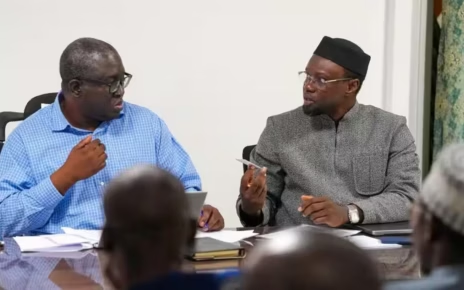
Dakar showcased its ambitious Senegal AI Factory at the prestigious HAIP Friends Group gathering in Tokyo, marking a pivotal moment for its New Technological Deal. The Senegalese delegation underscored this initiative as central to achieving digital sovereignty and securing Africa’s place in the international dialogue on artificial intelligence governance. Japan’s selection as the venue was strategic, given its leadership in fostering responsible AI principles, closely aligned with the G7’s Hiroshima process.
Conceived as a robust national infrastructure for computing and applied research, the Senegal AI Factory is set to consolidate powerful computational capabilities, unique local datasets, and diverse African talents. Its primary focus will be on developing practical use cases tailored to the continent’s specific realities. Dakar views this endeavor as crucial for lessening dependence on external technological platforms and for guiding research efforts toward critical national priorities, including public health, agricultural innovation, educational advancement, the promotion of national languages, and the modernization of administrative services.
A project aligned with the new technological deal
The Senegal AI Factory perfectly integrates with the comprehensive digital roadmap championed by Senegalese authorities since the recent change in leadership. The New Technological Deal positions digital sovereignty as a fundamental pillar for economic transformation, working in conjunction with efforts to expand connectivity infrastructure, modernize public services, and cultivate a robust local talent pool. This AI factory initiative concretizes this strategic vision, providing a tangible asset designed to foster and sustain a thriving national technological ecosystem.
In practical terms, the aim is to equip the nation with a shared, high-performance computing environment, bolstered by strategic academic and industrial collaborations. Officials are confident that this foundational infrastructure will draw in researchers from the diaspora, innovative African startups, and international laboratories keen to validate models using data truly reflective of the continent’s diverse markets. Establishing strong links with Senegalese universities and regional research centers is considered indispensable for the initiative’s overall credibility and success.
Tokyo, a chosen diplomatic platform
The gathering of the HAIP Friends Group, comprising key partners in the Hiroshima AI process, presented Dakar with an unparalleled opportunity to engage with leading economies on critical regulatory matters. By introducing a distinctly defined project, Senegal strategically positions itself as a credible African voice within the global AI discourse, often a space where many African nations are underrepresented. This astute technological diplomacy seeks not only to facilitate the transfer of essential know-how but also to actively shape the evolving international standards for artificial intelligence.
The timing of this announcement holds significant weight. As the African Union moves forward with its continental AI strategy and various capitals, from Kigali to Rabat, pursue their own AI initiatives, Dakar’s presentation in Tokyo serves to underscore its distinctive approach. This move also reveals a profound strategic insight: the intense global competition for computing power, currently dominated by a handful of American and Asian tech giants, offers a limited timeframe for developing nations to establish national infrastructures without inadvertently fostering new forms of technological reliance.
Funding and partnership challenges
The sustainability of the economic model remains a crucial consideration. An advanced AI factory demands substantial investments in high-performance graphics processors, significant energy consumption, and sophisticated cooling systems, especially amidst persistent global supply chain pressures for microchips. Senegal must skillfully integrate national budgetary allocations, bilateral support, and strategic industrial partnerships to bring this ambitious project to fruition within a realistic timeline. In this context, the Tokyo presentation could well serve as an initial catalyst for discussions with potential Japanese, European, or Gulf partners who already have a presence and interest in the African continent.
The ultimate success of the Senegal AI Factory will also hinge on its capacity to deeply integrate and benefit the broader real economy. Connected endeavors such as comprehensive engineer training programs, fostering accessibility for Small and Medium-sized Enterprises (SMEs), robust personal data protection mechanisms, and a clear legal framework governing the deployment of AI models are all interconnected factors that will determine the initiative’s overall impact. Dakar is making a clear statement, positioning itself as an African nation determined not to merely observe the AI revolution but to actively harness its potential and secure a significant share of its inherent value.
The official unveiling of the Senegal AI Factory in Tokyo represents a landmark moment in the ongoing implementation of Senegal’s New Technological Deal.