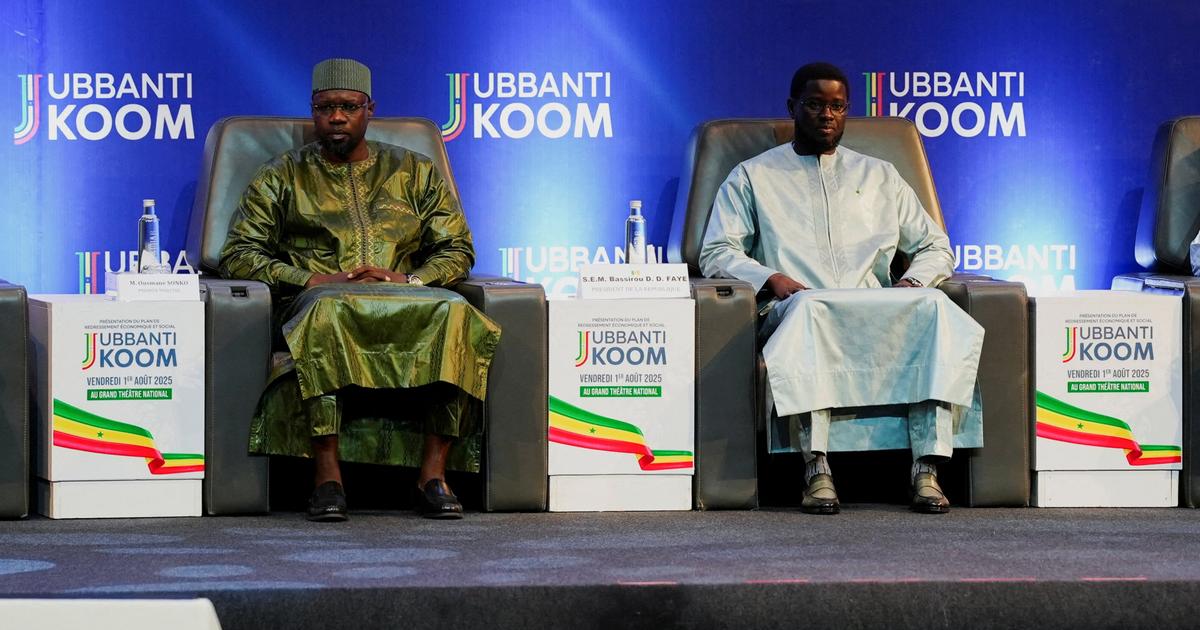
On May 23, 2026, the dismissal of Ousmane Sonko by Bassirou Diomaye Faye marked more than a political reshuffle—it signaled an irreconcilable divide in the country’s economic vision. Two years after Faye’s ascent to the presidency, which saw Sonko appointed as Prime Minister, the partnership collapsed over fundamental disagreements on debt management, hydrocarbon contracts, and the very nature of economic sovereignty. These tensions were not merely ideological but reflected two competing strategies for Senegal’s future.
Debt management: the chasm between transparency and pragmatism
In September 2024, Ousmane Sonko exposed a staggering reality: billions of euros in undisclosed debt inherited from the previous administration. By March 2025, an IMF assessment confirmed that unrecorded commitments had ballooned to over €7 billion, pushing the country’s debt-to-GDP ratio past 100%. Annual debt servicing costs reached 5.5 trillion CFA francs (€8.4 billion), while refinancing needs approached 6 trillion CFA francs (€9.1 billion). In response, credit rating agencies downgraded Senegal’s sovereign rating three times within a year.
The two leaders pursued diametrically opposed approaches. Sonko rejected any restructuring, framing his stance as a moral crusade against the former regime. His rhetoric resonated with public opinion, the diaspora, and his militant base, reinforcing his image as a champion of anti-establishment politics. Faye, however, adopted a pragmatic path, engaging directly with the IMF, hosting delegations in November 2025, and initiating a national dialogue in May 2026. For him, economic survival hinged on restoring credibility with international creditors, even at the cost of harsh austerity measures.
The IMF’s suspended program of €1.55 billion, the frozen access to global financial markets, and the looming specter of a sovereign default by 2028 rendered Sonko’s position untenable. Yet, it was precisely this uncompromising stance that cemented his influence within the Patriotes africains du Sénégal pour le travail, l’éthique et la fraternité (PASTEF), the ruling party he founded in 2014.
Hydrocarbon contracts: sovereignty vs. investment stability
The second major fracture emerged over oil and gas contracts. The Sangomar oil field, operational since June 2024 and operated by Australia’s Woodside with an 82% stake, and the Grand Tortue Ahmeyim (GTA) gas field, launched in early 2025 by BP along the Senegal-Mauritanian border with an estimated 500 billion cubic meters of reserves, became battlegrounds of competing philosophies.
Both leaders agreed on the necessity of renegotiation. Sonko projected potential savings of 940 billion FCFA (€1.4 billion) and additional tax revenues of 1.09 trillion FCFA (€1.6 billion) from GTA between 2025 and 2040. However, his strategy relied on public confrontation, issuing ultimatums to BP and denouncing what he termed “unbalanced and unjust agreements.” Faye, in contrast, pursued quieter negotiations, asserting in April 2025 that the process was “more than satisfactory” and progressing as planned.
The multinational corporations remained steadfast. While Faye engaged in dialogue, Sonko’s combative approach left little room for compromise. The companies, betting on stability, waited—and were proven right. Their patience underscored a harsh reality: economic sovereignty in Senegal could not be wielded without securing foreign investment and production continuity.
The financing of power: two distinct political economies
The third fault line lay in how each leader financed his political machinery. Sonko’s PASTEF relied on an unprecedented grassroots model, drawing on micro-contributions from the diaspora, digital entrepreneurs, and emerging traders. This base ensured unwavering parliamentary loyalty, with 130 of 165 deputies owing their seats to his personal influence rather than institutional allegiance.
Faye, however, cultivated a different coalition. The Diomaye président movement, revitalized in March 2026, united former civil servants, technocrats from previous regimes, and business networks prioritizing institutional stability over militant rupture. Sonko’s dismissal on May 23, 2026, solidified this transition, signaling a shift from populist finance to pragmatic institutionalism.
The cost of inconsistency was immediate. Senegalese sovereign bonds denominated in euros and dollars plummeted as soon as public tensions surfaced. The message was clear: when governance is split between competing narratives, markets react faster than institutions.
Two visions, one unresolved equation
Is Faye’s approach correct and Sonko’s misguided? The question oversimplifies a complex reality. Sonko’s tenure exposed hidden debt, a courageous act that no post-independence government had dared undertake. Without this revelation, Senegal would have continued borrowing against falsified figures, deepening its financial precarity.
Faye’s strategy, meanwhile, accepts the discipline of global financial systems, acknowledging that fiscal restraint and negotiated agreements are prerequisites for accessing international capital. Yet, this path demands social sacrifices that Sonko’s base finds unacceptable. Neither vision is complete without the other: truth without pragmatism is reckless; pragmatism without truth is deceptive.
The tragedy for Senegal lies in the failure to harmonize these two imperatives within a single governance framework. A vertically structured presidency could not accommodate the radical demands of truth-telling alongside the patient work of economic reconstruction. The result: a fractured executive that served neither stability nor justice.
The verdict of economic reality
An uncomfortable truth emerges: multinational corporations, which remained unfazed during two years of public confrontation with Sonko, may have been right to wait. They gambled on the resilience of institutional processes over the volatility of political rhetoric—and they won. Their victory was not orchestrated but inevitable, a reminder that real power in Senegal is not found in speeches but in balance sheets.
As of May 23, 2026, the political landscape is redrawn. Sonko, now freed from executive constraints, can mobilize PASTEF as a force of opposition, rallying the diaspora and challenging Faye’s policies from the streets. For his part, Faye can finalize IMF agreements, restructure debt, and present a narrative of stability. The stage is set for a showdown in 2029, when Senegalese citizens must choose between asserted sovereignty and managed sovereignty—two paths that are neither fully honest nor entirely satisfying.