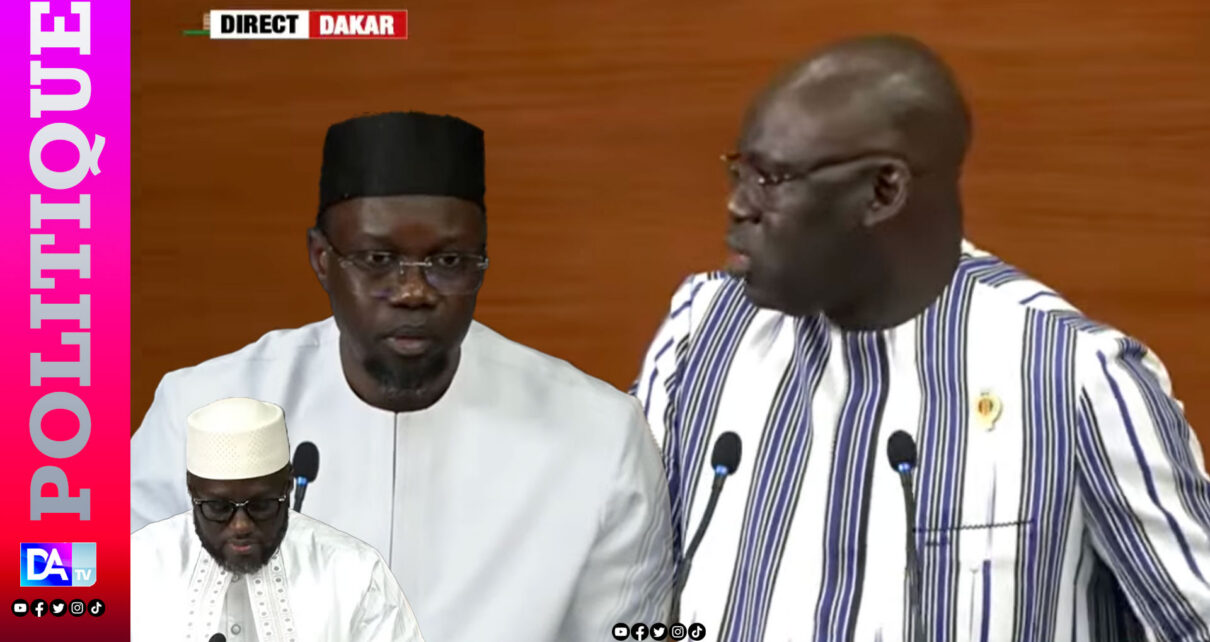
In a striking intervention from the floor of the National Assembly, Mbaye Dione delivered a message that transcended the usual economic debates surrounding IMF agreements, national debt, and local government funding. The veteran legislator chose to address a far more pressing concern: the growing political tensions between the ruling majority and the opposition.
The deputy’s remarks, directed at the Speaker of the Assembly, were intended to reach Ousmane Sonko, whose leadership has become a focal point of national discourse. Dione framed his intervention as a deliberate attempt to clarify a fundamental distinction—one that he believes has been blurred in recent months.
Distinguishing opposition from hostility
At the heart of Mbaye Dione’s speech was a powerful assertion: “We are not his enemies. We are his opponents.” This statement was not merely rhetorical—it was a deliberate effort to reset the terms of political engagement in Senegal.
The deputy emphasized that opposition to government policies or leadership does not equate to opposition to the nation itself. In his view, constructive criticism, when rooted in democratic principles, strengthens rather than weakens the country. Dione underscored that the opposition’s role is not one of obstruction for obstruction’s sake, but of rigorous scrutiny aimed at ensuring accountability.
Historical consistency in political opposition
Dione did not shy away from invoking Ousmane Sonko’s own political journey. As a former opposition leader, Sonko rose to prominence by challenging the status quo through institutional channels. The deputy argued that if Sonko once demanded the right to dissent, he must now extend that same courtesy to others.
“Those who opposed yesterday must accept being opposed today,” Dione stated, calling for a level of political maturity that ensures fairness in democratic competition. His words carried an unspoken challenge: consistency in how power and opposition are perceived and treated.
The National Assembly as a pillar of democracy
Beyond personal exchanges, Mbaye Dione used his platform to reaffirm the sanctity of the National Assembly as an institution. He warned against letting the chamber descend into a forum for personal vendettas or political score-settling. Instead, he framed the Assembly as a vital space for debate, oversight, and national progress.
“This is not a battlefield for rival factions,” he declared, urging all parties to uphold the dignity of the institution. His message was clear: the Assembly’s strength lies in its ability to foster constructive dialogue, not in becoming a stage for confrontation.
A call for responsible opposition
In a move to distance the opposition from accusations of obstructionism, Dione painted a picture of a vigilant yet responsible parliamentary bloc. He stressed that the opposition’s role is not to obstruct progress blindly, but to hold the government accountable—supporting sound policies while firmly contesting those deemed harmful to national interests.
“We will act as responsible republicans and courageous opponents,” he affirmed, signaling a commitment to constructive engagement rather than political gridlock.
Paving the way for political reconciliation
The deputy’s intervention was, in many ways, an appeal for calm. By framing opposition as a legitimate and necessary component of democracy, he challenged the notion that governance requires silencing dissent. His message to Ousmane Sonko and the broader political class was simple: recognize the legitimacy of political disagreement as a cornerstone of a healthy democracy.
In closing, Mbaye Dione reiterated that opposition is not synonymous with betrayal. It is, instead, a vital mechanism for balance—one that ensures no single voice or faction monopolizes the national narrative. His words served as both a reminder and a challenge: to govern with humility, and to oppose with purpose.