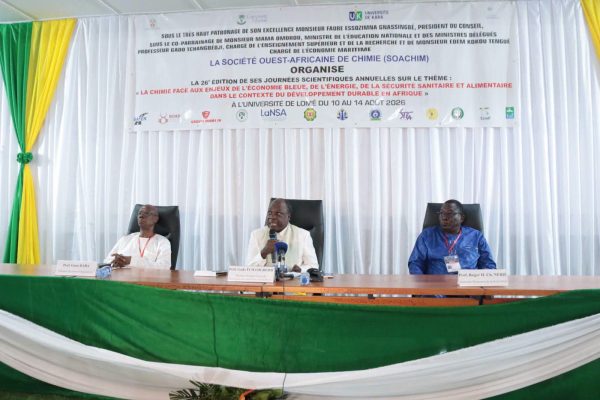
Lomé, 14 August 2026 — Four days of intensive scientific discussions concluded on Friday at the University of Lomé with the close of the 26th edition of the West African Chemistry Conference (SOACHIM). Organised jointly by the Universities of Lomé and Kara, the event brought together researchers, academics, university professors, and students to explore contemporary challenges in chemistry and its practical applications.
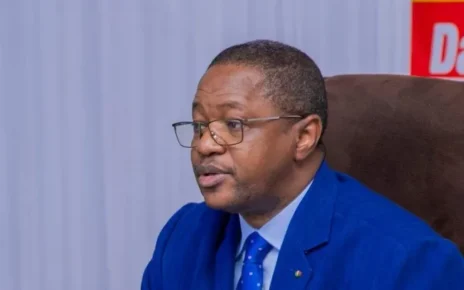
The closing ceremony, presided over by Professor Gado Tchagbedji, Minister Delegate for Higher Education and Scientific Research, provided an opportunity to review an edition characterised by strong scientific engagement and international participation.
Advertisement
Nearly 500 scientific papers presented at SOACHIM 2026
A total of 493 scientific papers were delivered to an audience of 533 participants, hailing from the eight member countries of the SOACHIM community.
Over four days, attendees exchanged findings, shared experiences, and addressed key issues in chemistry. The programme featured a keynote lecture, a roundtable discussion, 15 thematic conferences, and various other scientific activities.
This diversity fostered meaningful dialogue across generations of scientists. For students and early-career researchers, the conference offered a platform to showcase their work, receive peer feedback, and forge collaborations beyond their home institutions.
SOACHIM 2026 praised for fostering regional scientific collaboration
Closing remarks and adopted motions during the ceremony highlighted the event’s strong organisation and the depth of its exchanges.
Participants from across the SOACHIM network described the 26th edition as a success, underscoring the value of regional scientific forums in uniting universities, laboratories, and researchers across West Africa.
The true challenge now lies in translating these exchanges into joint scientific ventures, collaborative projects, and solutions tailored to the region’s evolving needs.
Hands-on learning at Lomé’s food safety laboratory
Following the closing ceremony, participants visited the National Laboratory for Food Safety and Phytosanitary Control (LaNSA), where they toured facilities and explored operational workflows.
This practical session added depth to the conference by giving scientists and students firsthand insight into a system dedicated to safeguarding food quality and plant health in West Africa.
The conclusion of SOACHIM 2026 signals more than just the end of four days of lectures—it underscores the urgent need to strengthen ties between academic research, scientific expertise, and the real-world priorities of West African societies.