
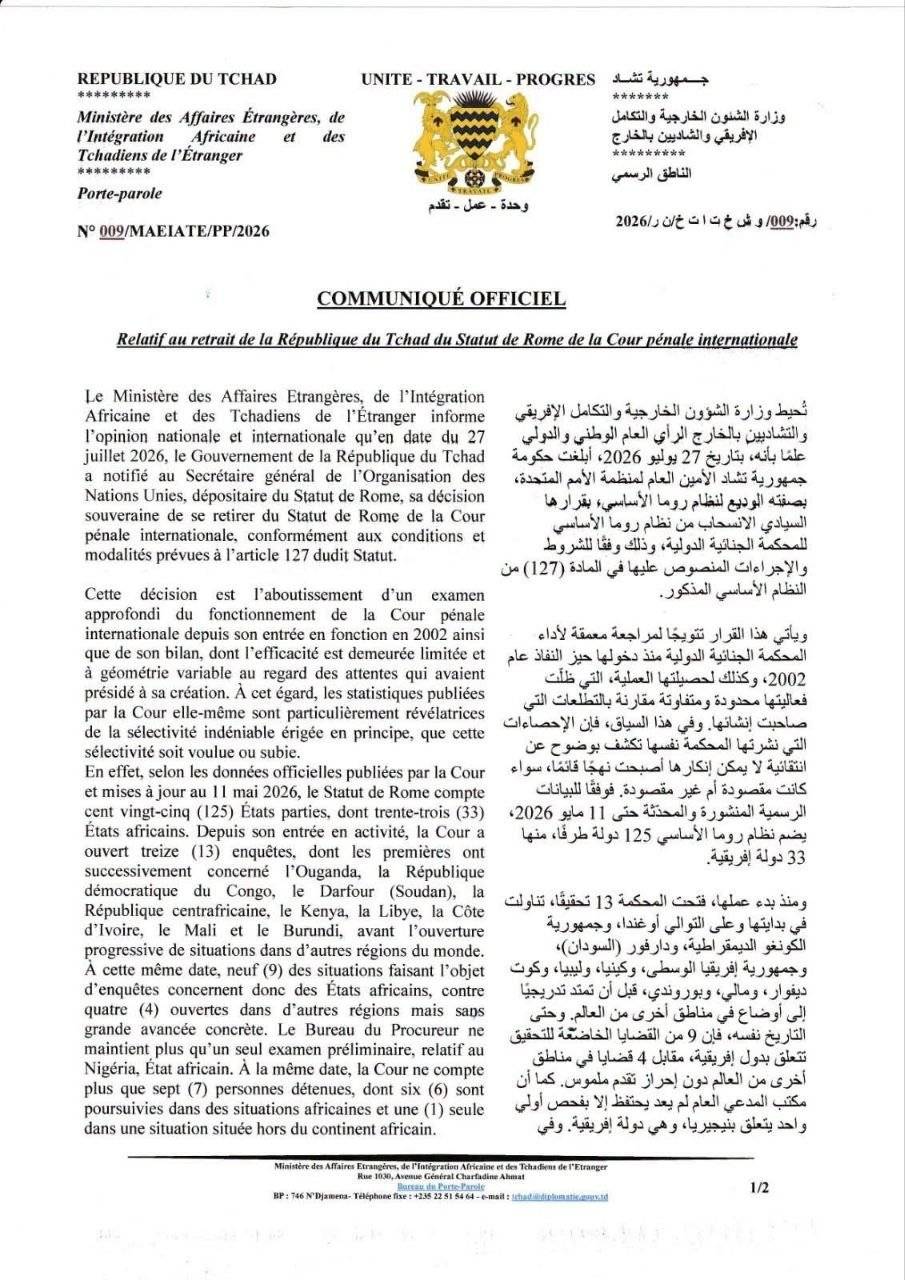
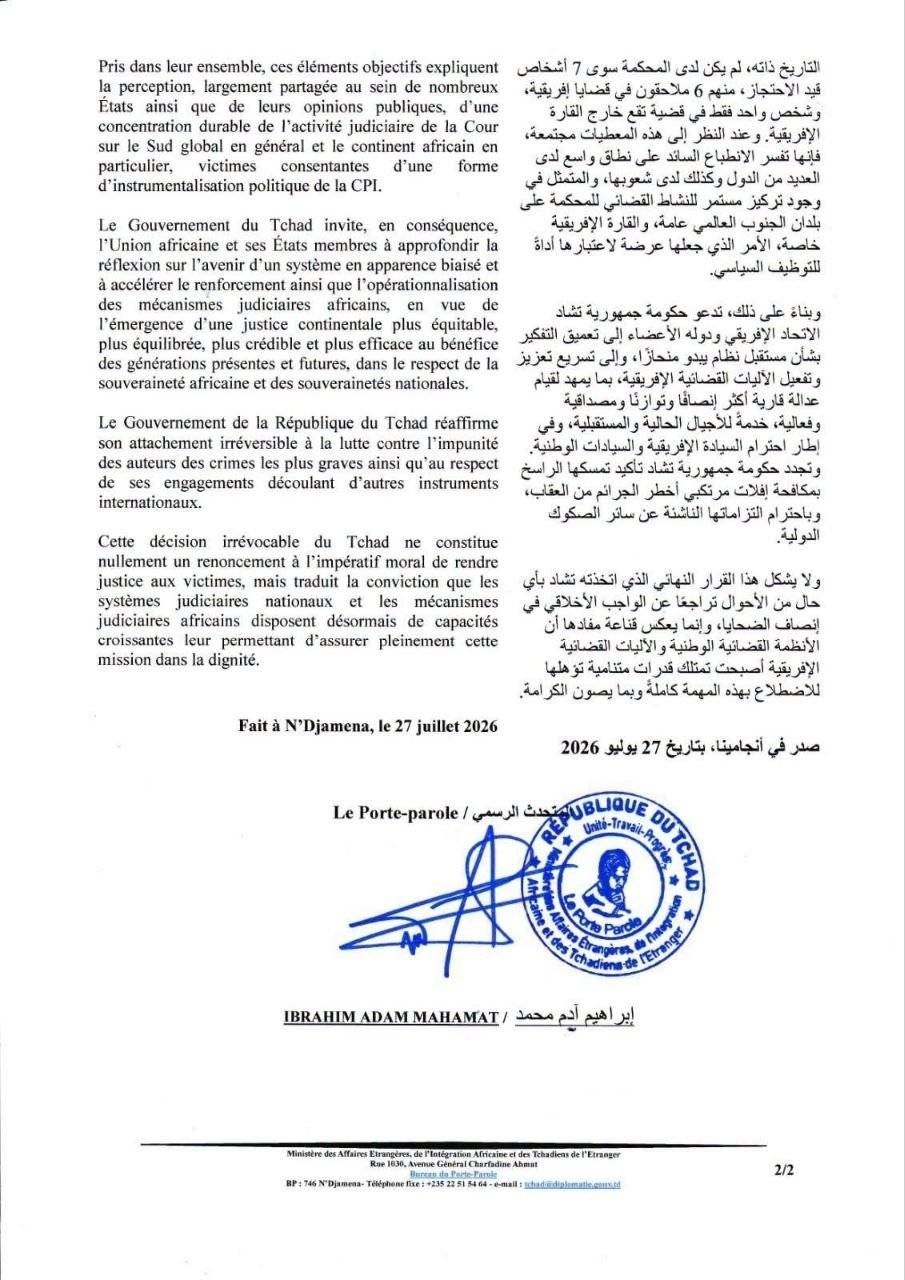
On Monday, July 27, Chad took a definitive step away from the global justice system by submitting formal notification to the United Nations Secretary-General regarding its withdrawal from the International Criminal Court (ICC). The move, described by N’Djamena as a response to the court’s alleged political manipulation, underscores deep-seated frustrations within African nations over the institution’s perceived bias.
Breaking diplomatic ties with The Hague
The announcement marks the culmination of a growing discontent among African states toward the ICC. In a letter dispatched to United Nations headquarters in New York, Chad initiated the formal process to exit the Rome Statute, the treaty that established the court. Authorities in N’Djamena did not mince words, criticizing the ICC for its perceived lack of effectiveness and geographical imbalance in its prosecutions. The government argues that the court disproportionately targets leaders and actors from the Global South while overlooking major crises elsewhere. This decision places Chad at the forefront of a widening divide between several African nations and the Hague-based jurisdiction, which was originally conceived as a safeguard against impunity for war crimes, crimes against humanity, and genocide.
Immediate impact on Chadian citizens
The withdrawal carries significant implications for the people of Chad, particularly in terms of legal recourse for grave human rights violations. The ICC operates on the principle of subsidiarity, meaning it only intervenes when national courts are unable or unwilling to prosecute. By severing ties with the Rome Statute, Chad removes the final layer of independent international judicial oversight for crimes committed within its borders.
The end of an external safeguard
With the ICC no longer serving as a potential recourse, victims of mass atrocities or large-scale abuses face increased uncertainty. The onus now falls entirely on Chad’s domestic judiciary to deliver justice. For victims of state-sponsored abuses or armed group violence, obtaining fair and impartial justice hinges on the ability of national courts to operate without political interference. Civil society organizations have already raised alarms about a potential rise in impunity.
A growing challenge for local justice
The absence of ICC oversight may complicate efforts to document violations and protect witnesses. Without the possibility of international intervention, gathering evidence and ensuring the safety of those who come forward becomes significantly harder, leaving victims more vulnerable.
Diplomatic isolation or a sovereign stance?
The decision extends beyond Chad’s borders, resonating across West Africa and the Sahel, where debates over national sovereignty and resistance to foreign influence dominate political discourse. By distancing itself from the ICC, N’Djamena seeks to assert its judicial independence, but the move carries substantial diplomatic risks. Western partners and international donors traditionally tie financial aid to commitments in human rights and the rule of law. Additionally, independent legal recourse remains a cornerstone of investor confidence. While the African Union has frequently criticized the ICC in the past, member states remain divided on strategy, with Chad opting for a radical approach.
The future of the rule of law in Chad
Proponents of the withdrawal argue that strengthening sovereign institutions is a necessary step. The government asserts that Chad’s judiciary is fully capable of prosecuting its own citizens and upholding the rule of law. However, achieving this promise will require sweeping structural reforms, including increased funding for courts, stronger guarantees for judicial independence, and robust mechanisms to protect witnesses and victims. The one-year transition period outlined in Article 127 of the Rome Statute will be critical. During this time, the ICC retains theoretical jurisdiction over crimes committed prior to the withdrawal notification, though Chad’s cooperation may significantly diminish.
A pivotal moment for African justice
The formalization of this withdrawal on July 27 represents a turning point in Africa’s complex relationship with global governance institutions. While the criticism of double standards in international justice resonates widely, the practical consequences of this rupture raise legitimate concerns on the ground. By closing the door to The Hague, Chad has placed its bet on sovereignty. The true measure of this decision’s success or failure will not be found in international courtrooms or diplomatic salons, but in the daily lives of Chadian citizens: will they find justice and protection within their own courts? The government’s performance will now be judged on this critical internal front.