In Bénin, traditional leaders hold a pivotal sociocultural role, deeply embedded within the fabric of local communities. They serve as custodians of heritage, tradition, and communal identity, embodying moral and cultural legitimacy for their people (Affo, Sina, & Gnanvi, 2019).
Legal recognition and evolving roles
Their significance is further underscored by formal state recognition. In April 2025, the Béninese legislature enacted Law No. 2025-09, which establishes a legal framework for traditional chieftaincies. This legislation categorizes and legally recognizes 16 kingdoms and 90 traditional chieftaincies, acknowledging their contributions to socio-economic development, social cohesion, and cultural preservation (Fatondji, 2025).
The law not only formalizes their status but also highlights their role in conflict resolution and community cohesion, reinforcing their institutional legitimacy.
Political influence and public perception
Despite their cultural and institutional standing, traditional leaders often find themselves entangled in the political arena. Political parties frequently enlist their support to sway voter decisions, sometimes offering material or financial incentives in return (Cessou, 2017).
To curb these practices, Bénin has implemented strict measures prohibiting traditional rulers from engaging in partisan politics (République du Bénin, 2025).
Citizens’ trust and expectations
Public opinion data reveals a nuanced perspective on traditional leaders. Nearly a quarter of Béninese citizens reported interacting with them in the past year, reflecting their continued relevance in public life. A majority of respondents express trust in these leaders and believe they wield significant influence over local governance. In fact, many citizens advocate for strengthening this influence.
However, this positive perception is tempered by growing concerns about integrity. Approximately three-quarters of respondents suspect at least some traditional leaders of being involved in corrupt activities—a concern that has intensified since 2022. Trust in these leaders has also declined compared to 2020.
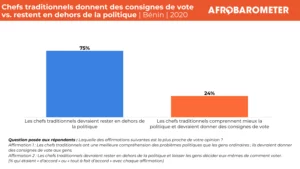
Despite their perceived positive impact, a substantial majority of citizens insist that traditional leaders should refrain from political involvement, emphasizing the importance of voters making their own choices.
Balancing tradition and governance
The evolving role of traditional leaders in Bénin underscores a delicate balance between preserving cultural heritage and maintaining political neutrality. While they remain trusted figures, the public’s call for their exclusion from partisan politics reflects a desire for transparent, independent electoral processes.