A high-ranking Moroccan official has revealed that Rabat had already notified Madrid of the potential migration risks stemming from a recent Spanish court ruling, long before the unprecedented influx into Ceuta unfolded. Speaking on condition of anonymity, the official dismissed any suggestion of security lapses within Morocco’s border control mechanisms.
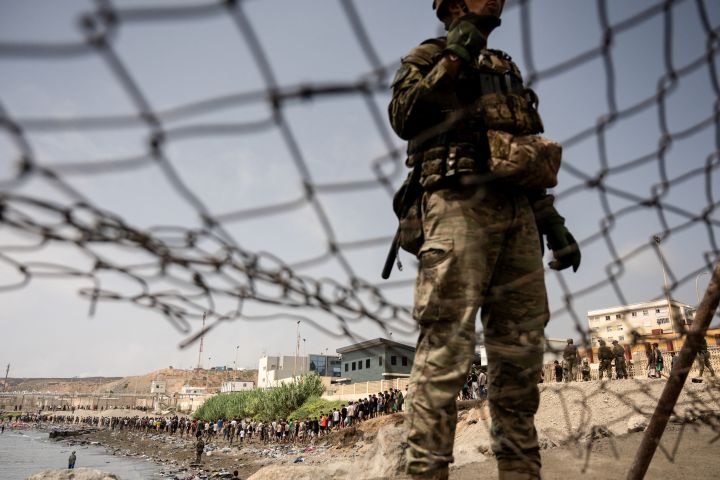
Over the past few days, nearly 60,000 individuals—primarily Moroccan nationals—have either entered or attempted to enter the Spanish enclave of Ceuta, either on foot or by swimming from the nearby town of Fnideq. This sudden surge overwhelmed Ceuta’s capacity, prompting the return of thousands of migrants to Morocco.
The Moroccan government official pointed to a recent Spanish Supreme Court decision that prohibits immediate repatriation of migrants arriving by sea as the catalyst for the crisis. «We had warned that this ruling would create a problem—and it did,» the official stated.
Spanish Prime Minister Pedro Sánchez previously attributed the migration surge to «rumors spread by human trafficking mafias,» suggesting a deliberate misinterpretation of the court’s decision.
According to the Moroccan source, discussions with Spanish authorities began around July 22–23, as trafficking networks started circulating details of the ruling. The official firmly rejected claims of any failure in Morocco’s border security measures, emphasizing the challenges of managing such a large-scale movement without resorting to force.
«It’s overly simplistic to suggest that Morocco should have merely blocked these people at the border,» the official argued. «This ignores the sheer scale of the challenge. Our forces cannot be expected to confront such numbers without escalating tensions.»
The official also highlighted Morocco’s substantial financial burden in handling migration, estimating annual costs at approximately €500 million. While acknowledging strong bilateral cooperation with Spain, the source stressed that both nations must share responsibility for addressing the broader migration challenge.
«Ultimately, it is Spain’s turn to address the consequences of this ruling,» the official concluded.