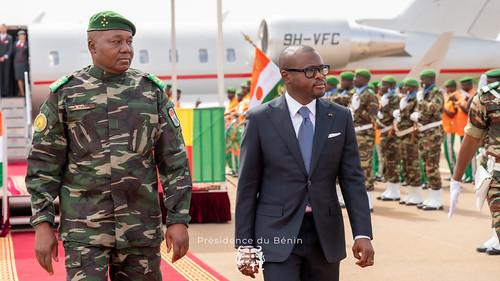
The tarmac at Cotonou International Airport became the stage for a historic moment on Friday, June 19, 2026, as a high-level Nigerien delegation landed to formalize the resumption of bilateral talks. The arrival, marked by full diplomatic honors, signaled more than just political choreography—it represented a tangible breakthrough in a relationship that had reached a breaking point. For international observers, this was not merely a display of handshakes and protocol, but a clear indication that the channels of dialogue, once severed, were now reopened.
The impetus for this rapprochement did not emerge overnight. It followed a direct path set in motion during a pivotal meeting in Niamey between Benin’s President Romuald Wadagni and Niger’s transitional leader, General Abdourahamane Tiani. The two heads of state had underscored the urgent need to move beyond deadlock, setting the stage for intense behind-the-scenes negotiations. Over two consecutive weeks, technical experts, career diplomats, and military officials from both nations convened in closed-door sessions to address lingering grievances, map out key disputes, and lay the groundwork for political decision-makers. The overarching goal was unambiguous: to forge a lasting agreement that would reopen the shared border, closed amid the political upheaval in Niamey.
economic strangulation fuels urgency for resolution
The weight of the crisis is palpable in the economic fallout gripping both nations. The prolonged closure of the Benin-Niger border has acted as an economic vise, suffocating trade flows that have historically bound these two West African neighbors. For Niger, a landlocked nation dependent on Cotonou’s port for nearly all imports and exports, the blockade has triggered a logistical nightmare. Transport routes have been rerouted through distant, often hazardous corridors, forcing traders and transporters to endure grueling detours. The result has been a surge in transportation costs, which has in turn fueled spiraling inflation in Niamey’s markets, eroding purchasing power in a country already strained by international sanctions.
Benin, too, has borne the brunt of the fallout. The corridor linking Cotonou to Niamey serves as the financial backbone of Benin’s economy, sustaining a significant share of activity at its port. The sudden halt in cross-border trade has led to a sharp decline in customs revenue, draining a vital source of funding for national development projects. Beyond macroeconomic indicators, the human cost is stark. From large logistics firms to informal traders—street vendors, roadside eateries, and day laborers—the sudden stoppage has left entire communities without livelihoods. What began as a political dispute has morphed into a daily survival crisis for thousands of families on both sides of the border.
security concerns remain the ultimate hurdle
While economic pressures are pushing both delegations toward compromise, the core of the impasse remains rooted in deep-seated security and sovereignty concerns. Since the establishment of Niger’s National Council for the Safeguarding of the Homeland, the military-led authorities in Niamey have adhered to an unyielding stance: no economic imperative will outweigh the imperative of national security and the stability of the transition.
The ongoing talks in Cotonou are navigating highly sensitive geopolitical terrain. At the top of the agenda is the management of the Niger River, a natural border frequently exploited for clandestine crossings. Equally critical is the establishment of joint surveillance protocols along the land border to prevent infiltration by armed terrorist groups that continue to destabilize the Sahel. Niger has repeatedly voiced fears that a porous frontier could be exploited by hostile elements aiming to undermine its sovereignty. To assuage these concerns, Benin’s delegation is tasked with proposing robust assurances, including real-time intelligence-sharing mechanisms between security forces.
The central challenge for the experts assembled in Cotonou is to design a new border management model—one that is impervious to asymmetric threats and illicit trafficking while ensuring the smooth flow of legitimate commerce. Striking this balance between sovereign vigilance and economic necessity is the linchpin of these negotiations.
a new chapter for west african diplomacy
The prolonged negotiations in Cotonou underscore a stark reality: geography and pragmatism inevitably prevail over ideological posturing and regional solidarity rhetoric that often clashes with ground-level realities. What began as a response to sanctions imposed after Niamey’s regime change has exposed the fundamental interdependence of these two nations.
Yet, as seasoned observers of West African politics note, a simple return to the status quo ante is unlikely. The erosion of mutual trust means that any signed agreement will not mark a return to business as usual. Should the delegations secure a durable compromise, the resulting framework will redefine bilateral relations—shaped by heightened vigilance, stricter controls, and lingering mistrust, but guided by the shared recognition that neither nation can thrive in isolation. The outcome of these talks is being closely watched by international partners, financial institutions, and neighboring states. The Cotonou-Niamey axis is a vital link in regional economic integration, and the resolution of this crisis will serve as a litmus test for the ability of West African states—whether within ECOWAS or the Alliance of Sahel States—to prioritize economic stability and social peace over political differences.
The people on both sides of the border, weary from months of uncertainty, are now waiting for tangible actions and the lifting of barriers to validate the smiles captured by cameras and press releases.